题目内容

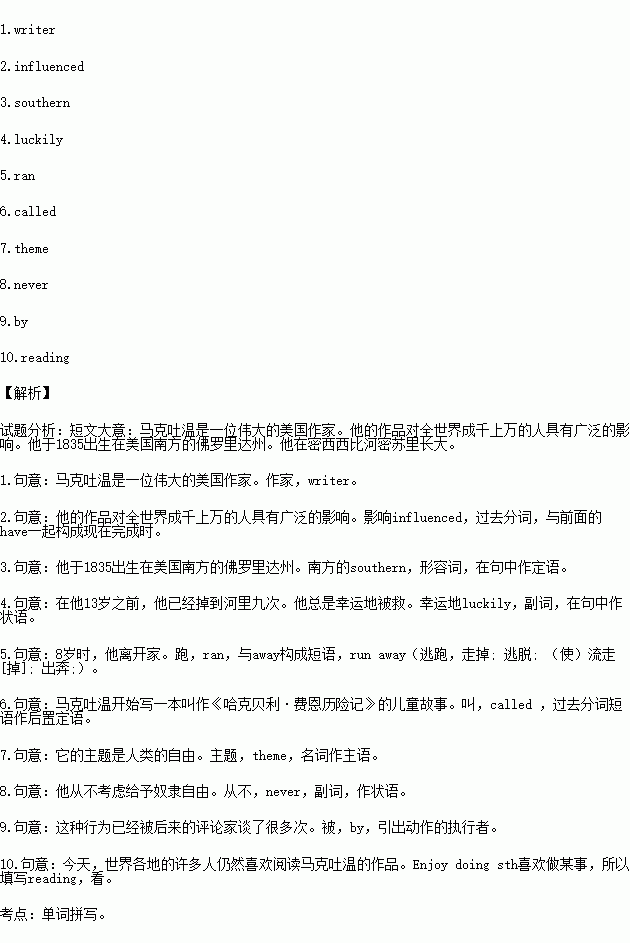
Mark Twain is a great American 1.________(作家). His works have widely2.______ (影响) millions of people all over the world .He was born in 1835 in Florida , a 3._______(南方的) state of the USA. He grew up in Missouri on the Mississippi River .Before he was 13 , he had fallen into the river for nine times . 4._______(幸运地), he was always saved .At the age of 18, he 5.________(跑)away from home .For a time, he worked as a sailor and a newspaper reporter.

Mark Twain started writing a children’s story 6.________(叫) The Adventures of Huckleberry Finn in 1876. Its7._____(主题) is to do with the freedom of humans. However, he didn’t question the slavery in the book and 8.________(从不) thought of giving freedom to slaves . This behaviour has been talked about many times 9._________(被) later reviewers. Today many people around the world still enjoy 10.________(看)Mark Twain’s works .They are great treasures of American . “There was nothing before . And there has been nothing as good since,” said a famous man .
练习册系列答案
相关题目

English is spoken as a first language by about 375 million people and as a foreign language by around 750 million people. It is being learned by about a billion people. These numbers alone make English to learn. If you are not fluent (流利的) in English, it may be good for you to know the advantages of learning the language.

In many countries, English is used as a working language. In the United States, English speakers make more money than those who don’t speak English at all. Learning . English can increase the chance of getting a good job.

If you visit a country, you can easily find someone who can speak at least a little English. So if 'you know English, you have a chance to communicate almost anywhere you travel.

Its not easy for parents who don’t understand English to raise children in an English -speaking country. For example; if they send their children to school and the teacher does not speak their mother language, parents are likely to have difficulty communicating with the teacher. And if the children have homework they do not understand, parents cannot help them.

Want to get advice on how to learn English well? Please go on looking at our website.

根据材料内容选择最佳答案,并将其标号填人题前括号内。

1. According to the first paragraph, about million people speak English as a

first language. .

A.375 B.750 C.1,125 D. 1,500

2.Which of the following can be put in ?

A. hopeless B. difficult C. Boring D. important

3.Which of the following is NOT mentioned in the reading?

A. English is helpful in finding a job.

B. English is helpful in traveling to other places.

C. Children who learn English well can receive more attention.

D. Parents who know English well have no trouble helping kids with homework

4.Who is this passage written for?

A. People who learn English as a first language.

B. People who are not good at English.

D. People who love traveling.

5.Where can you probably find the above reading?

A. In a museum. B. In a magazine.

C. In a newspaper. D. On the Internet.

Mr Brown was going away for a week. he left, he said to his son,“ If anyone asks for me, you can tell him that father has been out doing and will be back in a week. Then be to ask him to sit down for a cup of tea.”

“OK, Dad,” said his son. But he was afraid his son remember this, he wrote these words down on a piece of and gave it to him. His son put it his pocket, and it out and looked at it every now and then.

Four days passed, but no one came to see his father. The boy that no one would come and that the piece of paper was of no more to him, so he threw it in the fire.

The next afternoon, someone at the door. The boy opened it. A man was standing at the door and said: “ Where is your father?” The boy put his hand into his pocket at once and the piece of paper. He could not find it. He suddenly he had burned it, so he shouted: “ No more!”

The man was very . He asked: “ No more? I met your father last week. When did it happen?”

“Burned yesterday evening.”

1.A. After B. When C. Until D. Before

2.A. my B. your C. his D. her

3.A. anything B. nothing C. something D. everything

4.A. careful B. afraid C. polite D. brave

5.A. shouldn’t B. needn’t C. mustn’t D. couldn’t

6.A. because B. so C. but D. since

7.A. clothes B. paper C. record D. pocket

8.A. into B. on C. up D. away

9.A. put B. left C. gave D. took

10.A. learned B. knew C. thought D. found

11.A. freedom B. use C. interests D. advantages

12.A. knocked B. stood C. visited D. looked

13.A. looked down B. looked at C. looked after D. looked for

14.A. forgot B. remembered C. imagined D. guessed

15.A. angry B. excited C. pleased D. surprised

违法和不良信息举报电话:027-86699610 举报邮箱:58377363@163.com

精英家教网