题目内容
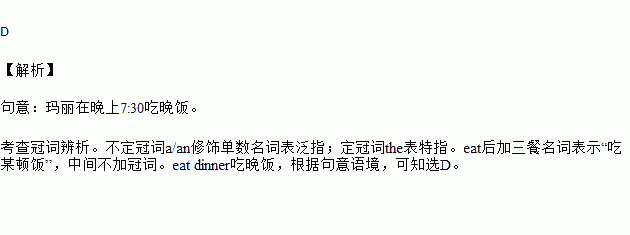
Mary eats dinner at 7:30 in the evening.
A.a B.an C.the D./
Which do you feel like______the time on the train, chatting with friends or just reading something?
A.killing B.to share C.to kill D.sharing
Read the passage and choose the correct words. (阅读短文,选择恰当的单词)
Many students have jobs after school. They work in stores, gas stations and other places. Some of these students save their money to go to college or to__________ a car of their own. Susan is one of them. She has a job in a drugstore. In some parts of the world, drugstores _________ sell medicine. However, in the United States, they often sell toys, cameras, tools and magazines besides medicine. Susan helps people to find what they want_________ the store is so large and there are so many things in it. Susan likes to talk about her_______. She always has something interesting to tell her parents at the dinner table. The parents are_______ that their daughter has a good job. She only works two or three hours a day, but she learns to save money and to work with other people.
1.A.sell B.clean C.buy D.borrow
2.A.no B.all C.some D.only
3.A.so B.because C.but D.or
4.A.job B.school C.dinner D.medicine
5.A.sad B.dull C.smart D.happy
Beijing is _____ Asian city with ______ Great Wall and a lot of historical buildings.
A.a; the B.an; a C.an; / D.an; the
In many English homes people eat four meals a day. They have breakfast at any time from seven to nine in the morning. They eat porridge(粥) eggs or bread and drink tea or coffee at breakfast. Lunch comes at one o’clock. Afternoon tea is from four to five in the afternoon and dinner is about half past seven. First they have soup, then they have meat or fish with vegetables. After they eat some other things, like bananas, apples or oranges. But not all English people eat like that. Some of them have their dinner in the middle of the day. Their meals are breakfast, dinner, tea and supper and all these meals are very simple.
1.Many English people have ______ meals a day.
A.two B.three C.four D.five
2.People may have _______ for their breakfast according to the passage.
A.tea and eggs B.hamburgers and tea
C.coffee and salad D.eggs and fish
3.People have lunch at _______.
A.any time B.nine C.five D.one
4.People don’t have _______ for their dinner.
A.bananas and apples B.soup and meat C.meat and fish D.porridge
5.Most Englishmen have dinner ________.
A.at one B.at any time C.at noon D.in the evening
I usually go to bed _______ ten o’clock.
A.in B.after C.on D.from
Rewrite the following sentences as required.(按要求改写句子,每空格限填一词)
1.Daniel had some noodles in the morning. (改为否定句)
Daniel ________ ________ any noodles in the morning.
2.I always walk to school. (保持原句意思不变)
I always go to school _____ ______.
3.Mr Hill flew to Shanghai.(改为一般疑问句)
_______ Mr. Hill ________ to Shanghai?
4.He hid the birds inside a special pocket in his trousers. (对划线部分提问)
________ did he ________ inside a special pocket in his trousers?
5.Sarah went to the bus stop in a hurry this morning. (保持原句意思不变)
Sarah ________ ________ the bus stop this morning.
6.Mary’s seldom late for school. (改为反意疑问句)
Mary’s seldom late for school,________ _______?
7.notice, I, playing games, the children, over there, this morning (连词成句)
__________________________________________________________
“I can’t start the engine. There be something wrong with it.” Sally said.
A.should B.must C.can D.need
Hannah Taylor is a schoolgirl from Manitoba, Canada. One day, when she was five years old, she was walking with her mother in downtown Winnipeg. They saw a man eating out of a garbage can. She asked her mother why he did that, and her mother said that the man was homeless and hungry. Hannah was very _______. She couldn't understand why some people had to live their lives without shelter or enough food. Hannah started to think about how she could ________, but of course, there is not a lot one five-year-old can do to solve the problem of homelessness.
Later, when Hannah attended school, she saw another homeless person. It was a woman _______ an old shopping trolley (购物车) which was piled with bags. It seemed that everything the woman owned was in them. This made Hannah very sad, and even more ______ to do something. She had been talking to her mother about the lives of homeless people since they first saw the homeless man. Her mother told her that if she did something to change the problem that made her sad, she wouldn't feel as bad.
Hannah began to speak out about the homelessness in Manitoba and then in other provinces. She hoped to _______ her message of hope and awareness. She started the Ladybug Foundation, an organization aiming at getting rid of homelessness. She began to host "Big Bosses" lunches where she would try to persuade local business leaders to _______ to the cause. She also organized a fund raising drive in "Ladybug Jars" to collect everyone's spare change during "Make Change" month. More recently, the foundation began another activity called National Red Scarf Day—a day when people donate $20 and wear red scarves in support of Canada's hungry and homeless.
There is an emergency shelter in Winnipeg called "Hannah's Place", something that she is very ______ of. Hannah Places is divided into several areas, providing shelter for people when it's so cold that sleeping outdoors can mean death. In the more than five years since Hannah began her activities, she has received a lot of ________. For example, she received the 2007 BRICK Award recognizing the _______ of young people to change the world. But through all this, Hannah still has the life of a Winnipeg school girl, except that she pays regular visits to homeless people.
Hannah is one of many examples of young people who are making a ______ in the world. You can, too!
1.A.annoyed B.nervous C.ashamed D.upset
2.A.behave B.manage C.help D.work
3.A.pushing B.carrying C.buying D.holding
4.A.excited B.determined C.energetic D.grateful
5.A.exchange B.leave C.keep D.spread
6.A.contribute B.lead C.apply D.agree
7.A.aware B.afraid C.proud D.sure
8.A.praises B.invitations C.replies D.appointments
9.A.needs B.interests C.dreams D.efforts
10.A.choice B.profit C.judgement D.difference

 黄冈天天练口算题卡系列答案黄冈天天练口算题卡系列答案