题目内容
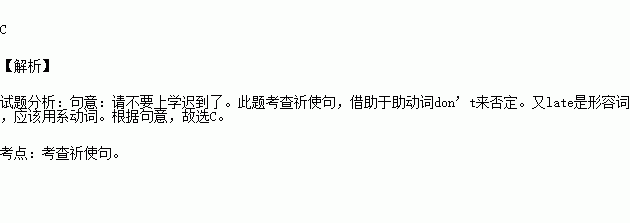
Please late for school.
A. isn’t B. aren’t
C. don’t be D. not be
Breakfast at home is healthy and delicious, ________ I have to eat breakfast on the way to school because I can’t get up so early.
A. and B. but C. so D. or
Meimei thinks maths is ______ than Chinese.
A. easy B.easier
C. the easiest D. very easy
—Would you like to go for a picnic with us?
—_____, but I’m too busy.
A. No, I can’t B. Yes, I would
C. I’d love to D. Why not
Find the answer _____ the question, please.
A. of B. with C. to D. for
完成对话。根据对话内容填入合适的单词。
A:Hello! This is Alice.
B:Hi, Alice. This is Bob. How’s it ___1.____?
A:Not bad. How’s the ___2.___ here?
B:It’s windy.
A:What are you doing now?
B:I am ___3.____ TV at home.
A:What’s your mother ___4.____?
B:She’s __5.____. It’s time to have dinner. Bye!
A:Bye!
I have a good friend. Her name is Kate. She is American girl. She is eleven. She with her family in China. There are people in her family. They’re her father, her mother, her brother and herself(她自己). She has a cat. name is Mimi. It’s Sunday today. They at home. Look! Kate with Mimi. Her father is reading newspapers. Her mother is cleaning the house. Where is her brother Jim? He is doing homework in his study. Kate Chinese very much, but she can’t it very well. Jim likes soccer. He can play it very well.
1.A. a B. an C. the D. /
2.A. live B. living C. to live D. lives
3.A. five B. four C. six D. three
4.A. It B. It’s C. Its D. It is
5.A. are all B. are not C. all are D. not are
6.A. play B. plays C. playing D. is playing
7.A. he B. his C. her D. my
8.A. like B. to like C.likes D. liking
9.A. speak B. tell C. say D. talk
10.A. play B. plays C. plaies D. Playing
完成句子 (本大题共10分,)
1.排队等候是一种很好的礼仪。
_______ ________ your turn is a good manner.
2.他在参加游泳比赛后更加自信了。
He became _________ __________ ___________ _________the swimming competition.
3.在公共场合低声说话是好的行为。
It’s good manners _______ ________ _________ _________ ________in public.
4.他有足够的耐心给我们解释一切。
He is ____________________________________________________________.
5.他让水龙头一直开着真是很粗心。
It’s careless _____________________________________________________.
6.那些贫穷地区的孩子们被给予了基础教育。
The children in poor areas _____________________________________________.
Cars, buses, bikes and people stop when the traffic lights are red.
A.can B.may C.must

 小学生10分钟口算测试100分系列答案小学生10分钟口算测试100分系列答案