题目内容
18.Manners are important in England.Here is some a(66)dvice if you are going to England.British people usually say"hello"or"nice to meet you".When you are first i(67)ntroduced to someone,shake their right hand with your own right hand.They only greet relatives or close friends w(68)ith a kiss.They like to start a conversation with subjects like the weather,holidays,music or books.They avoid (避免) talking about age,weight or money.It is considered i(69)mpolite to ask a lady her age.
British people think it is rude to push in before o(70)thers.They always wait patiently for their turn.They say"sorry"if they bump (撞) into you in the street.When they want you to move they say"excuse me".They do not like to shout or laugh l(71)oudlyin public.Do open doors for other people.Men and women both hold the door open for each other.It depends on (取决于) w(72)ho goes through the door first.They say"please"or"thank you"all the time.
When sitting at the table,do not start eating u(73)ntil everyone is ready,and it is impolite to make too much noise while eating or drinking.Do not eat with your mouth O(74)pen or talk with food in your mouth.Also do not reach over someone's plate for something.Before leaving,wait for everyone to f(75)inish.
"When in Rome,do as the Romans do."When we are in a strange place,we should do as the local people do.
分析 这篇短文向大家介绍在英国应该注意的一些礼貌问题.包括初次见面、打招呼、谈论话题、排队、公共场合以及就餐时需要注意的一些事项.
解答 66.advice 归纳理解题:这篇短文向大家介绍在英国应该注意的一些礼貌问题.具体包括初次见面、打招呼、谈论话题、排队、公共场合以及就餐时需要注意的一些事项等,故这是提的一些建议,可知答案为advice.它是一个不可数名词.
67.introduced 根据后文shake their right hand with your own right hand要用你的右手去握对方的右手.结合句意和首字母提示,be introduced to"被介绍给某人"可知答案为introduced.
68.with 本句的意思是:他们只有对亲人或者亲近的朋友才亲吻.结合句意和首字母提示,故答案为with.
69.impolite 根据前文They avoid (避免) talking about age,weight or money他们避免谈论年龄,体重或钱.因此询问年龄是不礼貌的.结合句意和首字母提示,可知答案为impolite.
70.others 本句的意思是:英国人认为在其他人面前推挤是粗鲁的行为.结合句意和首字母提示,可知答案为others.
71.loudly 根据前文When they want you to move they say"excuse me".当他们想让你移动时,他们说"打扰了";同时这里需要一个副词来修饰动词 shout or laugh,结合句意和首字母提示,可知答案为loudly.即他们不喜欢公众大喊或者大笑.
72.who 句意:这取决于谁先进入.结合句意和首字母提示,这是一个由who引导的宾语从句,可知答案为who.
73.until 本题考查固定短语not…until…直到…才,结合句意和首字母提示,可知答案为until.句意:在餐桌就餐时,要等到大家都准备好了才可以开始吃.
74.open 根据前文 it is impolite to make too much noise while eating or drinking在吃饭或喝酒时发出太多的噪音是不礼貌的.结合句意和首字母提示,可知答案为open.意思是:嘴里有食物的时候不要开口说话.
75.finish 根据前文Before leaving,wait for everyone在离开之前,要等待每个人.故答案是finish.即要等到所有人都结束的时候再离开.
点评 本文是一篇填词型阅读理解,在解题时,务必根据上下文的语境和逻辑关系找出所填的词,同时还要注意单词的正确形式.

| A. | No,it isn't. | B. | That's OK. | C. | No,not at all. | D. | Thank you. |
| A. | too many,too much | B. | too much,too much | ||
| C. | too much,much too | D. | much too,too much |
 Singapore's public transport system(公共交通系统)is one of the best in the world,so you should have no problem finding your way around like a local(当地人).There are three main forms of public transport that you would find in any other major citytrains,buses and taxis.
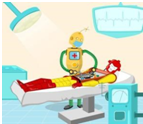 French and American doctors have done an operation (手术) together in which the doctors were outside the operating roomThis kind of operation is known as robotic operation.
Then I fainted(晕倒) at Euro Disney (18)B low blood pressure.This was the first time I had ever fainted,and my parents said that I must(19)D for a while after First Aid.(20)A I stepped towards the door,I saw my dad pushing a wheelchair in my direction!
I could not believe this was happening to me.Wheelchairs were (21)B for other people but not for me.As my father wheeled me out into the main street,people began to treat me differently at once.People looked down at me,pity in their eyes.Then they would look away,maybe because they thought the (22)A they forgot me,the better I will feel.
"I am just like you!"I wanted to scream."The only (23)C is that you've got legs,and I have wheels."
Looking out at the faces,I finally understood:I was once just like them.I (24)D people in wheelchairs exactly the way they did not want to be treated.I realized it is some of us with two healthy legs who are (25)B disabled.We should respect every one.
| 16.A.look around | B.talk about | C.get around | D.make out |
| 17.A.other | B.another | C.others | D.the others |
| 18.A.such as | B.because of | C.in order to | D.for example |
| 19.A.sleep | B.break | C.leave | D.rest |
| 20.A.as | B.until | C.after | D.before |
| 21.A.sad | B.fine | C.light | D.cheap |
| 22.A.faster | B.happier | C.sooner | D.harder |
| 23.A.choice | B.advantage | C.difference | D.difficulty |
| 24.A.needed | B.thought | C.gre eted | D.treated |
| 25.A.badly | B.truly | C.mostly | D.likely. |