Every people(民族) uses its own special words to show its ideas and feelings. Some of these expressions are commonly used for many years. Others are popular for just a short time. One such American expression is “Where’s the beef?” It is used when something is not as good as it is said to be. In the early 1980s “Where’s the beef?” was one of the most popular expressions in the United States. It seemed as if everyone was using it at the time.

Beef, of course, is the meat from a cow, and food is more popular in America than a hamburger made from beef. In the 1960s a businessman named Ray began building small restaurants that sold hamburgers at a low price. Ray called this “McDonald’s”. Ray became one of the richest businessmen at last in America.

Other business people watched his success. Some of them opened their own hamburger restaurants. One company(公司) called “Wendy’s” said its hamburgers were bigger than those sold by McDonald’s or anyone else. The Wendy’s Company began to use the expression “Where’s the beef?” to make people know that Wendy’s hamburgers were the biggest. The Wendy’s television advertisement(广告) showed three old women eating hamburgers. The bread that covered the meat was very big, but inside there was only a bit of meat. One of the women said she would not eat a hamburger with such a little piece of beef. “Where’s the beef?” she shouted in a funny way. The advertisement for Wendy’s hamburger restaurants was a success. As we said, it seemed everyone began using the expression “Where’s the beef?”

1.The expression “Where’s the beef?” is used when .

A. someone can’t find the beef at all

B. someone isn’t satisfied with the beef

C. something is better than it is said to be

D. something is not as good as it is said to be

2.“Where’s the beef?” was one of the most popular expressions in ________ in the early 1980s.

A. Britain B. America C. India D. Australia

3.The Wendy’s Company used the expression “Where’s the beef?” in order to .

A. show Wendy’s hamburgers were the biggest.

B. make people know where they could find the beef

C. let people notice the bread that covered the meat was big

D. compare its hamburgers with those sold by McDonald’s

4.This passage mainly tells us .

A. two famous companies B. a rich businessman

C. a popular expression D. a television advertisement

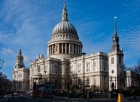
There was a famous church(教堂) in London. It was 110 meters high. The center of the church was like a bell. The ceiling of the church was painted by a famous artist. A platform (平台) was built so that the artist could put up a ladder on it and paint the ceiling. The platform was about 70 meters over the ground.

One day the artist was working hard and had nearly finished one popular corner of the ceiling. Also on the platform was his assistant(助手), who was mixing paints. The artist stepped back so that he could see how his work was doing. To have a better look at his painting, he stepped back again. Suddenly, his assistant shouted, picked up a small bowl of paint and started to paint the artist's work on the top. The artist was very angry and rushed forwards to stop him.

“What do you think you are doing?” he shouted angrily. “Are you mad(疯的)?” His assistant replied, “I saw you walking backwards to have a better look at your painting. But you didn't notice that you had reached the very edge(边缘) of the platform. You were in great danger. I wanted to make you move forwards. If I had not made you run forwards, you would have fallen backwards off the edge of the platform.”

1.The story happened in _______.

A. America B. England C. Germany D. France

2.Why did the artist step back again?

A. To have a better look at his painting.

B. To see how his work was doing.

C. To paint a bowl in his painting.

D. To pour some paint on his painting.

3.What did the assistant do to stop the artist falling off the platform?

A. He ran forwards to stop him.

B. He stopped mixing the paints.

C. He painted a famous painting himself.

D. He shouted to the artist and painted his painting.

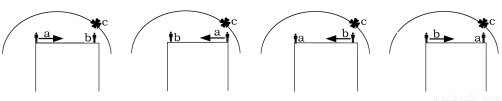
4.Which picture shows the same situation as the underlined sentences in Paragraph 2?

Note: a: artist; b: assistant; c: painting; ←: the direction of the movement

A. B. C. D.

5.After reading the passage, what do you think the artist would probably do?

A. He would be angry with what the assistant had done.

B. He would be thankful to the assistant for having saved his life.

C. He would punish the assistant for having destroyed (毁坏) his painting.

D. He wouldn't allow the assistant to work with him any more.

违法和不良信息举报电话:027-86699610 举报邮箱:58377363@163.com

精英家教网