题目内容
书面表达
假如你是李华,你的英国笔友David给你发来电子邮件想了解一下你上周末是如何度过的。请你根据下面的提示给他回复邮件。
提示:1.What did you do last weekend? 2.How did you feel?
要求:词数70左右,电子邮件的格式和开头已给出,不计入总词数。
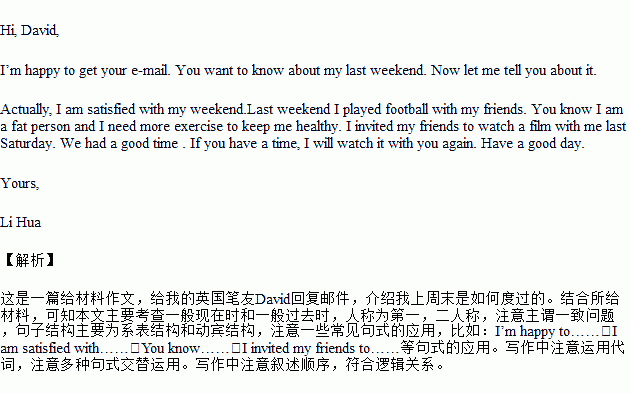
Hi, David,
I’m happy to get your e-mail. You want to know about my last weekend. Now let me tell you about it.
 Hi, David,
I’m happy to get your e-mail. You want to know about my last weekend. Now let me tell you about it.
Actually, I am satisfied with my weekend.Last weekend I played football with my fri...
Hi, David,
I’m happy to get your e-mail. You want to know about my last weekend. Now let me tell you about it.
Actually, I am satisfied with my weekend.Last weekend I played football with my fri...

 仁爱英语同步练习册系列答案
 学习实践园地系列答案
In China, more and more villagers have left home to make a living in big cities. As a result, their children have become leftover children (留守儿童) and they need more care. The survey below is from some villages in China. Three hundred children were chosen to answer the questions.
What they want | Love | Pocket Money | Freedom | Control | Something else |
40% | 18% | 28% | 10% | 4% | |
Who to talk with | Oneself | Family members | No one | ||
27% | 55% | 18% | |||
Communicate with their parents freely or not | Yes | A little difficult | No | ||
46% | 44% | 10% | |||
The way they like to live | Living with parents | Living without parents | No idea | ||
58% | 14% | 28% | |||
What they think of their parents’ Working in cities | Bad | Good | No idea | ||
20% | 39% | 41% | |||
Happiest place | School | Home | Friend’s home | ||
48% | 34% | 18% |
1.In the survey, the children were asked about many things EXCEPT ______.
A. places they like B. pocket money
C. their needs D. their parents’ working in cities
2.Of all the four things, the leftover children need ______ most.
A. love B. money C. control D. freedom
3.Which of the following is True according to the passage?
A. About 18% of the leftover children often talk with their family members.
B. All the children like to stay at home without their parents.
C. About 1/3 of the children think their parents’ working in cities is bad.
D. More than half of the children think it is good to live with their parents.
4.How many children think their happiest place is their school?
A. 48. B. 102 C. 144 D. 156
5.The survey tells us that ______.
A. most leftover children want money from their parents
B. over 40% of the children have difficulty talking to parents freely
C. all the leftover children dream of making money in big cities
D. most villagers like living a life in the countryside
1.A
2.A
3.D
4.C
5.B
【解析】
试题本文是一篇调查报告,通过对300个留守儿童的问卷调查,指出留守儿童需要更多的照顾和关爱。
1.题意:在这项调查中,孩子们被问到了许多事情,除了 。考查细节理解题。A. places they like他们喜欢的地方;B. pocket money零花钱;C. their needs他们的需要;D. th... ─ Jack, can we park our car here?
─ No, we can’t. The public sign there ______ that we can’t park the car here.
A. tells B. talks C. speaks D. says
D
【解析】
句意:——杰克,我们可以把车停在这儿吗?——不,我们不能。那里的公共标志说我们不能把车停在这里。考查动词辨析题。tell讲述/告诉,常跟双宾语,有tell sb. sth./tell sth. to sb.告诉某人某事短语。talk交谈/谈话,着重强调两人之间的相互说话,有短语talk to/with sb.。speak说,常以某种语言作宾语。say说,着重说话的内容,后... There is a student from China in our class. He is very good at his lessons, but he is also very shy. He doesn’t talk too much with us because he thinks that there are so many differences. When he came into our classroom for the first time, he was so frightened(受惊的) that he cried out.
That’s because of our appearances. For example, his hair is short, black and straight, but ours are all different from his. Jim’s hair is yellow and much longer than his. Dave’s hair is curly and brown. Kitty’s hair is blonde. Our builds and clothes seem to be strange in his eyes, too. Peter is a boy. He is tall and thin, but he wears a colorful T-shirt.
1.How many students are described (描述) in the passage?
A. Three. B. Four. C. Five.
2.What does the word “differences” mean?
A. 困难 B. 差别 C. 作业
3.Whose hair is curly?
A. Jim’s. B. Dave’s. C. Kitty’s.
4.Why did the student cry out when he came into our classroom for the first time?
A. Because he is Chinese.
B. Because he didn’t like to be a student of our class.
C. Because our appearances frightened him too much.
5.Which of the following statements (陈述) is NOT true?
A. The student with straight hair is from China.
B. Jim’s hair is shorter than that of the Chinese.
C. Our clothes are also different from that of the Chinese.
1.C
2.B
3.B
4.C
5.B
【解析】
本文讲述了一个来自中国的学生来到我们班,被我们的长相给吓哭了。文中介绍了他和我们班四个学生的长相。
1.C
推理判断题。根据本文描述的学生有Jim,Dave, Kitty和Peter,故一共有四个学生,故选C。
2.B
词义猜测题。根据For example, his hair is sh... — ?
—He is heavy and has short hair.
A. What does Joe do B. What does Joe like
C. What does Joe look like
C
【解析】
句意:——乔长什么样?——他很胖,留着短发。What does Joe do 他做什么工作?What does Joe like乔喜欢什么?What does Joe look like乔长什么样?根据He is heavy and has short hair.可知此处询问他的长相,故选C。 ______ of my parents like me very much. ______ of us in my family are friendly.
A. All; both B. Both; All C. Each; Each D. Both; both
B
【解析】
试题我的父母都非常喜欢我。我们家所有的人都非常友好。Both两者都;all三者或三者以上都。依据句意,答案为B。 - Have a good day!
- _______ ! _______ , too.
A. OK;I B. OK;You C. Thanks;I D. Thanks; You
D
【解析】
-祝你度过愉快的一天!--谢谢。你也一样。OK,行,好的,表示赞同,同意或者接受。thanks谢谢。表示也给与对方同样的祝福,经常说“You,too,你也一样”。根据上句送祝福,所以答语首先要表示感谢,故选D。