题目内容
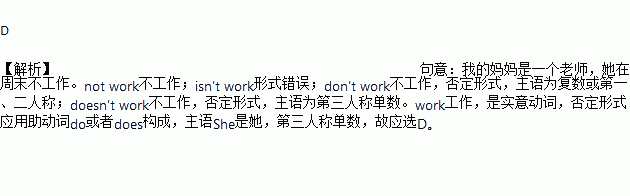
My mother is a teacher. She on weekends.
A. not work B. isn't work C. don't work D. doesn't work
Do you know the movie I, Robot? It tells us a story about the future. The year is 2035 and robots are just as common as mobile phones. People depend on their robots to do lots of things, such as babysitting, cooking, doing chores and taking their dogs for a walk. Robots have to obey(顺从)humans' orders, because their designers make them do so, A police officer called Spooner hates robots. He doesn’t think humans can get on well with their robots at all. But the scientist Susan has different opinions. Susan works on robots’ mind and she thinks one day robots will become more powerful (强大的) than humans and help humans to make progress (进步)
When Spooner and Susan work together, they find that something is wrong with the worlds robots, A few robots have their own thoughts and they're trying to get out of humans: control(控制)!Of course these robots' dream doesn’t come true. Humans work hard to control their robots again and they succeed at last.
1.The story happens in __________.
A. 2010 B. 2020 C. 2035 D. 2040
2.The phrase “depend on” in this article means __________.
A. 依靠 B. 悬挂 C. 受……的影响 D. 取决于
3.Spooner is a __________ and Susan is a __________
A. scientist, professor B bank clerk, police officer
4.Susan thinks that one day
A. robots can’t get on well with humans
B. robots will help humans to make progress
C. robots will have their own thoughts
D. robots will control the world
5.Which of the following is NOT TRUE according to this passage?
A. The movie I, Robot talks about the future
B. People use their robots to do everything
C. A few robots want to get out of humans 'control
D. At last humans succeed in controlling the robots again.
—Wow! I have passed the last level.
—______________!
A. All right B. Congratulations
C. I’m sorry to hear that D. Bad luck
Those men arrived Beijing a Sunday morning.
A. in; in B. on; at C. at; in D. in; on
he a small nose or big one?
A. Do; has B. Does; has C. Does; have D. Do; have
Do you know Mark? He is 1. (冠词) good boy. He 2. (come) from England. He lives in London 3. (介词) his parents. His house is near his school. Every day he 4. (walk) to school. After school he usually 5. (talk) with his father about his favourite sport. Today is Saturday, Mark’s parents 6. (do not) go to work. Now they are doing different 7. (thing). Mark’s mother is 8. (make) breakfast for her family. 9. (he) father is listening to music. Where is Mark? He doesn’t get up. He 10. (be) sleeping on his bed.
听下面一段对话, 回答以下小题。
1.Where is Tony?
A. On the Great Wall. B. In a zoo. C. At a supermarket.
2.How many people does Tony mention (提及) to his mum?
A. One. B. Two. C. Three.
3.What does Tony’s mum want Tony to do?
A. Go back to school. B. Buy some ice cream. C. Take some photos.
4.How does Tony feel about the trip?
A. Bored. B. Happy. C. Surprised.
A. [li?f] B. [l?v] C. [la?k]
根据括号内的要求完成下列各题,每空一词(含缩略形式)。
1.Jane never drinks milk. (改为一般疑问句)
_________ Jane _________ _________ milk?
2.Kate always gets home late. (改为否定句)
Kate _________ _________ _________ home late.
3.He usually does his homework after school. (用They替换He改写句子)
_________ usually _________ _________ _________ after school.
4.We have a book sale on weekends. (对划线部分提问)
_________ _________ you have a book sale?
5.It is eight thirty-five now. (对划线部分提问)
_________ _________ _________ _________ now?