ÌâÄ¿ÄÚÈÝ

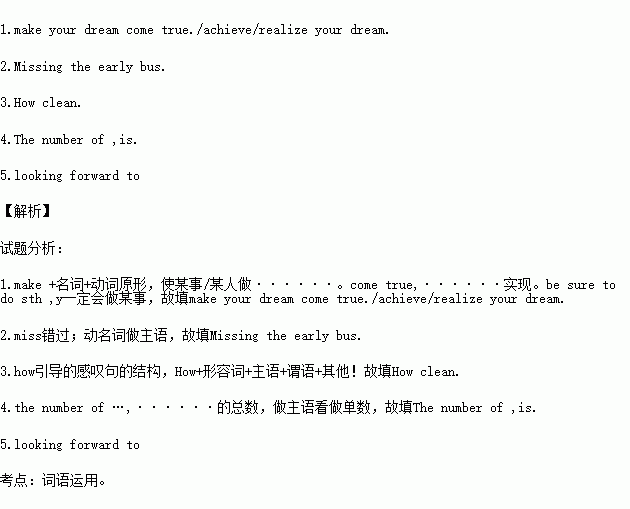
Íê³É¾ä×Ó£º¸ù¾ÝÖÐÎÄÒâ˼£¬Íê³ÉÏÂÁи÷¾ä£¬Ã¿¿ÕÒ»´Ê¡££¨Ã¿Ìâ2·Ö£¬¹²10·Ö£©

1.ŬÁ¦Ñ§Ï°£¬ÄãÒ»¶¨»áʵÏÖÄãµÄÃÎÏë¡£

Study hard, and you are sure to _________.

2. ´í¹ýÔç°à³µÊ¹ËûºÜÉúÆø¡£

_______________ made him very angry.

3.¶àô¸É¾»µÄ½ÖµÀ°¡£¡

_____________ the street is!

4.ÎÒÃǰàµÄѧÉúÊýÊÇ60¡£

___________ the students in our class ________ 60.

5.ÎÒÒ»Ö±¿ÊÍûÉýÈëÀíÏëµÄ¸ßÖС£

I am ______________ going to an ideal senior high school.
Á·Ï°²áϵÁдð°¸
Ïà¹ØÌâÄ¿

Most people want to work, but it has become more difficult in today¡¯s world to find work for everyone. The economy (¾­¼Ã) of the world needs to grow by 4% each year just to keep the old number of jobs for people. Often this is not possible, and so more people are out of work. Some people have no jobs now because new machines can do the work of many people in short time. Also, machines do not ask for more money and longer holiday. In all of the countries of the world, machines are taking work from people, not only in factories but also on the farms. One machine can often do the work from forty people. About 75,000 people are moving to the cities a day to look for jobs, but only 70% of them can find jobs.

1.It was _______ for people to find work before than today.

A. not possible B. difficult

C. more difficult D. easier

2. If the economy of the world grows by 4% each year, _______.

A. people will have no jobs

B. people can still have jobs as before

C. 4% of the people will have jobs

D. 97% of the people will have jobs

3.One machine can do as much work as _______.

A. 40% of the people B. 4% of the people in the world

C. 40 people D. 75,000 people

4.How many people outside cities go into to look for jobs each day?

A. 70% of the people.

B. 4% of the people in the world.

C. More than 75,000.

D. About 75,000 people.

5.Which of the following is NOT true?

A. Machines are taking work instead of people.

B. Now more people are out of work.

C. Machines need more money and longer holidays.

D. Most people want to have jobs.

ÔĶÁÏÂÃæÒ»Æª¶ÌÎÄ£¬Àí½â´óÒ⣬Ȼºó´Ó¸÷СÌâµÄËĸöÑ¡ÏîÖÐÑ¡³öÒ»¸ö×î¼Ñ´ð°¸£¬Ê¹¶ÌÎÄÁ¬¹áÍêÕû¡£

Athough 19-year-old Geoge Dennehy is armless, he isn¡¯t letting that stop him from pursuing (×·Çó) his dreams and sharing his passion£¨ÈÈÇ飩with the world.

Born __ arms, the young boy¡¯s birth parents left him. Luckily, a warm-hearted couple adopted£¨ÊÕÑø£©him and __ him . __ , his new parents never allowed him to use his disability as an excuse to be __ . When Geoge was eight, they asked him to sigh up (±¨Ãû) for cello (´óÌáÇÙ) lessons. The instrument is __ ven for people who have the use of both their hands, so it was far more challenging£¨ÌôÕ½ÐԵģ©for Geoge, who had to learn to play it with his feet.

Thanks to his music teacher, the young boy not only interested in the cello, but also realized that he had a passion and talent for __ . During middle school years, he also __ the piano and the guitar.

His music talent caught the eye of an American rock band who__ him to perform alongside them at a ten-day-long music festival.

The experience has inspired (¼¤Àø) this once shy boy to pursue a career (ÊÂÒµ) in music. He has also become a motivational speaker__ encorages both able and disabled people to pursue their dreams, no matter __ impossible these dreams may sound.

1.A. in B. with C. without D. of

2.A. looked after B. worried C. gave up D. put on

3.A. As B. Though C. But D. However

4.A. lazy B. busy C. nervous D. serious

5.A. easy B. difficult C. interesting D. beautiful

6.A. dancing B. singing C. music D. drawing

7.A. taught B. mastered C. discovered D. hated

8.A. warned B. forced C. trained D. invited

9.A. who B. whom C. which D. whose

10.A. why B. where C. how D. when

Have you ever heard the song called ¡°Is there anyone who told you¡±? It may be impossible for you not to know the song and its singer£®It is sung by the famous ¡°Happy Boy¡± Chen Chusheng£¬ who appeared on Hunan Satellite TV£®He caught everyone¡¯s attention£®Before the competition he was just a farmer¡¯s son who had never got professional trainings of any kind£®As a child£¬ Chusheng wasn¡¯t a good student£¬but he was very interested in music£®He liked to listen to and sing his favorite songs again and again£®Like many other parents£¬ his parents also wanted him to go to college£¬but he failed£®Chusheng had no choice but to help his brother repair bicycles and motorbikes£®In Sanya, a small city in Hainan Province£¬ Chen worked during the daytime while singing in different bars in the evening£®He lived like that until the year 2000£®

In 2000, Chen went to Shenzhen£®He never expected that his first job in this new place would be delivering food£®He went on working in the daytime while singing in the evenings£®His life was hard at that time£®In the bar called Star-making Factories he met many famous local musicians£®In the following several years, Chen, with his musical dream, attended many music contests throughout the country£¬ winning prizes many times£®Today£¬when we think about his success, we cannot help thinking that if one wants to be successful, he should work harder than others£®

1.From the passage we know that ________ £®

A£®Chen Chusheng wasn¡¯t very lucky

B£®Chen Chusheng¡¯s parents wanted him to be a singer

C£®Chen Chusheng became a successful singer because he worked hard

D£®Chen Chusheng got more money

2.What did his parents want him to do?

A£®They wanted him to go to college£®

B£®They wanted him to be a doctor£®

C£®They wanted him to repair bikes for his brother£®

D£®They wanted him to go to bars£®

3.What was Chen Chusheng¡¯s life in Shenzhen like?

A£®Enjoyable£® B£®Interesting£®

C£®Comfortable£® D£®Hard£®

4.What¡¯s the meaning of the word ¡°delivering¡±?

A£®Åëâ¿ B£®µÝËÍ C£®Æ·³¢ D£®¹ºÂò

5.Where did he work in the evening in Shenzhen?

A£®In a bar£® B£®In a factory£®

C£®In a restaurant£® D£®In a supermarket£®

Î¥·¨ºÍ²»Á¼ÐÅÏ¢¾Ù±¨µç»°£º027-86699610 ¾Ù±¨ÓÊÏ䣺58377363@163.com

¾«Ó¢¼Ò½ÌÍø