题目内容

In a classroom in any countries, the teacher teaches more than art or history or language. He or she teaches something behind--- the culture of the country.

In a country such as the United States, people with different history, culture and language join together and they pay much attention to person ideas. Teachers try to make each student special. Students do not have to remember a lot of information, instead, they work and find answers by themselves. There is often discussion in the classroom. At an early age students learn to have their own ideas. Their education encourages personal thought . The importance is placed on how to arrive at an answer and not only to get the correct answer.

In most Asian countries, people have the same language, history and culture. Perhaps for this reason, the education there pays more attention to group goals than personal ideas. Children in China and Japan often work together and help each other on homework. In the classroom, the ways of teaching are often very traditional. The teacher says, and the students listen. There is not much discussion. Instead, the students repeat rules or information that they have been taught in order to keep them in mind.

In many ways these differences come from different educational ideas. In Western countries teachers are taught to help students to learn. They make it easier for the students to learn by themselves. In some Asian countries, however, teachers often feel that their job is to pass knowledge to students.

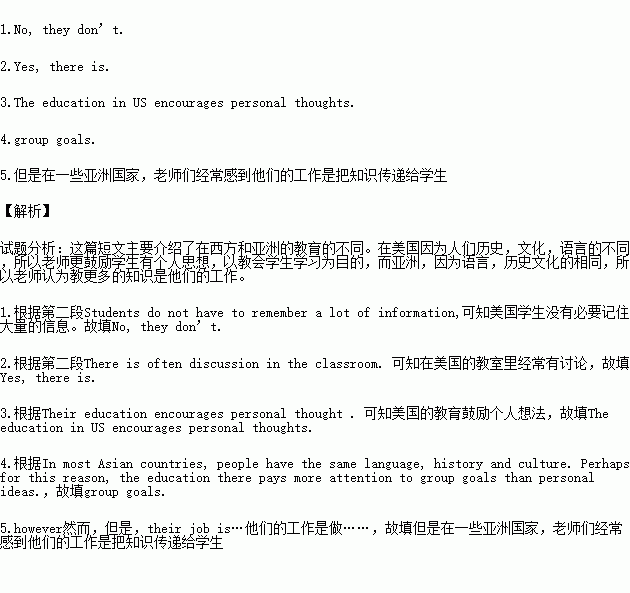
1.Do students in the United States have to remember a lot of information?

__________________________________________________________

2.There is often discussion in the classroom in America, isn’t there?

___________________________________________________________

3.What does the education in the United States encourage?

___________________________________________________________

4.Which does the education in some Asian countries pay more attention to, group goals or personal ideas?

___________________________________________________________

5.Put the sentence “In some Asian countries, however, teachers often feel that their job is to pass knowledge to students,” into Chinese.

_____________________________________________________________
练习册系列答案
相关题目

If the only sports you do are dancing your fingers across your keyboard, you could be in serious danger of more than just becoming overweight and out of shape.

Do you often feel sleepy, like something is weighing down on your head? Do you feel forgetful? Do you sometimes feel uncomfortable up and down your neck and lower back, and you can’t explain why? Do you get sick often? It could be radiation (辐射) from your computer causing it. If you spend three hours or more a day in front of a computer (and at this point, who doesn’t?), you are more easily harmed by the hazards.

We have got so used to using computers that we often neglect (忽视) to think of them as dangerous sources of harmful radiation. A safe amount of radiation is 25 V/m (Volts/meter). Do you want to guess how much our personal computers give off?

Keyboard: 1000 V/m

Mouse: 450 V/m

Monitor: 218V/m

CPU: 170V/m

Notebook computers: 2,500 V/m

Ways of Protect Yourself from Harmful Computer Radiation

1. Decorate your desk with cactus (仙人掌) plants, they take in radiation.

2. Drink two to three cups of green tea a day and eat an orange daily. The vitamins in tea leaves and oranges protect us from radiation and keep our eyes healthy as well.

3. Use a screen filter(滤色镜) for your monitor.

4. Avoid having metal objects (金属物体) nearby on your desk.

5. Put the back of the computer to the wall. Most of the radiation comes off the back.

6. Keep your monitor at least 50cm away from your face.

7. Keep your computer rooms ventilated (空气流通的).

8. Eat healthily-----especially fruits and vegetables.

9. Don’t fall asleep on your computer. Turn it off if you have to rest nearby.

The ways above are useful, why not have a try at once?

1.Sitting to close to your computer for too long can cause .

A. your fingers to turn blue

B. radiation sickness

C. your parents to think you’re smart

D. your games scores to go down

2.The underlined word “hazards” in paragraph 2 means .

A. illness B. feelings C. danger D. headache

3.How can you avoid the affects (影响) of radiation?

A. Spend less time at your computer.

B. Use plastic to cover your screen.

C. Type in a dark room.

D. Have your cat do your homework for you.

4.Which of the following is NOT true according to the passage?

A. Cactus plants take in harmful radiation.

B. Eating healthily helps you stay well.

C. You should fall asleep at your computer daily.

D. A well ventilated room is good prevention.

5.The best title of the passage is .

A. Computer problems

B. Computer radiation: a silent killer

C. Protect yourself

D. Harmful radiation

How important is color in the business world?

Google, one of the biggest U.S. companies, is trying to find it out. The company has already found “a close connection between color and satisfaction with a person’s work area”. That’s according to its spokeswoman named Meghan Casserly.

“Color is a silent salesperson,” said Elyria Kemp. She is an assistant professor of marketing at the University of New Orleans.

Kemp is following color trends in business. She is studying the connection between feelings and color. According to Kemp, when people make an evaluation (评估) of a product, usually they do this within 90 seconds or less. Besides, more than half of their first evaluation is based on (以……为根据) color alone.

That’s why so many companies are researching their color choices. They are spending thousands of dollars on the research, too. Just think of UPS’s Pullman brown, Home Depot’s orange and Tiffany & Co.’s blue.

Joclyn Benedetto is a spokeswoman for Tiffany & Co. She said the success of the company’s jewelry (珠宝) was connected to its blue color. It is used to wrap (包装) every product. She said the color was chosen by the founder Charles Lewis Tiffany for the cover of Blue Book, Tiffany’s annual collection of beautifully hand-made jewels, which first came out in 1845.

Coca-Cola’s red color also dates back more than 100 years. The soft drink was shipped in barrels painted red.

A spokesperson for Home Depot said research showed that the first thing people thought of was orange when they heard the name of the company.

Smaller companies are also realizing the importance of color. But picking the right color is important.

“You know when something is right because you get a feeling of safety, and it’s not something that you think about. It just will hit you,” said Emil Hagopian, a distributor for Mar Plast Color Building Accessories in Ann Arbor, Mich. “And sometimes, if it’s done wrong, that also hits you.”

1.What is Google trying to find out?

A. How to create a better work area.

B. How to become the biggest U.S. company.

C. The connection between color and business.

D. The secret of success in the business world.

2.Which company does Meghan Casserly work for?

A. Tiffany & Co. B. Coca-Cola.

C. Home Depot. D. Google.

3.People usually make an evaluation of a product .

A. in a short time B. in a long time

C. based on its shape D. based on their feelings

4. What do we know about Tiffany & Co. according to the passage?

A. It only sells women’s clothes.

B. Blue is its owner’s favorite color.

C. Its products are wrapped in blue.

D. Its red color dates back over 100 years.

5.The passage is mainly about .

A. the colors which are popular in the United States

B. the importance of color in the business world

C. the relation between color and a company’s name

D. the bad influence color has on small companies

违法和不良信息举报电话:027-86699610 举报邮箱:58377363@163.com

精英家教网
