题目内容

When someone says, “I guess I′ll have to face the music”, it doesn′t mean he is going to a concert. It is something unhappy. For example, a student is called in by his teacher to explain why he didn′t finish his homework.

Every American, young or old, knows the phrase “to face the music” well. It′s at least 100 years old. Where did the expression come from?

One explanation (解释) is about the American writer James Fennimore Cooper. He said the expression was first used by actors. When they were asked to perform, they would say, “It′s time to face the music.” And that is exactly what they did-face the band which is just below the stage (舞台).

An actor might be nervous when he moved onto the stage in front of the audience (观众). But he had to go out. So, “to face the music” came to mean having to go through something no matter how unhappy it might be, because you had no choice.

The other explanation comes from the army. The soldiers had to face their leader′s check. They were worried about how well they looked. Were their guns clean enough to pass the check? Still, the men had to go out to face the check. What else could they do?

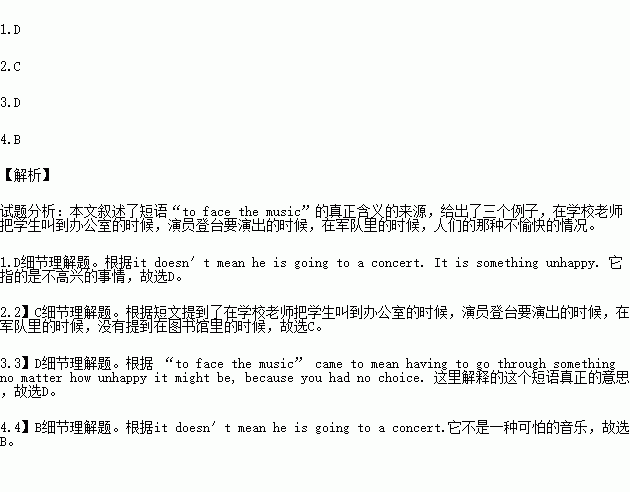
1.What does the expression “to face the music” exactly mean?

A. To go to a concert.

B. To become interested in music.

C. To join the army.

D. To go through something unhappy.

2.In which of the following places won′t the expression “to face the music” be

used?

A. The stage. B. The school. C. The city library. D. The army.

3.What′s the main idea of the fourth paragraph?

A. Worries of an actor on the stage.

B. Different kinds of audience.

C. Why an actor is nervous on the stage.

D. The true meaning of “to face the music”.

4.Which of the following is NOT true according to the passage?

A. Here are two explanations about the expression “to face the music”.

B. The music in “to face the music” is a kind of terrible music.

C. When you face the music, it means that you must go through it.

D. When someone says he has to face the music, he will have no choice.
练习册系列答案
相关题目

请先阅读下面短文,掌握其大意,然后从各小题所给的A、B、C、D四个选项中选出可以填入相应空白处的最佳选项。(每小题1分)

He met her at a party. She was outstanding and many boys were her. But nobody paid any attention to him. After the party, he her for coffee. She was surprised but went with him.

As they sat in a nice coffee shop, he was too to say anything and she felt uncomfortable too. Suddenly, he asked the , “Could you please give me some salt? I′d like to put it in my coffee.” And when the salt came, he put it in his coffee and drank. Curiously (好奇地), she asked, “Why coffee with salt?” He , “When I was a little boy, I lived near the sea, I could feel its salty taste, like salty coffee. Now every time I it, I think of my childhood and my hometown. I them and my parents.”

She was deeply . A man who could admit that he was homesick must love his home and care about his family. He must be . She talked too, about her faraway hometown, her childhood and her family. That was the of their love story. They continued to go out for a date. She found that he all her requirements. So they married and lived together. And every time she made coffee for him, she put in some - the way he liked it.

After 40 years, he passed away and left her a letter which said, “My dearest, please forgive (原谅) my life-long lie. Remember our first date? I was so nervous that I asked the waiter for salt instead of sugar. Many times, I tried to tell you the , but I was afraid that it would ruin (毁坏) everything. Sweetheart, I don′t exactly like salty coffee. But I′ve learnt to it. Having you with me was my greatest happiness. If I could live a second time, I hope we can be together again, even if it means that I have to drink salty coffee for the rest of my life.”

1.A. beyond B. over C. behind D. after

2.A. suggested B. invited C. required D. warned

3.A. surprised B. happy C. nervous D. scared

4.A. cleaner B. waiter C. friend D. salesgirl

5.A. reported B. announced C. explained D. expressed

6.A. drink B. eat C. make D. buy

7.A. miss B. discover C. keep D. remember

8.A. amazed B. touched C. shocked D. wounded

9.A. strong B. responsible C. active D. friendly

10.A. end B. stop C. start D. result

11.A. had B. got C. caught D. met

12.A. happily B. completely C. seriously D. easily

13.A. salt B. sugar C. milk D. chocolate

14.A. lie B. joke C. story D. truth

15.A. understand B. enjoy C. support D. value

违法和不良信息举报电话:027-86699610 举报邮箱:58377363@163.com

精英家教网