Alexander Graham Bell was a British man who was a teacher to people who could not hear. He was born in Edinburgh , Scotland in 1847 and went to school in Edinburgh and London. People who cannot hear any sounds at all are called deaf people, and Alexander became interested in helping them to learn to speak. He taught people how to use their mouths to make the sounds needed for talking.

Bell’s family moved to Canada in 1870 and to the USA in 1871. For several years he taught the people who could not speak in Boston( 波士顿). But at the same time he was developing a way to use electricity to send the sounds of talking along a wire(电线), and he made the first telephone in June, 1875. He worked hard in his workshop for six months with his helper Tom Watson. Finally , he spoke these famous words slowly into the telephone, “Mr. Watson, come here. I want to see you.” And Watson came to him.

The telephone developed quickly in the USA over the next few years. The Bell Telephone Company started in 1877, and in 1878 the first telephone centre was built in New York. More than 150, 000 people had telephones in their homes ten years later. Alexander Graham Bell was a kind man and spent much of his money and time during the rest of his life helping deaf people . In 1922 he died in Canada.

1.Was Alexander Graham Bell born in Scotland?

_____________________________________________

2.What was he interested in doing when he was in Britain?

_____________________________________________

3.Where was Bell’s family in 1870?

_____________________________________________

4.When was the first telephone invented?

_____________________________________________

5.What do you think of the great inventor?

_____________________________________________

When you’re not at home,many worries may start to crowd your mind.Did I turn the coffee maker off?Did I lock the door?Are the kids doing their homework or watching television?With a smart home,you can quiet all of these worries.

A smart home is a home with a communication network.This network connects devices(装置),such as lights and TV sets,and allows them to be controlled from far away through electrical wiring,mobile phone communication or WiFi over the internet.

More and more people may start to consider owning a smart home,because it makes life much more convenient.It can help keep your room at a certain temperature.It can record what happens inside the home and send the video to your phone.When you are on vacation abroad,you can use a smart home controller to switch on or off the electricity when necessary.Some smart homes can receive a visitor,allowing him to come in and offering him a drink.They can even feed the cat and water the plants.

Besides,smart homes are easy to fix.Most smart home technology and devices are wireless and can be set up with a minimum of tools,using only the guiding information.When a problem appears,you can deal with it yourself without paying a professional.

However,for home-users,the smart home technology is far from perfect.It can be rather expensive to own the technology and the devices.Also,because the smart home system(系统)allow its owner to get home information from anywhere,it leaves the home easy to be attacked by hackers(黑客),who may secretly use or change the information in the system.

Now,many scientists are excited at the future of smart home technology.Imagine being able to get fashion advice from your mirror,or receive food shopping suggestions from your refrigerator.While there are others who worry that those smart devices will make people lazier and lonelier.Whatever it is,one thing is for sure---smart home technology will change the way we live and work.

1.According to the passage,nowadays a smart home can lock the door through ______________.

A.electric lights B.mirror technologies

C.mobile phones D.shopping programs

2.The third paragraph of the passage is mainly about _________.

A.the steps to use smart systems

B.the prices of smart programs

C.the advantages of a smart home

D.the tools for setting up smart devices

3.Which of the following is TRUE about a smart home according to the passage?

A.Smart homes can’t help feed pets nowadays.

B.Smart homes costs a lot of money at present.

C.You can’t control your smart home in other countries.

D.It’s hard for hackers to get information from smart homes.

4.What’s the writer’s opinion according to the passage?

A.People will become less happy in the future.

B.People’s life style will be different in the future.

C.Mobile phones are the most important in smart homes.

D.Smart homes are much better than other smart systems.

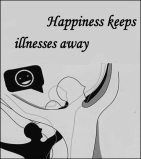
It is important to have positive (积极的) feelings in our daily life.

Compared some unhappy people, those who are always pleased and relaxed are less likely to suffer from colds, a new study. The researchers from New York University said, “ helps the body prevent diseases.”

“It seems that positive feelings may reduce the of illness,” said the chief researcher Sheldon Cohen.

In an earlier study, Cohen found that people who were caught colds less often. And they seldom told their doctors that they felt .

In this study, Cohen’s team interviewed 193 adults every day for two weeks. In this , the people told researchers about happy or sad feelings that day. Two weeks later, all of them were made to catch colds by doctors, and they had to stay in a room for six days.

The results that each in the study was equal (平等的) to fall ill. people who were lively and relaxed said they felt happy during the research. Their illnesses were less serious and lasted for a time.

Cohen believes that people have positive feelings, their body may produce a kind of chemical that helps to illnesses. So if you your health, please look on the bright side and make yourself happy all the time

1.A. to B. with C. in D. of

2.A. as for B. because of C. instead of D. according to

3.A. Being happy B. Being careful C. Being angry D.Being nervous

4.A. hope B. safety C. freedom D. danger

5.A. painful B. proud C. cheerful D. clever

6.A. active B. uncomfortable C. scared D. comfortable

7.A. moment B. field C. period D. times

8.A. themselves B. their C. its D. theirs

9.A. alone B. hardly C. lonely D. brave

10.A. expected B. reminded C. agreed D. showed

11.A. But B. Or C. So D. And

12.A. longer B. fewer C. shorter D. more

13.A. why B. which C. whether D. when

14.A. afford B. fight C. cost D. support

15.A. care about B. look for C. pick up D. get over

违法和不良信息举报电话:027-86699610 举报邮箱:58377363@163.com

精英家教网