题目内容

单词拼写

根据下列句子及所给单词的首字母,在答题卷上按题号写出各单词的完全形式 (每空限填一词)。

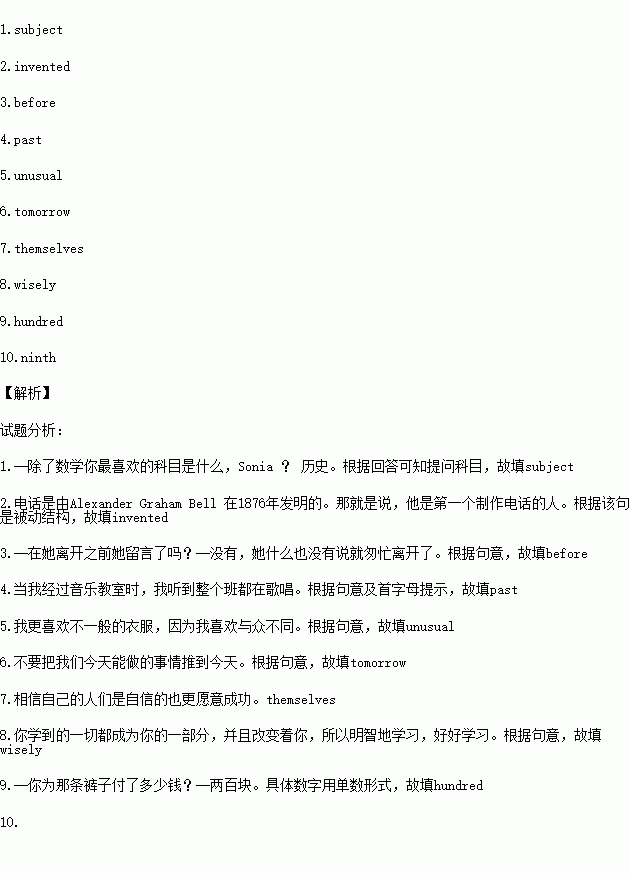
1. ---What’s your favorite s________ besides maths, Sonia?

---History.

2. The telephone was i________ by Alexander Graham Bell in 1876, that is, he was the first person to make the telephone.

3. ---Did she leave a message b________ she went?

---No. She left in a hurry without saying anything.

4.When I walked p________ the music classroom, I heard the whole class singing.

5. I prefer clothes that are u________, because I like to be different from others.

6.Don’t put off till t________ what can be done today.

7.The people who believe in t________ are self-confident and more likely to succeed.

8.Everything that you learn becomes a part of you and changes you, so learn w________ and learn well.

9. ---How much did you pay for the trousers?

---Two h________ yuan.

10.The building has ten floors, he lives on the n________ floor.
练习册系列答案
相关题目

通读下面短文,掌握其大意,然后在每小题所给的四个选项中,选出一个最佳答案,并将答题卡上对应的选项涂黑。

Every Friday night, Winston would stand at the gate of the railway(铁路) station to play his violin happily. He smiled to everyone and many people put money into the in front of him. One day, Winston and put his hat on the ground as usual. But from what he always did in the past days, he took out a large piece of paper and laid it on the ground.

It said: Last night, a gentleman George Miller left an important thing into my hat by mistake. Please , Mr. Miller. About half an hour later, a middle-aged man rushed to Winston in a hurry and said, “It is you! I know that you are an man and will certainly be here.”

Winston asked, “Are you Mr. Miller? Did you lose anything yesterday?” “Yes, a lottery (彩票) ticket!” answered the middle-aged man quickly. Winston then it to the man. When the man knew that his was worth $ 500,000 yesterday, he was so excited! So he threw some money into the young man’s hat, later he realized that he threw the ticket together with the money!

Someone asked Winston, “You play the violin to . Why didn’t you keep the ticket and take the prize for yourself?” Winston replied, “Although I don’t have much money, I live now. But if I lose honesty, I won’t be happy forever.”

1.A. hat B. bag C. paper D. ground

2.A. sent up B. cleaned up C. showed up D. picked up

3.A. usual B. different C. free D. tired

4.A. had B. talked C. said D. named

5.A. talk back B. come back C. hand back D. give back

6.A. interesting B. unhappy C. energetic D. honest

7.A. returned B. offered C. sent D. sold

8.A. watch B. clothes C. ticket D. car

9.A. make friends B. make money C. make plans D. make mistakes

10.A. happily B. angrily C. silently D. confidently

This is a tale of two friends ---one is blind, the other has no arms. On their own, the two are “disabled”. But together, they are a powerful team that has changed part of their village in North China’s Hebei Province into a rich, green forest. Meet 53-year-old Jia Haixia and Jia Wenqi!

Their story began in 2000, when Haixia, who was already blind in his right eye, lost his left one after an illness. Wenqi lost his arms in an accident when he was just three. Neither could find a job, so the two decided to team up. They rented some poor land and began to plant trees. In return, the local officials paid them a small fee. Haixia and Wenqi never imagined that they would end up creating an environmental paradise. Their forest now has over 10,000 trees, hundreds of birds and many other wild animals. In addition, it saves the village from river flooding during the rainy season. When the friends work together, they focus on their strengths not their disabilities. Their day begins at 7 a.m. when the sightless Haixia carries Wenqi across the river to get to their worksite. Since they cannot afford to buy young trees to plant, the two use branches from existing trees. Haixia climbs to the tree-top and with Wenqi’s direction, selects the perfect branch. He then digs a hole and carefully plants it. Finally Wenqi waters the area. )

Though hard-working, the men don’t make much money. But as Wenqi puts it, “We stand on our own feet, so the fruits of our work taste sweeter.”

Neither Haixia nor Wenqi cares about money. Together, they already have everything they need --- a perfect pair of eyes, two strong hands, and the best friendship in the world!

1. Why did Haixia and Wenqi start working together?

A. Haixia needed someone to help him.

B. They both needed a way to make money.

C. They wanted to improve the environment.

D. They were required to do so by local offcials.

2.Haixia and Wenqi’s forest has helped the village by ________.

A. stopping floods in the rainy season

B. increasing the number of tourists

C. making the villagers richer

D. providing more farmland

3.Why do Haixia and Wenqi plant tree branches?

A. They are easy to get.

B. They do not cost money.

C. They can grow very quickly.

D. They are preferred by animals.

4.In paragraph 5, when Wenqi says “We stand on our own feet, so the fruits of our work taste sweeter”, he means that “________”.

A. they hope to make the forest even better

B. the fruits from their trees are very sweet

C. they are proud not to depend on others

D. they are able to do any difficult work

5. What can we learn from this story?

A. Never give up and you will succeed.

B. We should help the disabled to work.

C. Try your best when facing difficulties.

D. We can achieve more with teamwork.

Amos Dudley, a 24-year-old boy who studies digital design at New Jersey University of Technology, felt ashamed about his teeth. But being a student, Dudley didn’t have the money to get braces(牙箍). So, he decided to

3-D print his own and marked down the DIY project in a recent blog post. His braces totaled less than $60, and after wearing them for 16 weeks, his teeth are also getting straighter.

Months ago, he mentioned on his blog that he avoided smiling for a while because he was unhappy with his teeth.

However, clear braces can get pricey, costing up to $8,000. But after studying some images of these expensive clear braces, something comes up on him--they looked like that one which can come from a 3-D printer.

So he decided to hit up his school’s 3-D printing equipment and scanned and printed models of his teeth. He

then made non-harmful plastic molds (模子) around them to make 12 sets of braces.

Dudley, who does not recommend attempting any of this at home said that he didn’t ask a dentist for his project. But the student did get information from journal articles and textbooks. And though this was a perfectly

friendly choice to buy braces. He didn’t accept the project just to save money--he was also up for the challenge. “When I realized that I could do something that was a little bit special, while proving my skills as a designer

and a maker, and fixing something that was making me self-conscious for actually free, I felt it was more than worth the risk.” he said.

1.Dudley got the information on making a 3-D printed braces from___________.

A. a professional magazine

B. a recent blog post

C. journal articles and textbooks

D. a 3-D printer user

2.Why did Dudley choose a 3-D printer braces over-buying them?

A. He didn’t have enough money.

B. He felt ashamed about his teeth.

C. He studies digital design at school.

D. He wanted to be a famous person.

3.What made Dudley get the idea of using 3-D printed braces?

A. The advice from the dentist.

B. The advice from his friends.

C. His major studies at university.

D. The possibility of making 3-D braces.

4.According to the page, Dudley___________.

A.has got a 3-D printer at his home

B.did the project totally for challenge.

C.made each set of braces cost less than 5 dollars

D.supports others to try making their own 3-D braces

5.The article is mainly about___________.

A.a 3-D printer made braces cheaper

B.A college student made fantastic 3-D braces.

C.digital design major student created 3-D printers

D.3-D braces with non-harmful plastic molds became popular

违法和不良信息举报电话:027-86699610 举报邮箱:58377363@163.com

精英家教网