题目内容

I live in a large neighborhood. I have lived here since I was born. I have a lot of neighbors. My favorite neighbor is Mr Chan. He is 85 years old. I enjoy visiting Mr Chan because he often tells me exciting stories about Hong Kong in the past. He also shows me old photos. Yesterday, I visited Mr Chan after school. I asked him when and why he moved here. This is what he told me:

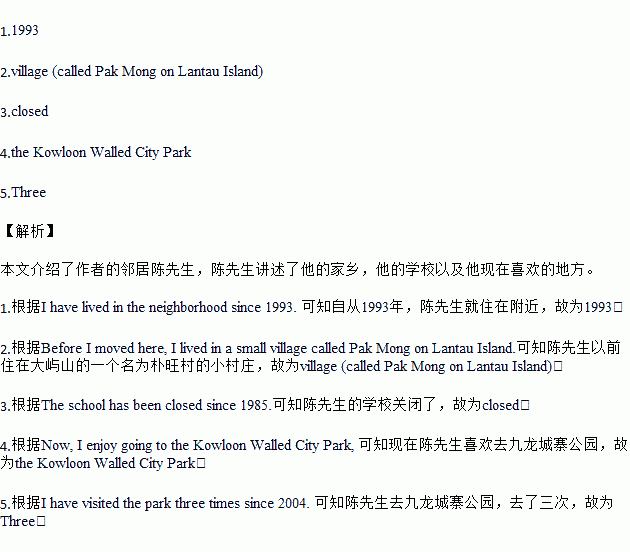
"I have lived in the neighborhood since 1993. Before I moved here, I lived in a small village called Pak Mong on Lantau Island. There were many people living in the village when I was young. Now, there are only a few families left. Most families moved to the city for work. I left the village in 1993, when my son moved to the city.

Pak Mong is an old village. There are watchtowers (瞭望塔) around the village. In the old days, soldiers used to stand in the watchtowers and keep guard (站岗). Here is a photo of my school. I went to that school a very long time ago. The school has been closed since 1985.

Now, I enjoy going to the Kowloon Walled City Park, because it makes me think of my old village. I have visited the park three times since 2004. Would you and your family members like to go to the park with me next week?"

根据短文内容完成表格。

About Mr Chan

How long has Mr Chan lived in the neighborhood?

Since 1..

Where did Mr Chan live before?

In a small 2..

What happened to Mr Chan’s school?

It has been 3..

What does Mr Chan enjoy doing now?

Going to 4..

How many times has Mr Chan gone to the Kowloon Walled City Park?

5. times since 2004.

练习册系列答案
相关题目

I was invited to be an instructor(辅导员) at a high school leadership camp this summer vacation.On the first day of camp,I noticed a boy under the tree.He was small,and his shyness made him appear weak and lonely.Nearby,200 campers were playing,joking and meeting each other,but the boy seemed to want to be anywhere else rather than where he was.

I was instructed to care more about campers who might feel left out.So I walked toward him and said,“Hi,I'm Kevin.It's nice to meet you.How are you?” In a shaky voice,he unwillingly answered,“Okay,I guess.” I calmly asked him if he wanted to take part in the activities and meet some new people.He quietly replied,“No,this is not really my thing.” I could sense that he was in a new world that this whole experience was foreign to him.But I somehow knew it wouldn't be right to push him,either.He didn't need a pep talk.He needed a friend.

The next day,at my first opportunity,I tried again,with the same questions as before.To which he again replied as before.I realized that there was a long way to go.That evening at our nightly staff meeting,I made my worry about him known.I asked them to pay special attention and spend time with him when they could.

The days flew by fast.When the “last dance” came,surprisingly,the boy from under the tree was now a shirtless dancing wonder.He owned the dance floor sharing meaningful time with others.I was happy to see his changes.At that moment,I realized that when you're good to others,you are best to yourself.

1.It's clear that the boy under the tree ________.

A. disliked making friends with people who are older than him

B. was not supposed to show up in the camp

C. was no good at communicating with instructors

D. preferred to stay alone

2.After their first talk,the writer ________.

A. helped the boy take part in the camp activities for the first time

B. allowed the boy not to join in the camp activities

C. found it was useless to have a talk with the boy

D. didn't give up helping the boy

3.The word “pep” in the reading material means “________”.

A. encouragement B. fun

C. interest D. pity

4.From the reading,we know that the boy changed ________.

A. because he got familiar with the environment

B. to show his thanks to the writer

C. with the help of all the staff's effort

D. because of his confidence in dancing

5.The reading wants to tell us ________.

A. gold can't be pure and man can't be perfect

B. the rose's in his hand,the flavor in mine

C. it's never too late to help others

D. it's easier said than done

As any homemaker who has tried to keep order at the dinner table knows, there is far more to a family meal than food. Sociologist Michael Lewis has been studying 50 families to find out just how much more.

Lewis and his co-workers carried out their study by videotaping the families while they ate ordinary meals in their own homes. They found that parents with small families talk actively with each other and their children. But as the number of children gets larger, conversation gives way to the parents’ efforts to control the loud noise they make. That can have important effects on the children. “In general the more question-asking the parents do, the higher the children’s 1Q scores,” Lewis says, “And the more children there are, the less question-asking there is.”

The study also provides an explanation for why middle children often seem to have a harder time in life than their siblings (兄弟姐妹). Lewis found that in families with three or four children, dinner conversation is likely to center on the oldest child, who has the most to talk about, and the youngest, which needs more attention. “Middle children are invisible,” says Lewis. “When you see someone gets up from the table and walks around during dinner, chances are it’s the middle child.” There is, however, one thing that stops all conversation and prevents anyone from having attention. “When TV is on.” Lewis says, “Dinner is a non-event.”

1.Why are the parents with small families talk actively?

A. Their children are outgoing.

B. They love to community.

C. They get along well with each other.

D. They think it’s easy to control the order.

2.What is the meaning of “invisible”?

A. The middle children keep away from the dinner.

B. No one likes the middle children.

C. The middle children are quiet

D. The middle children get no attention.

3.Why are some children most likely to get up from the table during the dinner time?

A. They are full.

B. They don’t want to eat food with their families.

C. They didn’t get enough attention.

D. They want to eat alone.

4.Lewis’ research provides an answer to the question ______.

A. why TV is important in family life

B. why parents should keep good order

C. why children in small families seem to be quieter

D. why middle children seem to have more difficulties in life

5.Which of the following statements would the writer agree to?

A. It is important to have the right food for children.

B. It is a good idea to have the TV on during dinner.

C. Parents should talk to each of their children frequently.

D. Elder children should help the younger ones at dinner

违法和不良信息举报电话:027-86699610 举报邮箱:58377363@163.com

精英家教网