题目内容
【题目】阅读理解
Find Which Direction Is South
Do you have a good sense of direction? If not, please take with you a compass. But if you forget to take a compass, you can still find your way.
It's never a wise idea to believe that the family member who was good at the job of map-reading knows where the family is. You can tell by the troubled look on their faces that nothing on the ground seems to match the map. Never mind. The sun is shining and it's still morning. If you don't know the exact time, you can still find out where south is, but you'll need to be patient.
①Find a straight stick and put it in the ground in a place where you can mark its shadow(a dark shape on a surface that is made when something stands between a light and the surface).
②Try to position the stick as vertically(垂直)as you can. You can check this by making a simple plumb line(铅锤线). You haven't got one? OK, use a thread(线) from your clothes with a button(纽扣) tied at the end to act as a weight.
③Mark the end of the shadow cast(投射) by the stick.
④Wait about half an hour and mark the end of the shadow again.
⑤Keep doing this until you have made several marks.
⑥The mark nearest the stick will represent the shortest shadow, which is cast at midday, when the sun is highest in the sky and pointing to the exact south.
⑦Pick a point in the distance along the line between the shortest shadow and the stick.
⑧That point is south of where you are.
⑨Now you can turn the map, like you did before, and find which way you should be travelling.
(1)To find the direction, we have to be patient probably because ___________.
A.it is not easy to find a proper stick
B.it is not easy to position the stick
C.it takes hours to make the marks
D.it takes hours to mark the map
(2)The passage would probably be most helpful to ___________.
A.those who draw maps
B.those who get lost
C.those who make compasses
D.those who do experiments
(3)Which of the following pictures best shows the way of finding the direction of south?
A.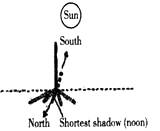
B.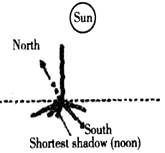
C.
D.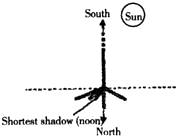
(4)The writer presents this passage by ___________.
A.telling an interesting story
B.describing an activity in a lively way
C.testing an idea by reasoning
D.introducing a practical method
【答案】
(1)C
(2)B
(3)A
(4)D
【解析】你的方向感怎么样?来到一个陌生的地方,如果没有指南针,你将如何判断方向?本文介绍给我们一种辨别方向的方法。(1)C 推理判断题。根据文章中的辨别方向的步骤可以推断出这种方法需要花费时间,故本题选C。(2)B 推理判断题。根据文章第二自然段大意可知本题选B。(3)A 推理判断题。由文章介绍的辨别方向的步骤可知本题A项正确。(4)D短文结构题。根据这就条做法可知,这是介绍实际的方法。故选D。



【题目】阅读下面这篇文章,根据文章内容完成信息表格。(每空限填一词)

ChaiJing, who worked for China Central Television (CCTV) from 2001 to 2013 as a TV reporter made a documentary(纪录片) named under the Dome (穹顶之下)to educate the public about smog. It is released(发行)online on March 1st, 2015.
In the opening of the documentary, Chai tells the story of her daughter with a begin tumor (良性肿瘤)before her birth. “ I couldn't help worrying while seeing the polluted sky in Beijing,” she says. She only took her daughter outside when the air in Beijing was good. The rest of the time she had to keep her at home like a “prisoner(囚犯)”. And there were175 polluted days in 2014 in Beijing.
In the documentary, Chai had an interview with a six-year-old girl, WangHuiqin, who live in Shanxi Province, a heavily polluted area in China. The girl told Chai that she had never seen stars, blue skies or white clouds in her village.
Chai also went to London and Los Angeles, which had both suffered air pollution in the past, to learn how they had improved their environment.
Chai spent one year making this 103-minute film, which cost her over 1 million yuan. In the documentary, Chai tries to answer three questions. They are “ What is smog”, “ Where does it come from?” and “What should people do?” And she calls on everyone to get into the fight against smog.
The documentary Under the Dome | |
Producer | Chai Jing, who used to be a TV |
Release date | On March 1st, 2015 |
Running time | minutes |
cost | Over 1 million yuan |
purpose | To educate the public about |
contents | What is smog? Where does it come from? What should people do? |
Details | In the opening of the documentary, Chai tells the story of her . Chai had an interview with Wang Hui qin from Shanxi Province , a heavily polluted in China. Chai went to London and Los Angeles to how to reduce air pollution. |