题目内容

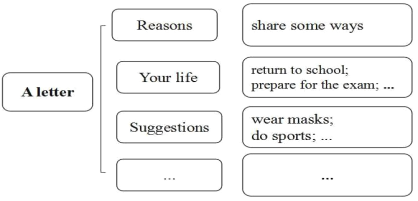
【题目】 假设你是李华,当前新型冠状病毒(COVID-19)在全球肆虐,你的外国朋友 Alex 通过 email 向你询问关于预防病毒的方法。请你围绕这一主题,回复给 Alex

注意:1. 可适当加入细节,使行文连贯;

2. 词数:100 左右(开头和结尾已给出, 不计入总字数);

3. 不得出现真实的校名和人名。

Dear Alex,

I’m glad to hear from you when the COVID-19 has made its way around the world!

____________________________________________________________________________________________________________________________________________________________________________________________________________________________________________________________________________________________________________________________________________________________________________________________________________________________________________________________________________________________________

Best wishes.

Yours sincerely,

Li Hua

【答案】Dear Alex,

I’m glad to hear from you when the COVID-19 has made its way around the world! As you mentioned in your letter, China has put all the efforts to fight the battle and everything is nearly coming to what it is like before the COVID-19. We all returned to school and I am busy preparing for the final exam now. So, I’d like to share some ways which prove to be useful in practise.

First of all, stay at home and avoid face-to face contact if possible. Do wear masks once out, and keep a proper distance with others. And wash hands properly and exercise regularly to keep healthy. Most importantly, everyone should have a positive attitude to the situation. Attitude means everything.

I hope the COVID-19 will disappear soon.

【解析】

1.题干解读:这是一篇材料作文。内容是当前新型冠状病毒(COVID-19)在全球肆虐,你的外国朋友 Alex 通过 email 向你询问关于预防病毒的方法。请你围绕这一主题,回复给 Alex。我们可从以下几个方面展开作文,即本文的写作要点:1. 写这封信的原因;2. 预防病毒的方法;3. 愿望。

练习册系列答案
相关题目

【题目】

If you go to another country, what kinds of things would you buy? Would you buy some beautiful clothes in France, or a watch in Switzerland? No matter what you may buy, you might probably think those products were made in those countries. However, you could be wrong. Kang Jian is a 17-year-old student from Shanghai. Last year he went to visit his aunt and uncle in San Francisco.

He found it interesting that so many products in the local shops were made in China. “I wanted to buy a toy car for my cousin, but even though most of the toys had American brands, they were made in China.”

Toys are not the only things made in China. “I wanted to buy a pair of basketball shoes,” he explains. “ But I had to visit five or six stores before finding a pair made in America! ” He realized that Americans can hardly avoid buying products made in China. “ In fact, ” he continues, “there are so many things made in China — footballs, handbags, pet food, mobile phones, and etc. Even American flags are made in China!” Kang Jian thinks it’s great that China is so good at making these things.

回答下面五个问题,每题答案不超过 5 个词。

1To which country did Kang Jian go to visit his aunt and uncle?

______________________________________________

2What did he discover in the toy stores?

______________________________________________

3Why did he have to visit many stores before buying a pair of basketball shoes?

______________________________________________

4What did he realize after his shopping experiences?

______________________________________________

5How do you feel after reading the article?

______________________________________________

【题目】 A jigsaw is a power-driven saw () used to cut sharp curves (急弯曲线) in pieces of wood.

A jigsaw is also a puzzle. It is made up of a large number of small, interlocking pieces. Each piece has a small part of a picture on it. A completed puzzle produces a picture or design.

Jigsaw puzzles were first created by producing a picture on a flat, rectangular (矩形) piece of wood, then cutting that picture into small pieces with a jigsaw – that’s where the name comes from!

Pictures found on jigsaw puzzles mainly include scenes from nature, city life and similar designs. Castles, mountains and water scenes are traditional subjects. However, any kind of picture can be used to make a jigsaw puzzle. Cartoon-styles are popular. There are companies that create puzzles from personal photographs. Completed puzzles can also be glued onto a piece of wood to make a wall hanging.

The first jigsaw puzzles were designed as geography teaching tools by John Spilsbury in 1767. His “jigsaw” was a map puzzle. It was a hand-painted map of England on a piece of wood. It was a successful teaching method. He went on to make over thirty other map puzzles. The pieces were not interlocking.

With the invention of power tools more than a century later, jigsaw puzzles with fully interlocking pieces came into being. The jigsaw machine could cut sharp curves. Then the name jigsaw puzzles came into being. Jigsaw puzzles became very popular in the United States in the early 1930s, when people had difficulty in finding jobs and making money.

Today puzzles of all sizes are a standard item in toy shops and supermarkets. However, they usually come in 300-piece, 500-piece, 750-piece, and 1,000-piece sizes. The largest one even has 24,000 pieces.

Some jigsaws are quite tricky. Try doing one with all pieces without pictures on it. A few puzzles are made double-sided, so they can be solved from either side. This increases the difficulty, because the puzzle solver cannot be certain which way up each piece goes. Some jigsaws do not have straight edges (边缘). The edge pieces could be any interlocking piece. Solving these jigsaws requires more effort than doing those straight-edged ones. Others designedly have a piece or two missing. Jigsaws are no longer educational toys but are used for entertainment or a hobby.

1What can we learn about jigsaw puzzles?

A.Cartoon-style pictures are traditional subjects of jigsaw puzzles.

B.People can choose any photo they like to use in a jigsaw puzzle.

C.The smallest jigsaw puzzle in the world has three hundred pieces.

D.There are many small, interlocking pieces in all the jigsaw puzzles.

2Which of the following can most probably be made by John Spilsbury?

A.B.C.D.

3Which of the following jigsaws is the most difficult to solve?

A.A double-sided jigsaw with straight edges.

B.A one-sided jigsaw with straight edges.

C.A double-sided jigsaw with curved edges.

D.A one-sided jigsaw with curved edges.

4What can we infer (推断) from the passage?

A.Puzzles are cheap entertainment that can be replayed or passed on to others.

B.By 1767, students began to learn geography by putting the puzzles back together.

C.Spilsbury continued to build more puzzles with different area maps and sell them.

D.Early wooden puzzles had pictures printed to the front and lines for cutting on the back.

违法和不良信息举报电话:027-86699610 举报邮箱:58377363@163.com

精英家教网