题目内容
【题目】 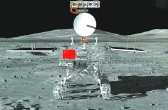
Earlier this year, China achieved a new landmark in space exploration. On Jan 3, Chang’e 4 became the first space probe in history to successfully land on the far side of the moon, People’s Daily reported.
From Earth, we can only see one side of the moon. The other side has been a mystery. Scientists have long wondered what is on this side of the moon.
Chang’e 4 can’t communicate with Earth directly. But Queqiao, a reply satellite(中继卫星), can help us stay in touch. Queqiao was sent into space in May. After Chang’e 4 landed on the moon, it took pictures and sent them back to Earth through Queqiao.
Chang’e 4 has sent back photos of the far side of the moon. It is also being used to carry out experiments, such as growing seeds in a low-gravity environment. The data(数据) collected from these experiments could be used to help us build a base on the moon in the future.
The success of the Chang’e 4 mission is a major achievement for China’s space program. It marks a new stage in China's deep space exploration, said Wu Yanhua.
China launched its lunar exploration program in 2004, naming it Chang’e. Chinese scientists set three goals — “orbiting(环绕运行), landing and sample returning” — referring to launching probes that could circle around the moon, touch down on its surface and bring lunar materials back to Earth.
Chang’e 4 has realized the second goal. The third will be achieved during the Chang'e 5 mission, which is set to take place before the end of this year, China Daily reported.
Following the success of the Chang’e missions, Chinese scientists are looking even farther into(调查) our solar system. China’s first Mars mission is expected to be carried out by 2020, Wu said.
【1】 reported that Chang’e 4 has successfully landed on the far side of the moon.
A. People’s DailyB. China DailyC. Chinese scientistsD. Wu Yanhua
【2】Why was Queqiao set up?
A. To take photos.B. To be sent into space.
C. To keep in touch with the earth.D. To grow seeds on the moon.
【3】What does the underlined “it” refer to in Paragraph 5?
A. The Chang’e 4 probe.B. A base on the moon in the future.
C. China's space program.D. The success of the Chang’e 4 mission.
【4】What’s the third goal of Chang’e?
A. Circle around the moon.B. Bring lunar materials back to earth.
C. Send people to the moon.D. Land on the surface of the moon.
【5】What can we infer from the passage?
A. Chang’e 5 will be China's last lunar exploration program.
B. China has not launched any space probes to Mars so far.
C. Chang’e 4 has uncovered the secrets of the far side of the moon.
D. China launched its space exploration program fifteen years ago.
【答案】
【1】A
【2】C
【3】D
【4】B
【5】C
【解析】
本文介绍了中国在空间探索方面取得了新的里程碑。据《人民日报》报道,1月3日,嫦娥4号成为历史上第一个成功地降落在月球远端的太空探测器。嫦娥四号发回了月球远端的照片。“嫦娥四号”飞行任务的成功,是中国航天事业的重大成就。这标志着中国深空探索进入了一个新阶段。随着“嫦娥”号任务的成功,中国科学家正在进一步研究我们的太阳系。吴邦国说,中国第一次火星探测任务预计将在2020年完成。
【1】细节理解题。根据On Jan 3, Chang’e 4 became the first space probe in history to successfully land on the far side of the moon, People’s Daily reported. 据《人民日报》报道,1月3日,嫦娥4号成为历史上第一个成功地降落在月球远端的太空探测器。可知,《人民日报》报道,嫦娥4号已经成功地降落在月球的远侧。故选A。
【2】细节理解题。根据But Queqiao, a reply satellite(中继卫星), can help us stay in touch. 但鹊桥,一颗中继卫星可以帮助我们保持联系。可知,设立奎桥是为了与地球保持联系。故选C。
【3】推理判断题。根据It marks a new stage in China's deep space exploration, said Wu Yanhua. 吴艳华说,这标志着中国深空探索进入了一个新阶段。根据上文的句子The success of the Chang’e 4 mission is a major achievement for China’s space program. “嫦娥四号”飞行任务的成功,是中国航天事业的重大成就。可知,该句话中的it是指上文的The success of the Chang’e 4 mission。故选D。
【4】细节理解题。根据Chinese scientists set three goals — “orbiting(环绕运行), landing and sample returning” — referring to launching probes that could circle around the moon, touch down on its surface and bring lunar materials back to Earth. 中国科学家设定了三个目标——“绕月运行”、“着陆”和“返回样品”。这三个目标指的是发射能够绕月旋转、接触月球表面并将月球物质带回地球的探测器。可知,“嫦娥四号”的第三个目标是把月球材料带回地球。故选B。
【5】推理判断题。根据China launched its lunar exploration program in 2004, naming it Chang’e. Chinese scientists set three goals — “orbiting(环绕运行), landing and sample returning” — referring to launching probes that could circle around the moon, touch down on its surface and bring lunar materials back to Earth. 中国于2004年启动了月球探测计划,命名为“嫦娥”。中国科学家设定了三个目标——“绕月运行”、“着陆”和“返回样品”。这三个目标指的是发射能够绕月旋转、接触月球表面并将月球物质带回地球的探测器。可知,嫦娥四号揭示了月球远端的秘密。故选C。

 阅读快车系列答案