题目内容
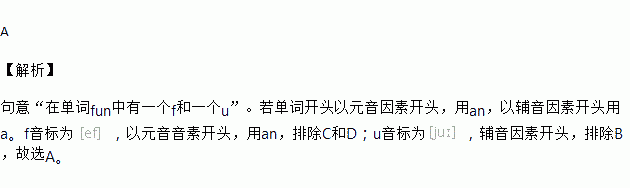
“f” and “u” are in the word “fun”.
A. An, a B. An, an C. A, a D. A. an
Some primary schoolchildren have been raised in homes with more green space around. They are likely to come with larger volumes of white and grey matter in certain areas of the brain. These differences are associated(关联) with beneficial effects on cognitive function (认知功能) . This is the main conclusion of a study led by the Barcelona Institute for Global Health.
The study was performed among 253 schoolchildren in Spain .Lifelong exposure(接触) to green space in the living places was recorded—using the information on the children’s addresses from birth up through to the time of the study. Brain structure was studied using 3D magnetic resonance imaging (MRI). Working memory and inattentiveness(注意力不集中)were graded with computers.
“This is the first study that shows the association between long-term exposure to green space and brain structure.” Says Dr. Payam Dadvand, the leading researcher of the study, “Our findings suggest that exposure to green space early in life could result in beneficial structural changes in the brain.”
The findings show that long-term exposure to greenness is positively associated with white and grey matter volumes in several parts of the brain. Some of them are related to higher scores on cognitive tests. Moreover, larger volumes of white and grey matter in those parts might lead to better working memory and less inattentiveness.
Exposure to nature has been thought to be necessary for brain development in children. Another study of 2,593 children shows that children in school with more green space have a greater increase in working memory and a greater decrease in inattentiveness.
Humans are believed to be tied to nature. Playing in greener areas offers children opportunities to search and learn. Accordingly, green space is thought to prompt important exercises in discovery, creativity and risk taking. These exercises in turn positively influence brain development.
Dr. Dadvand’s study suggests how such structural changes could bring about the beneficial effects of green spaces on cognitive development, it also adds to the proof that suggests the lasting effects of early life exposure to greenness on our health and the benefits of increasing greenness in cities.
Further studies are needed to prove the findings in other populations, settings and climates. And researchers need to examine differences according to the nature and quality of green space.
1.The second paragraph is mainly about .
A. how the study was performed B. what was recorded in the study
C. how long the study lasted D. who took part in the study
2.The word “prompt” in paragraph 6 probably means “ “.
A. control B. encourage C. balance D. change
3.What can we learn from the passage?
A. Working memory influences white and grey matter in the brain.
B. Dr. Dadvand stressed the importance of changing the environment.
C. Studies proved the influence of greenness on populations outs of Spain.
D. Living in greener neighborhoods benefits children in brain development.
The little girl made her friend ________ her birthday cake for her.
A. cutting B. cut C. to cut D. cuts
Lucy’s mother ________ a teacher in a big school. She is kind to all her students.
A. works out B. works in C. works on D. works as
Her birthday is February.
A. in B. on C. at
We need a lot of every day.
A. vegetables B. meats C. broccolis
阅读表达
Do you hear about the name--Rain? Yes, he is a famous star of South Korea(S}; Iii ). Rain's music teacher gives him that name. His real name is Jung Ji Hoon. He's 32 years old now . He is good at singing and dancing. His eyes are bright and his smiles are sunny.
Rain's Songs sell well and he acts in a few TV shows. Rain doesn't want to sing forever(永远). "When I stop(停止)singing, I'd like to design(设计)clothes. My dream is to be a designer." he says.
1.Where does Rain come from?
____________________________
2.Who gives him the name Rain?
3.How old is Rain now?
4.What is he good at doing?
5.What's Rain's dream?
四、填写适当的句子补全对话
A: I lost my ring. Is it in the “lost and found” box?
B: 1.?
A: It is white.
B: Here is a white ring. 2.?
A: No, it isn’t. Mine is larger (更大的).
(A boy comes here with a ring.)
C: 3.. Is this your ring? I found it this morning.
A:4.. My name is on it. Thank you!
C: 5..
--Sorry , I am late ,________my bike is broken.
--Repair it in time, ________you won’t come late next.
A. because , or B. and, and C. but , or D. but , and

 科学实验活动册系列答案科学实验活动册系列答案