There are hundreds of funny and strange expressions in the English language. A lot of them include country names or nationalities. Take these examples:
The Dutch(丹麦人)are the target of most English expressions about nationalities. Why are there so many jokes about the Dutch in English? And what do these expressions mean? In the 17th and early 18th centuries, there were three wars between the British and the Dutch, and Dutch became a bad word. So double Dutch means something that has no meaning or is impossible to understand. A Dutch uncle is someone who gives much stronger advice than they need to. There are later expressions, which are funnier and kinder, like to go Dutch, which is nowadays a popular expression. It means to pay for your part of a bill. This often happens when a group of friends have a meal together, and each person pays for the food they ate. I’m a Dutchman is another commonly used expression. This means not being able to believe something.
An expression with a similar meaning to double Dutch is it’s all Greek to me, which means I don’t understand. The expression was made famous in Shakespeare’s play Julius Caesar although the expression is actually hundreds of years older.
If you take French leave, you are not present or leave somewhere without permission. For example, you could take French leave from a classroom or the place where you work. This expression is from the 18th century when French people left parties without saying goodbye to the host or hostess.
There are Chinese whispers, which mean confused(令人困惑的)messages. This describes the fact that a message can often change as it is passed from person to person. This expression comes from the First World War when foreigners were often confused by Chinese language.
Many people find English expressions confusing, but now that you know about some of them, you can easily have fun finding out many more funny English expressions.
【小题1】Are there many jokes about the Dutch in English?
【小题2】When did Dutch become a bad word?
【小题3】What does “French leave” mean?
【小题4】Which three expressions mentioned above have similar meanings?
【小题5】What do the funny and strange expressions in the passage have in common?

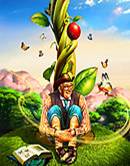
After death, John went to see God. God looked at him, feeling very unhappy, “You’ve lived in this world for 60 years. Why haven’t you gotten any result at all?” God asked.

John argued, “My God, I couldn’t become a successful person just because you didn’t give me any chance. If you let that magic apple hit on my head, the man who found the law of gravity should be me.”

God said, “OK, we might as well try again.”

God rocked his hands and the time turned back to a few hundred years ago.

God shook the apple tree for the first time, when a red apple fell and happened to drop on John’s head. John picked up the apple, wiped it and ate it up as soon as possible.

God allowed another bigger apple drop on John’s head and John ate it up once again.

God shook the apple tree for the third time, when a much bigger apple fell on John’s head. John got mad, picked up the apple, threw it out heavily. Then he shouted angrily: “The apple annoyed my sweet dream! What a bad luck!”

The apple flew out and happened to fall on Newton’s head. Newton awoke and picked up the apple. After a long time of thinking, he discovered the law of gravity at last.

The time returned once again now.

God said to John, “John, do you understand it now?”

John asked, “My God, please give me another chance…I will …”

God shook his head and said, “No. The chance that the apple drops on the head of everyone is the same, but each person’s ability to catch the chance is different.” 

1.When did John die?

A.At the age of 50.                        B.At the age of 60.

C.At the age of 70.                        D.At the age of 80.

2.How many times was John hit by apples?

A.Once.            B.Twice.            C.Three times.       D.Four times.

3. What did John do after he was hit by the apple for the second time?

A.He ate the apple at once.                 B.He got angry and shouted.

C.He threw the apple out.                  D.He thought something over.

4. Which is the best title of the passage?

A.God’s Words                         B.Annoying Apples

C.John’s Life                           D.Lost Chances


There was a pilot and four people in a small plane. Suddenly there was something wrong with the machine while it was flying in the air. The plane began to fall down. The pilot told the people there were only four parachutes (降落伞). They all became worried and started to make excuses.

“I must go,” said the pilot, taking one of the parachutes and jumped out. The first person stood up, “I’m a doctor,” he said. “I help people live longer and I save lives.” He took a parachute and jumped out.

The next person said, “I must have a parachute. I am a very clever person. I have to attend an important match. I know I will win the game because I’ll be the cleverest person there.” He picked up a pack and jumped out.

Two men were left---an old businessman and a young mountain climber. At this time the plane was going down fast. The businessman said, “ Young man, I am old but you are still young. You take the last parachute.” The young mountain climber smiled. “Don’t worry,” He said. “ We can both jump out because there are still two parachutes. Just now the clever man jumped out with my backpack.”

1.All the people became worried because_________.

A. they couldn’t find the parachutes          B. they saw the pilot jump out first

C. they were afraid the plane would be broken and knew there were not enough parachutes for each person.

D There was too much smoke and they couldn’t jump out from the plane.

2.The clever man jumped out with_________.

A.a parachute

B.nothing

C.the backpack of the climber’s

D.two parachutes

3.All the people thought of themselves except____________.

A.the pilot

B.the clever man

C.the doctor

D.the businessman

4.Who do you think was the most kind-hearted man?

A the pilot、B the mountain climber  C the businessman     D the doctor


There are differences between western culture and Chinese culture. We can see differences when we pay attention to the way words are used. Let’s look at the words about animals and plants. Most expressions in Chinese is about the dog, for example, “a homeless dog”, “a mad dog”, “a running dog” and “a dog catching a mouse”, have negative(消极) meanings. But in western countries, dogs are thought to be honest and good friends of humans. In English, people use the dog to describe positive(积极的) actions. For example, “you are a lucky dog” means you are a lucky person. And “every dog has its day” means each person has good luck sometimes. To describe a person’s serious illness, they say “sick as a dog”. The word “dog—tired” means very tired. However, Chinese love cats very much. But in western culture, “cat” is often used to describe a woman who is cruel(冷酷的). There are many other examples of how “cat” is used differently as well.

The rose is regarded as a symbol of love in both China and some western countries. People think the rose stands for love, peace, courage and friendship. And the rose is the national flower of England, America and many other countries.

The words about plants and animals are used in positive or negative ways in different cultures. We can learn about many differences in cultures by comparing how some words are used.

1.The word “dog” in Chinese usually ______.

A. stands for friendship                         B. has a negative meaning          C. has a positive meaning

2.“Every dog has its day.” means “______”

A. Everybody in the world is lucky.      B. Each person lives his own way of life.

C. Everybody has a time in life to be lucky.

3. Western people usually use “cat” to refer to “______”.

A. a tired person                                     B. a brave man                                C. an unkind woman

4. Which of the following is TRUE according to the passage?

A. Words show differences in cultures.                                                        

B. Western people think cats to be good friends.

C. Rose is the national flower of all western countries.

5. This passage mainly tells us ______.

A. negative or positive things              B. different countries have different cultures

C. what dog and cat mean in English and Chinese


违法和不良信息举报电话:027-86699610 举报邮箱:58377363@163.com

精英家教网