题目内容
根据短文内容及所给提示,在文中的空白处填写一个正确的单词。
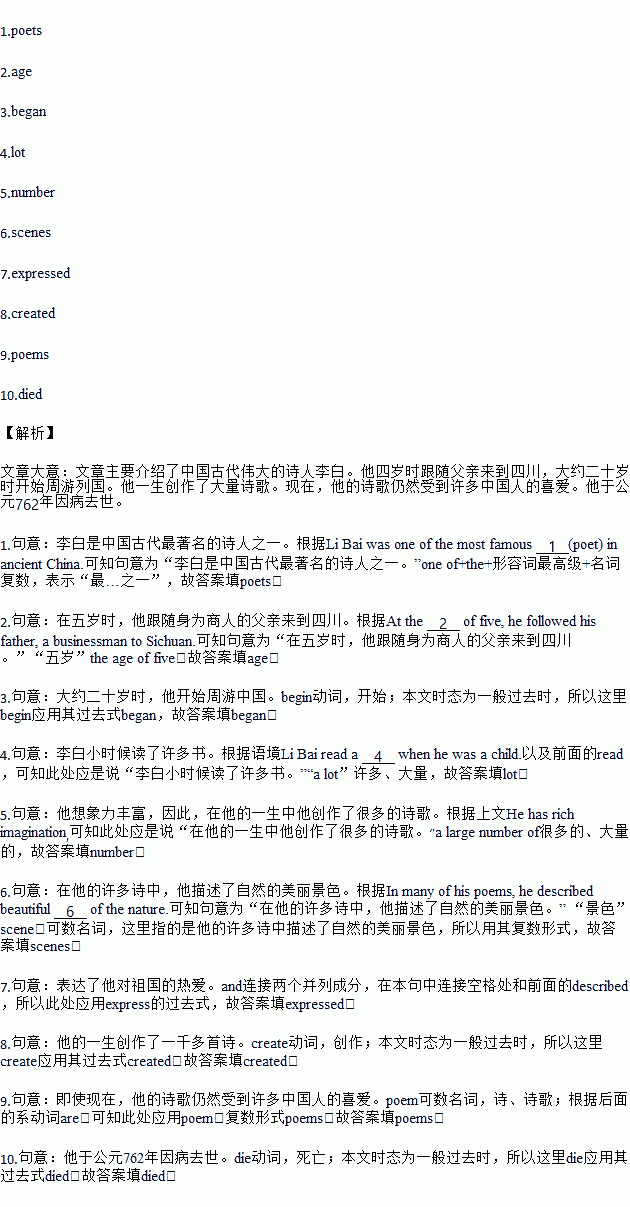
Li Bai was one of the most famous 1.(poet) in ancient China. At the 2. of five, he followed his father, a businessman to Sichuan. When he was about twenty years old, he 3.(begin) to travel around China. Li Bai read a 4. when he was a child. He has rich imagination, as a result, he created a large5. of poems throughout his life. In many of his poems, he described beautiful 6. of the nature and 7.(express) his love for the country. In his life, he 8.(create) more than one thousand poems. Even now, his 9.(poem) are still popular with many Chinese people. He 10.(die) in 762 AD because of illness.

 字词句篇与同步作文达标系列答案
将下面五个人的学习方法与相对应的解释相匹配。其中有一项为多余项。
26Liu Ying practices listening by trying to repeat the voice of the speaker.
27Jin Hua memorizes English words by reviewing his vocabulary regularly.
28Zhou Wei corrects his pronunciation by recording and listening to himself.
29Zhang Li learns English through her mistakes.
30Wu Yi gets help through sharing her goals with her teacher.
A.Increasing your vocabulary is one of the fastest ways to improve the level of your English. In order to remember the new words you learn during your English lessons, you must review them regularly. This will help you to remember more of your vocabulary. |
B.The goals for learning can influence your ways of learning and what you study. If you tell your teacher your goal of learning, they may help you and adapt(调整) their lessons to make sure you reach your goals more quickly. |
C.It's good to try to train your ear to hear different pronunciation and try to repeat them. You can do this by listening to very short extracts video and then trying to copy them. Try to copy the expression of the voice if the speaker is angry, sad or happy. |
D.It's necessary to record yourself and listen back to your records regularly. Record yourself saying a short text or talking about a topic. Then watch it and think about how you can improve it. Record it again and then watch and compare to your first record to see if it is better.Keep doing this and after a few months you should be able to see some clear improvement. |
E.Everyone tells us that mistakes are part of learning, especially when learning a language. The best learners take risks with the language and try to express themselves even when they don't know the exact words or grammar. If you don't make those mistakes then they can't help you improve. |
F.To learn new vocabulary and grammar successfully, you need to review your lesson or self?study notes regularly. Go through the notes you took and try memorizing some or all of the important language or grammar points. Then, write them down to see how much you can recall(回想). Repeat that until you've memorized all the words you learn. |
1.______________
2.______________
3.______________
4.______________
5.______________