题目内容

What do you see when look at abstract (抽象) art? Does it look like anything?

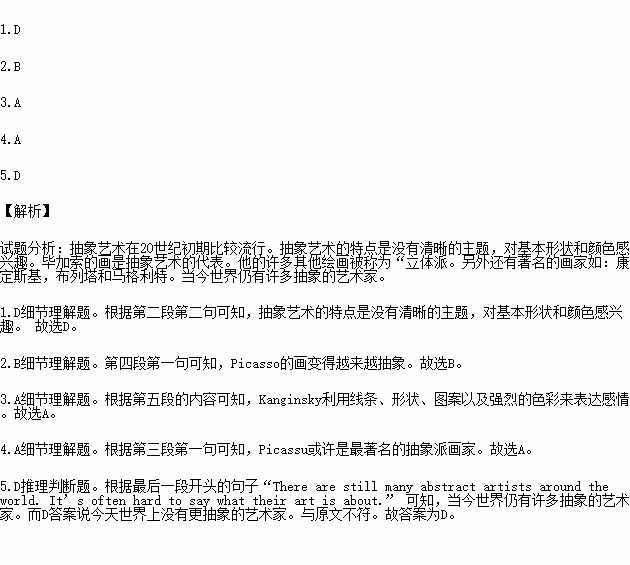
Abstract art became popular in the early 20th century. Artists did not want to paint, draw, or sculpt(雕刻) things exactly like they looked. They didn’t want their art to be realistic. They were more interested in basic shapes and colors.

Picasso is probably the most famous of these artists. He painted and drew in many, many styles. Sometimes he used a lot of blue colors (his “blue period”). Later he used more red and pink colors (his “rose period”). Many of his other paintings are called “cubist(立体画派)”because they are made of painted squares.

After a long time, Picasso’s paintings became more and more abstract. He painted people and things using strange shapes. His work was so original; many of other artists didn’t understand it.

Kandinsky, another famous artist, used shapes to paint his subjects. His paintings also used strong colors to express feelings.

Other artists, like surrealists (超现实主义者), were interested in the subconscious (潜意识). Painters like Breton and Magritte used many symbols in their works. The meaning or subject of their work wasn’t always clear. Dali, another surrealist artist, painted pictures that looked like dreams.

There are still many abstract artists around the world. It’s often hard to say what their art is about. They want each person to look at art and find their own meaning in it.

1.Which of the following would be most like abstract art?

A. A painting of a house.

B. A sculpture of a car.

C. A drawing of two people in a coffee house.

D. A red and blue painting, with no clear subject.

2.What happened to Picasso’s work after a long time?

A. It became less original.

B. It became more abstract.

C. He went from using red colors to using blue colors.

D. He only painted with colored squares.

3.How did Kandinsky express feelings?

A. By using colors and shapes.

B. By painting with a lot of symbols.

C. By painting realistic people.

D. By painting in red and pink colors.

4.Who is probably the most famous abstract artist?

A. Picasso. B. Dali. C. Breton. D. Magritte.

5.Which of the following is NOT true?

A. Magritte’s art was full of symbols.

B. Dali was interested in dreams.

C. Many people can't understand the meanings of some abstract art works.

D. Today there are no more abstract artists in the world.
练习册系列答案
相关题目

People usually check whether their keys, wallets and phones are with them before going out. But many people in China now have one more important thing to take, a face mask. They hope that it can protect them from polluted air.

Since January 2013, many cities in China have seen a lot of foggy days. In Beijing, only five days in January were free of smog (雾霾). What’s the difference between fog and smog?

According to scientists, fog is made up of tiny (微小的) drops of water and also ice particles (颗粒) during very cold conditions. Smog is dirty air that looks like a mixture of smoke and fog, caused mainly by smoke from cars and factories in cities.

An official for the Ministry of Environmental Protection told Beijing News that PM2.5 pollution is the main problem with air pollution. PM 2.5 refers to pollution with small particles 2.5 micrometers or less in diameter (直径).

According to the Chinese Academy of Sciences, two main factors that cause PM 2.5 are motor vehicles and the burning of coal.

Poor air has done harm to people’s health. Children and the elderly are more at risk. A report from Beijing Children’s Hospital shows that from December 5 to December 11, 2013, half of the patients in the hospital came for respiratory (呼吸道的) problems.

Air problems and environmental protection have become a care for the whole nation.

Premier Li Keqiang made his last Government Work Report(政府工作报告) on March 6, 2014. The report said that the government should work hard to prevent pollution and give people a healthy living environment.

It calls on people to make full use of energy and resources (资源) and cut down on energy use.

‘We should give people hope through our actions,’ Li said.

1.The underlined phrase “were free of” means _______________.

A. had some B. had no

C. had many D. had more and more

2.According to the third paragraph, we can know that________________.

A. fog is made up of drops of water with smoke

B. smog is formed (形成) during cold hours

C. smog is a mixture of fog and smoke

D. smoke from cars and factories cause fog

3. Paragraphs 4 and 5 are mainly about ________________.

A. what PM 2.5 is and how to protect ourselves against PM 2.5

B. how to prevent PM 2.5 pollution and how PM 2.5 looks

C. what PM 2.5 is and what causes PM 2.5

D. how seriously PM 2.5 affects us and how to deal with PM 2.5

4.From Li Keqiang’s report, we learn that __________________.

A. the environment has improved a lot since Li was in office

B. many people have breathing problems because of the air pollution

C. the air pollution problem is the government’s task

D. the government will try its best to solve the air pollution problem

缺词填空

根据短文内容和首字母提示,在下文空格处填入适当的词使短文完整。(每空一词)

I will never forget the tenth summer of my childhood with my grandfather in western Norway at the mountain farm where my mother was born.

One day my grandfather said, “Come. I have something for you.” I f 1. him to a workroom. “You should have a toy boat. You can sail it at Storvassdal,” he said. Great, I thought, looking around for the boat. But there was n 2. . Grandfather pointed to a block of wood. “The boat is in there,” he said. Then he handed me some tools and showed me h 3. to use them properly. “It’ll be a fine boat, and you’ll make it with your own hands,” he said. “No one can give you what you do for yourself.” The w 4. rang in my head as I worked. Finally I finished the boat. It wasn’t much to look at, but I was p 5. . Then I sailed it at Storvassdal.

We had to return to America. “You cannot bring that boat home with you,” my mother said. We already had too much baggage. Feeling sad, I h 6. my boat under a big rock at Storvassdal.

I said good-bye to Grandfather, not knowing I would n 7. see him again.

In 1964, I went to Storvassdal with my parents and my wife and children. To my surprise, for 34 years my treasure s 8. here, waiting for my return. I felt we three were together again a 9. my grandfather had died 22 years before.

After that, I returned to the lake five times. Each time I held the boat and carved the year, my g 10. seemed near.

My last trip to Storvassdal was in 1991. I brought my granddaughters: Catherine, 13; Claire, 12. At Storvassdal, Claire said softly, “Grandpa, someday I’ll come back.” She added, “And I’ll bring my children.”

违法和不良信息举报电话:027-86699610 举报邮箱:58377363@163.com

精英家教网