题目内容
Which has a different sound from the other three?
A. look B. foot C. food D. good
— Peter, do your parents like football?
— ________my dad________my mum likes it.They both like tennis.
A. Either; or B. Neither; nor
C. Not only; but also D. Both; and
There is _______ art room in the school. _______ art room is very clean.
A. a,the B. a,a C. the,a D.an,the
White doesn’t look good you , but you look cool black .
A. on ; on B. in ; in
C. on ; in D. in ; on
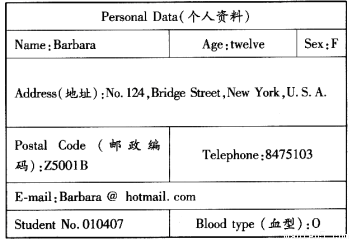
1.Barbara is from __________.
A. China B. Canada C. America D. England
2.Barbara is __________ years old.
A. eleven B. twelve C. thirteen D. fourteen
3. You can call her at __________.
A. Z5001B B. 010407 C. 8475103 D. No.124
4.She lives at __________.
A. No.142 Bridge Street, New York
B. No.124 Bridge Street, New York
C. No.142 Business Road, New York
D. No.124 Business Road, New York
5.What does "F" mean?
A. 体重 B.男性 C.女性 D.身高
根据句意和汉语注释,在答题卷标有题号的横线上,写出单词的正确形式。
1.China is a great country with a long __________ (历史).
2.This bike is one of my__________ (同班同学).
3.Can you show me how to use the __________ (新式的) computer.
4.I feel __________ (的确) sorry about the bad news.
5.Students enjoy doing after-school __________ (活动) .
—Your skirt is very nice. —__________.
A. Not nice B. Thank you
C. Here you are D. Here it is
Mrs.Jones is a teacher.Her house is not far from her school,and she always walks there in the moring.All the students in the school are very young.
One day Mrs.Jones walks to school on a very cold and windy(有风的) moring in October ,and the cold wind goes into her eyes,and big tears(眼泪) begin running out of them. She reaches the school, opens the door and Mrs.Jones is happy.But then a small boy looks at her for seconds(几秒),puts his arm round her and says kindly(友好地),“Don’t cry(哭), Miss.School isn’t very bad.”
根据短文内容判断正误。(正确的写“T”,错误的写“F” )( 10分)
1.She sometimes goes to school on foot.
2.One day the weather is cold,so Mrs.Jones goes there by bike.
3.She cries because she is ill.
4.A little girl tells Mrs.Jones not to cry.
5.In fact(事实上) ,Mrs.Jones doesn’t cry at all.
完形填空 (共15小题,每小题1分,满分15分)
阅读下面短文,从短文后各题所给的四个选项A、B、C、D中,选出可以填入空白处的最佳选项,并在答题卡上将该项涂黑。
Long long ago, there was a swan (天鹅) with golden feathers. She lived in a lake. A woman lived in a small house the lake with her two daughters. They were very poor. They worked hard all year round, _____ still, they lived a hard life and sometimes they even didn’t have enough ______ to buy food.
The swan was ____ to see that. She said to herself, “I’ll give one of my_ ___to them each day, then they can live a happy life with the money selling my feathers.” That evening, she ____ to the poor woman’s house and left a golden feather on the table without saying______. From then on, the swan came every day and gave them a feather. The woman was very happy because their life was much______than before.
But day after day, the woman became greedy(贪婪).She said to her _ _. “The swan may fly away one day. If so, we will be poor again. We should take all_______feathers if she comes next time.”
“Oh, no, Mom!” cried the daughters, “This will ______the swan. She helps us a lot!” But the mother wouldn’t listen. When the _______ came as usual, the mother caught her and took all her feathers. But suddenly, the golden feathers _______chicken feathers.
Then, the Golden Swan said, “Poor Mother, I came to ______ you, but you wanted to kill me. Now, I am leaving and will _ ____come back. Never be greedy!” With these words, the swan left.
1.A. above B. over C. near D. under
2.A. and B. but C. so D. or
3.A. money B. time C. room D. energy
4.A. happy B. surprised C. sad D. excited
5.A. presents B. golden coins C. feathers D. collections
6.A. flew B. ran C. climbed D. walked
7.A. something B. everything C. nothing D. anything
8.A. duller B. better C. busier D. harder
9.A. brothers B. sisters C. sons D. daughters
10.A. his B. her C. their D. our
11.A. hurt B. save C. protect D. help
12.A. woman B. daughter C. chicken D. swan
13.A. heard of B. changed into C. looked for D. came from
14.A. trouble B. help C. teach D. invite
15.A. sometimes B. always C. usually D. never


 中考解读考点精练系列答案中考解读考点精练系列答案