题目内容
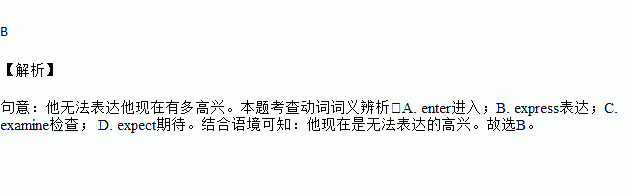
He can’t ________ how happy he is now.
A. enter B. express C. examine D. expect
―Tom! I you 40 times that I'll beat you if you don't leave that apple jam alone.
―Sorry, Aunt!
A. tell B. told C. have told D. am telling
―How can Lucy say bad words about me? I thought we were good friends.
―Who told you that? True friends need .
A. distance B. courage C. trust D. shame
—There was a basketball match between our class and Class 3 yesterday afternoon.
— ________. I missed it.
A. Certainly B. I'm sorry to hear that C. What fun D. What a pity
—Did your pen pal send a postcard to you last week?
—Yes. But I haven't ________ it so far.
A. avoided B. accepted C. refused D. received
Have you ever wished you could read someone’s mind? Well, you can, just by picking up some messages their bodies give you.
How can you tell if a friend is lying to you? They’ll often start becoming red in their faces, because they know they’re not telling the truth. They’ll probably look away while they’re talking. That’s because our eyes can “tell” what we’re thinking about.
Boys usually look at the ground when they’re lying, while girls look at the ceiling(天花板). If they put a hand over their mouths, it’s another sign that they’re lying. It is as if they’re trying to cover up the lie.
Imagine you’re asking your teacher for a few more days to finish your homework. As you talk, she starts rubbing her ear. This is a sign that she doesn’t want to listen to what you’re saying.
We use folded arms to protect ourselves when we don’t feel good. So, if you’re making a point in a discussion, and the others fold their arms, you’d better give up! They don’t agree with you—even if they say they agree with you.
1.How can you read someone’s mind according to the passage?
A. By reading their diaries.
B. By picking up some messages that their bodies send.
C. By watching their faces.
D. By reading the messages that they write.
2.What does a boy usually do when he is not telling the truth?
A. He looks at the ground. B. He looks at the ceiling.
C. He raises his head. D. He closes his eyes.
3.What do the underlined words “rub one’s ear” probably mean?
A. It means “I want to listen to you carefully”.
B. It means “I agree with you”.
C. It means “I don’t want to listen to you”.
D. It means “I can’t hear you clearly”.
4.If you are at a meeting, what should you do when the others fold their arms?
A. Make them accept your ideas.
B. Put your hand over your mouth.
C. Fold your arms to protect yourself.
D. Give up your ideas.
5.Which of the following can be the best title for this passage?
A. Telling the truth. B. Reading others’ mind.
C. Finishing your homework D. Protecting yourself.
This is _______novel _______I’d like to read it once more.
A. such a exciting; that B. so exciting a; that
C. so an exciting; as D. a such exciting; as
—Are you _______? —No, I come from _______.
A. French; Australia B. French; Australian C. Frenchman; Australia
书面表达
你愿意帮助他人吗?如果你有机会成为志愿者,你愿意做什么工作呢?为什么?根据以上要求,写一篇短文,字数在60左右。
____________________________________________________________________________________