题目内容
Liu Wei is very famous in China because he can play the piano with his toes(脚趾).
One day when Liu Wei was only 10 years old, he played a game with some friends. He lost both his arms because of electricity.
Liu Wei was very sad when both his arms were cut off after the accident. But soon he had to make a choice.
“For people like me, there were only two choices. One was to give up all the dreams, which would cause a quick death. The other was to work hard without arms to live an excellent life.”
says Liu Wei.
Liu Wei’s dream was to be a pianist. He learned to play the piano with his toes. And teaching himself to play the piano with his toes was very hard. Many times he wanted to give up, but his parents went on encouraging him and he wanted to make his parents proud.
Maybe you can not believe that Liu Wei is able to play well only with his toes. The audience(观众) were deeply moved and very excited when they watched his performance.
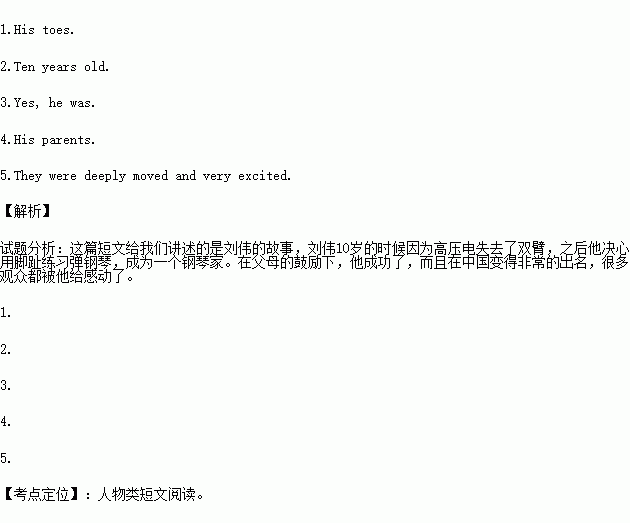
1.What can Liu Wei play the piano with?
2.How old was Liu Wei when he lost his arms?
3.Was Liu Wei very unhappy when both his arms were cut off?
4.Who encouraged Liu Wei to play the piano?
5.How did the audience feel when they watched Liu’s performance?

 愉快的寒假南京出版社系列答案
Have you ever noticed that you seem to learn faster in certain classes but slowly in others? Maybe you think it’s because of the different difficulties of subjects, but the real reason is that our learning types are different.
Now, you may wonder what a learning type is and how to find yours.
There are mainly three different learning types: Visual, Auditory and Kinesthetic. You can be a combination(混合) of learning types, but most people have one main type. Visual learners learn best by seeing. If you seem to easily remember information from pictures, charts and videos, you are likely a visual learner. Auditory learners learn best by hearing. If you seem to remember things by hearing them, then you are likely an auditory learner.
Kinesthetic learners learn best by doing. If you seem to learn best by working with your hands or testing out what you are shown, you are likely a kinesthetic learner.
So now that you know your personal learning style, the trick is to find out how to use your new-found knowledge to help you in your classes.
Tips for Visual Learners
*Pay attention! For visual learners, this is very important! If your teacher uses a PowerPoint, watch the pictures carefully and find out what they might include and their hidden meanings.
*Take notes by drawing charts and connecting ideas instead of just copying
down a list. This way, your brain will easily connect the different concepts(概念). You can even draw pictures if you find that works better for you.
*Mark your notes or your note cards in different colors. This will help your
brain in keeping all of the information separate. Different colors show different types of information or importance.
*Download the PowerPoint if your teacher puts it on QQ. This way, you canreview them before an exam.
Tips for Auditory Learners
*Again, pay attention! If you aren’t listening while the lecture is happening, then as an auditory learner, you’re missing the easiest way for you to learn.
*If your teacher allows you to record the lecture, record it for future
listening.
*If you find that taking notes stops you from listening, ask a friend if you can borrow his or her notes or write down everything you remember right after the lesson.
Tips for Kinesthetic Learners
*The first point is paying attention once again! For kinesthetic learners, it’s especially important to take notes either by writing or typing, in order to actively get information as you receive it.
*Make use of laboratories and other class activities. Focus on what you’re
learning from the experience and pay close attention to the process that you go through.
*Visualize! That is to imagine yourself picking up information and putting it into a category(类别). This may sound silly, but in this way you’re “doing” something without actually physically doing it.
*Rewrite notes and reread information. Try to translate the information into examples. This can help kinesthetic learners remember what they need to know.
The writer’s writing purpose: 1. | ||
2. | 3. | advice |
Visual | learn best by seeing | In class: If your teacher uses a PowerPoint, watch the pictures carefully and try to 4. them completely. Draw charts or pictures on your notebook. After class: Use different colors as 5. of different kinds of information on your notes or note cards. Download and review your teacher’s PowerPoint. |
Auditory | learn best by hearing | In class: 6. and 7.if your teacher allows. Don’t take notes if it stops you from listening. After class: Borrow your friend’s notes or write down everything according to 8. right after the lesson |
Kinesthetic | learn best by doing | In class: Take your notes by writing or typing. Take 9.of learning in laboratories and other class activities. Focus on learning 10.. After class: Visualize your learning. Write down the information in your notebook and try to put it in the form of 11. and read the notes again. |