题目内容
Draw the time on the clock.

It's one thirty.

What do you do if you're stranded(处于困境的)on a lonely island? Surely you need to find a way to get in touch with the outside world. Your best chance of doing this is to draw the attention of a passing plane.
Body signals(信号)
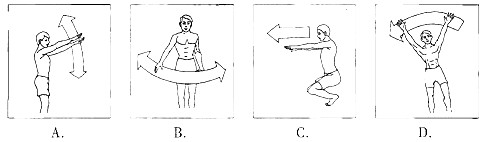
Pilots from different countries understand body signals if they have the correct training. When you wave your arms up and down in a straight line, it means "yes". When you point downwards and swing your arm from side to side, it means "no". If you want the pilot to know that it's safe to land, push your hands out in front of you and bend(弯曲)your knees. If you want to say that it's not safe to land, put your arms in the air and move them to one side.
Smoke signals
The smoke from a fire can be seen from far away, so it's a good way to draw attention. If the weather is dry, it isn't hard to start a fire. Remember, however, that fires can be very dangerous if they get out of control. Never light a fire unless you're sure that it can't spread. If the ground is dark, light smoke can be seen more easily. Green grass and leaves produce light smoke.
Ground-to-air signals
It's a good idea to build some signals, too. Use large pieces of wood to make the symbols(标记). If you can't find any wood, use earth. Some useful symbols are:
F "I need food and water."
II "I need medicine."
I "I am badly hurt."
X" I am unable to move from here."
Pilots' replies
If the pilot lowers the plane's wings from side to side, this means "message received and understood". (At night, the pilot flashes the plane's green lights.) If the pilots flies the plane in a clockwise circle, this means "message received but not understood".(At night, the pilot flashes the plane's red lights.)
However, there is no signal which means "message not received". Why not?
【小题1】 Which picture means "it's not safe land"?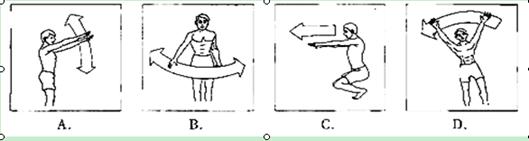
【小题2】 What can we learn from the passage?
| A.Swinging your arm from side to side means "yes". |
| B.If the ground is dark, light smoke can't be seen. |
| C.If you need some medicine, make a symbol "II". |
| D.The pilots make replies with a blue light at night. |
| A.The explanation of building signals on an island. |
| B.The importance of making signals on an island. |
| C.Ways of sending out signals on a lonely island. |
| D.Ways of receiving signals from a lonely island |
Tony Buzan’s grades were going down at university. Disappointed with his low marks, he went to the library to find a book on how to use his brain. He was directed to the medical section. Confused, he said to the librarian, “I don’t want to take my brain out, I just want to learn how to use it.” Her reply was simple: “There’s no book on that.”
“I thought to myself,” says Buzan, “if I buy a little radio, I get an instruction manual (说明书). If I buy a microwave, I get an instruction manual. But for the most important machine in the world, no instruction manual?”
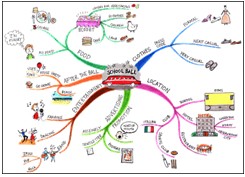
Fifty years later, Buzan has become the world’s leading speaker on the brain and learning. In the late 1960s, he invented the mind map, a visual representation of thought processes.
This kind of thinking has become a popular tool for planning, organizing, problem solving, and communicating across the world. He has since authored and co-authored over 100 books that have appeared in more than 30 languages.
“I think in most cases, people use less than 1 percent of their brains,” he says.
But how do you expand this 1 percent? How do you become the best student you can be?
According to Buzan, the answer is simple. You take a section of whatever it is that you are trying to learn, he says, and you read it for its essence (精髓、要素). Then you make a mind map of all the important details. For a truly effective mind map, you start with a colored image in the center of your page. Draw the first image that comes to mind on the topic you are mind mapping. Branch off from your central image and create one of your main ideas. From your main branches draw some sub-branches and from those sub-branches you can draw even more branches. He emphasizes that you should use plenty of images and colors as these help with memory recall and encourage creativity.
By using this visual format (形式), according to Buzan, your mind will begin to make associations that will help you remember more information for longer periods of time.
Buzan believes that traditional note-taking methods, such as lists and summaries, do not stimulate the brain’s recall capacity or ability in the same way. Because of this, students will often find themselves locked away in their rooms for hours, trying hard to memorize separate details. Buzan believes that for a more effective and lasting way of studying, you must first understand how your brain works.
“Everyone is born smart,” he says. “You just have to learn how to learn.”
【小题1】What is the main purpose of the first two paragraphs?
| A.To show that Tony Buzan was worried about his study. |
| B.To invite us to think about the importance of manuals. |
| C.To prove that the mind map is a useful tool for the brain. |
| D.To show why Tony Buzan studies the brain and learning. |
| A.Excite. | B.Improve. | C.Encourage. | D.Affect. |
| A.If we learn the mind map, we will become the best student. |
| B.The mind map will help your brain connect separate details. |
| C.The mind map will be more effective if we put more details in it. |
| D.We will solve the problem if we make connections between ideas. |
| A.How to make the mind map? |
| B.Is the mind map widely used? |
| C.Can your memory be mapped? |
| D.Is the mind map helpful in thinking? |
Long ago ,there lived in Greece a learned man. He was so well known for his good knowledge of almost everything that lots of people from all over the country came to learn from him. The great man taught his students whole-heartedly and answered their questions with great patience.
One day a student asked him, “ My dear teacher, didn’t you say you yourself have many ,many more questions about things than we do? But I think we students have far more than you.”
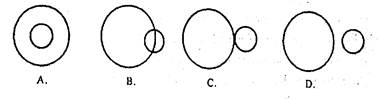
With a smile on his face, the teacher drew two circles ,one as large as a big cake, the other smaller. Then he said , “Of course, I have learned much more. But it’s wrong to think that a teacher has fewer questions than his students. Now, look at these two circles. The inside of the bigger one is my knowledge of things, and the inside of the smaller one is yours. Out of the circles is what is still unknown to us. Since mine is larger, I have to use the longer line to draw the bigger circle. That means I have more opportunities to face what is still unknown. And that’s why I myself have more questions than you do. The more you learn , the more questions you have. You will never learn enough ,you know.”
【小题1】The learned man drew two circles to show _____.
| A.he was good at drawing circles |
| B.his knowledge had something to do with the circles |
| C.why he had more questions than the students |
| D.how he could get more knowledge |
| A.the teacher had so many questions as a learned man |
| B.the teacher had so many questions |
| C.the students had fewer questions than the teacher |
| D.the students had more questions than 0the teacher |
| A.kindness | B.knowledge | C.patience | D.questions |
| A.the more questions we have, the more knowledge we may get |
| B.it’s never too old to learn |
| C.every one of us should try to be a learned man |
| D.a teacher should have many questions |