题目内容
The salad ______ good. I'd like to have more(更多的).
A. sounds B. tastes C. looks D. smells
Grandparents are respected in many human societies.But telling stories about old times and overfeeding grandchildren seem like distinctly human traits (特征).Are these classic grandparent behaviors really limited to human beings? Do any animals know their grandparents the way people do? For most species (物种) on Earth,the answer is NO! “Usually, there just aren't grandparents living anymore when an animal is born,” said Mirkka Lahdenper?, a biologist at the University of Turku in Finland. Even if an animal's grandparents are still alive, most species spread out to avoid competing for resources, so the chances of running into a grandparent are small.
But there are a few exceptions, primarily among mammals (哺乳动物) that live in close social groups. Canadian zoologist Anne Innis Dagg described groups of langur monkeys in India in which older females lived with their daughters and grandchildren. The grandmother langurs have a particular job: they protect the group's babies against hurt from humans, dogs and other monkeys. Some female langurs even give their own grandchildren special treatment, cleaning their fur and stepping in when they play too roughly with other young.
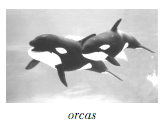
Many whale species, too, travel with their families,including both grandmothers and grandcalves. In groups of sperm whales, according to Dagg, old females help babysit the group's young while their mothers dive (潜水) for food. Orca grandmothers often lead their family members and can live for many years after they stop reproducing. In 2015, scientists suggested that these elder orcas help their grandcalves through hard times, because they remember all the best places to find food.
Female elephants rule the whole family. Calves (幼崽) are typically born into groups led by their grandmothers, who can live to around 80 years old. The female elephants form close relationships, said Lahdenper?, and raise their young together. Lahdenper? found that the calves of young mothers were eight times more likely to survive if their grandmothers lived near them than if they didn't. When the calves' mothers were older and more experienced at raising babies, this beneficial “grandmother effect” disappeared even if the actual grandmothers were still around.
It isn't very clear how elephant grandmothers help their inexperienced daughters, said Lahdenper?. It is believed that they may help nurse their grandcalves. But Lahdenper? thinks that the more likely advantage is the wisdom a grandmother elephant has got during her long lifetime.
And what about grandfathers? Studies of humans in recent years have shown that a living grandfather can improve a person's mental health and well?being, said Lahdenper?.
But there are signs of that in the animal kingdom, she said. Male animals seldom socialize with their own children, let alone grandchildren. “Males are usually focusing on producing their own children and aren't providing so much care,” Lahdenper? said.
1.From Paragraph 3, we know that orca grandmothers _______.
A. die after reproducing B. teach the young to dive for food
C. have rich experience D. enjoy travelling with grandfathers
2.The examples of monkeys, whales and elephants show that _______.
A. the “grandmother effect” lasts long in the animal world
B. grandmothers shoulder great responsibilities in their families
C. animal grandfathers can improve grandcalves' mental health
D. most species treat their grandparents like human beings do
3.Which of the following would be the best title for the passage?
A. Animal grandparents are like human grandparents
B. Animal grandmas are born group leaders
C. Are animal grandmas given enough respect?
D. Do any animals know their grandparents?
A.根据所给汉语完成下列句子。共5小题,计10分。
1.许多人认为他们学英语是通过听英语歌曲。(by)
Many people agree that they learn English _____________________.
2.你应该注意不在公共场合咳嗽(take)
You should ________________________ in public.
3.他们反复地干着简单的工作。(over)
They do simple jobs _________________
4.每个人都应该尽一份力来拯救地球。(part)
Everyone should _________________saving the earth.
5.那由你自己决定。(up)
That’s ____________to decide.
---Excuse me, I want to buy some stamps. Where can I find a post office?
---I know _____ not far from here. You can easily find _____.
A. that; it B. it; one C. one; it D. it; that
Mary always takes the subway to school.She likes watching people and relaxing.It's five miles to her school and takes about 5 minutes. Lin usually walks to school.It takes about 25 minutes.But sometimes he rides his bike.It takes about 10 minutes by bike.He can take the school bus,but he doesn't like it.He doesn't have any friends on the bus.It's boring.
根据短文内容,判断句子正(A)误(B)。
1.Mary often walks to school.
2.It's five miles to Mary's school.
3.It takes Lin half an hour to walk to school.
4.Lin has friends on the bus.
5.Lin thinks the bus is boring.
—What can you do,Li Tao?—______.
A. I like sports B. I want to join the music club
C. I am well D. I can do Chinese Kung Fu
Tom helps his parents ______ the housework.
A. with B. in C. at D. on
Camping is one of the most interesting outdoor activities. Last weekend, I______a camping trip to a hill with my teachers and classmates. We all_____ourselves very much. Each of us brought______for the camping. Liu Tao had a box of chocolates and David had some______. What did Nancy have? She had some fruits, too. Helen had a tin of fish and a tin of chicken. Mr Green and Miss Li had two big tents, the blankets and the cooking tools (工具).
When we______to the camping place, it was almost 11 a. m. Our teachers tried to put up the tents first. And we______went to look for wood. Then we made a fire to cook food. We didn't have much choice (选择) on food, but we all thought it______. After lunch, we took a rest. And then in the afternoon, we caught butterflies, looked for rare(稀有) plants in the woods and went boating in a river______the hill. In the evening, we held a party, singing and dancing around the campfire.
At about 11 p. m., we went into the tents and slept soon because we were______at that time.______, it didn't rain that night. The trip is really a wonderful experience
1.A. heard B. had C. went D. made
2.A. had B. played C. enjoyed D. left
3.A. something B. nothing C. everything D. anything
4.A. vegetables B. candies C. fruits D. drinks
5.A. arrived B. reached C. got D. lived
6.A. teachers B. friends C. students D. girls
7.A. bad B. healthy C. cheap D. delicious
8.A. down B. up C. along D. above
9.A. happy B. excited C. tired D. sad
10.A. Correctly B. Badly C. Finally D. Luckily
任务型阅读
My friend, Tom lives a happy life.(1)He usually gets up at 6:00 . Then he goes for a walk. At 7:00 he comes back. He brushes his teeth and takes a shower. (2) Then he eats breakfast. After breakfast, he goes shopping(购物)with his friends. (3)他大约十点半到家。And he cooks lunch. After lunch, he goes to the club. He reads books and plays chess. He eats dinner at home at 6:00 pm. (4) the evening he likes watching TV. At around 9:00 pm he goes to bed.
根据短文内容,完成下列任务
1.对文中(1)处画线部分提问。 ___________________________________
2.将(2)处画线部分译成汉语:_____________________________________
3.将(3)处画线部分译成英语。 _________________________________
4.文中(4)处的横线上应填的介词是 ________________
5.根据短文内容,下列句子中________是正确的。
A. Tom eats breakfast at 6:30. B. Tom goes to the club in the afternoon.
C. Tom goes to bed at 10:00 pm. D. Tom likes reading before he goes to bed.