题目内容
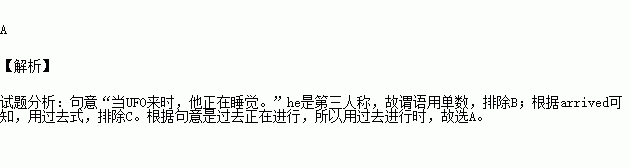
He _____ when the UFO arrived.
A. was sleeping B. were sleeping
C. has slept D. is asleep
Amy had three sons, Dave, Bill and Bob. Every year her sons sent her expensive gifts on her birthday.
The eldest son Dave, had a lot of money and he wanted his mother to have the most expensive gifts, but he didn’t know what to buy. So he put an ad in the newspaper. “Wanted—the greatest gift for my mother.”
About a week before his mother’s birthday, a man came to his office. He brought a big bird.
“This bird can speak six languages and sing eight songs.” the man said.
“Really? I’d like to listen to it,” Dave said.
The man made the bird talk in French and tell a joke in Japanese. Then the bird sang a beautiful song. Dave was very happy and paid eight thousand dollars for the bird. The next day Dave sent the bird to his mother with a birthday card.
The day after his mother’s birthday he called his mother. “Well, mother” he asked, “What do you think of the bird?”
“Oh, it’s very delicious, dear.” said his mother.
1. is the eldest brother?
A. Bob B. Bill C. Dave D. Amy
2.What did Dave put in the newspaper?
A. A show B. A joke C. An ad D. A report
3.How many songs could the bird sing?
A. Five B. Six C. Seven D. Eight
4.How much did the bird cost Dave?
A. $8 B. $80 C. $800 D. $8000
5. How did the mother deal with the bird?
A. She sold it. B. She played with it.
C. She ate it. D. She gave it to others.
— I missed the beginning of The Voice of China last week.
— ! But you can watch re-play this week.
A. Be careful B. Try your best
C. What a pity D. What good news
Most of us use alarm clocks to wake up at the right time for school or work. We look at our watches to know the right time for the bus or train. However, there is also a right time to eat, sleep, exercise, and take medicine. We can’t look at a clock for the right time for these activities. We must listen to the clock inside our bodies: the biological clock.
Barbara Wells exercised every morning. She woke up at 6:00 a.m. She ran about two miles before she went to work. But Barbara’s legs and back started to hurt. She did some exercise before she ran. But her legs and back still hurt. She ran slower, but the pain didn’t stop. Barbara talked to her doctor. The doctor said, “Don’t run in the morning. Try to exercise later in the day. That is the time when your body is at the right temperature for exercise after work.” Her legs and back didn’t hurt anymore.
Today, doctors are learning more about chronobiology(n.生物钟学), the study of biological(adj.生物的) clocks. They are learning about the importance of time for our bodies. For example, it is best for people to go to sleep on time every night and to eat only when they’re hungry. Also, doctors discovered that some illnesses, such as heat attacks, occur(v.发生)most often in the morning. This information tells them that the best time to take heart medication may be at night. When patients take heart medication(n.药物)at night, they may prevent a heart attack in the morning.
Many doctors believe chronobiology(生物钟) can help us live healthier lives. It may be the right time to listen to these doctors!
1.Do we all have biological clocks inside our bodies?
____________________________________________________________________
2.How far did Barbara Wells run every morning?
3.How did Barbara Wells’ legs and back get well?
4.What is the right time for the person who has a heart attack to take heart medication?
5.What can we learn from the passage?
Yang Liwei circled the earth 14 times in 21 hours on October 15 and 16, 2003, landing on the grasslands of Inner Mongolia. Looking a little tired, Yang stepped out of Shenzhou V, smiling and waving at the waiting people. “I feel very good.” Yang said to Premier Wen Jiabao on the phone. Yang said to a newspaper, “For our motherland and me, this is a great moment.”
China’s launch of Shenzhou V shows a higher starting point. It has two special systems(系统) to protect the spaceman, but neither Russian rockets(火箭)nor American ones have.
Yang didn’t know that he was chosen as China’s first spaceman until just before the launch. Although Yang was excited at the news, he still slept at 8p.m. as usual and was woken up at 8p.m. the next morning. Before the launch, Yang ate Chinese traditional food-dumplings. We all know that travelers usually eat them before going on a journey for good luck.
A stamp Success of China First Manned Space Flight was issued(发行)on October 16, 2003, making China the third country to send a spaceman into outer space.
1.It took Yang Liwei_____ to travel around the earth every circle.
A. 6 hours B. 90 minutes
C. 2 days D. 21 hours
2.How did Yang Liwei feel after he came back to the earth?
A. Quite tired. B. A little scared.
C. Tired but excited. D. A little nervous
3.Which of the following statement is right?
A. There is no difference between China’s spaceship and other countries.
B. Yang Liwei knew he would be China’s first spaceman long before.
C. From the news, Yang Liwei was too excited to fall asleep.
D. Yang was proud of the flight.
4.What does the underlined word “launch” mean?
A. 发射 B. 出发 C. 制造 D. 设计
5. China issued the stamps to _________.
A. leave them in space
B. give them to Yang Liwei as a reward
C. celebrate the success
D. give them to Russian and American spacemen.
完形填空
Peter and Charley will go to the movie house.But Peter doesn’t know the________.
Charley writes the way________a piece of paper.Walk straight Sun Avenue____3____you see a restaurant.________left and you are________Center Street.You will go past a library.Then turn right.Go straight and you will see a park________you.Go________the park and turn left.After you pass________shop,you will see a supermarket.The movie house is_______the supermarket.You can’t________(错过)it.
1.A.wayB.roadC.timeD.street
2.A.atB.onC.withD.by
3.A.afterB.whileC.untilD.to
4.A.WalkB.TakeC.TurnD.Round
5.A.onB.atC.inD.for
6.A.behindB.fromC.in the front ofD.in front of
7.A.overB.throughC.onD.across
8.A.seventhB.sevenC.fiveD.the first
9.A.nextB.betweenC.next toD.to
10.A.seeB.lookC.lostD.miss
The volunteers many signs to remind people to protect the environment.
A. put on B. put up C. put down D. put off
Miss Yang finally________first prize in the city’s speech contest.
A.kept
B.made
C.won
D.chose
(2014浙江宁波)—Are you surprised at the ending of the movie?
—No.because I________the story.
A.read
B.will read
C.have read
D.was reading

 outer space.
 ng statement is right?
 was too excited to fall asleep.