题目内容
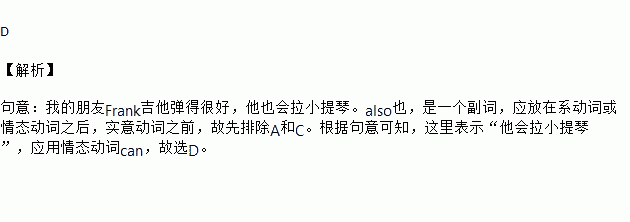
My friend Frank plays the guitar well, and he play the violin.
A. also can B. is also C. also is D. can also


Has anyone told you that it’s fun to play with English words? For a long time these “words within words” in English have been used to surprise and educate us…and they often make us laugh too. Now we go to learn about them.
Riddles(谜语) How did the animals open the zoo door? They used a monkey! What’s the longest word in English? Smiles—there’s a “mile” between the first and last letters! These jokes —a question followed by a surprising answer — are known as “riddles”. But the ones above are examples of a special kind of riddle, a riddle which is funny because a word is hidden within another word. Many English speakers are crazy about this kind of words with double meaning. And it can be found in texts written in English a very long time ago. But riddles are not the only example of “words within words”. |
Hidden words During Victorian times (1837—1901), the game of hiding words within a whole sentence became popular. Look carefully at this sentence—The king eats his lunch in a fine palace. Can you see that the countries “China” and “Nepal” are hidden in it? The Victorians even used hidden words to teach children history and geography at school. Today we still see hidden word games in books and magazines, but we also use hidden words in jokes. |
Palindromes(回文词) Palindromes are words and phrases which can be read the same forwards and backwards. The pop group “Abba”, for example, is a palindrome. The sentence “Was it a car or a cat I saw?” is also a palindrome. We find them interesting, but they can also be funny: I kept receiving emails about reading maps backwards, but then I realized it was just spam(垃圾邮件)! |
1.Which of the following is a riddle?
A. step—pets, part—trap B. hiding words within a whole sentence
C. silent—listen, the eyes—they see D. Which letter is a question? Y (Why) .
2.By reading the article we can know “___________”.
A. Riddles are the only example of “words within words”.
B. Victorians even used riddles to teach kids history at school.
C. “Was it a car or a cat I saw?” is a palindrome as well.
D. These “words within words” in English often make us cry.
3.The best title of the passage is ________.
A. It’s fun to play with words B. “Words within words” educate us
C. Riddles & Hidden words D. The pop group “Abba”
书面表达
假如你是Sandy,刚搬进新家,想邀请你的朋友Amy来你的新家做客。请你按照下面的提示写一篇题为Welcome to my new home的短文。
Location(位置) | not far from school, on the 12th floor in a tall building |
Layout(布局) | a small living room, … |
Community | good neighbors, help with different kinds of problems |
Giving directions (方向) | … |
注意:1. 文中不得出现你的真实姓名和学校名称;
2. 语言通顺,意思连贯,条理清楚,书写规范;
3. 词数80左右,文章的开头已经给出,不计入总词。
Welcome to my new home
Dear Amy,
I would like to invite you to my new home. ____ ____
I am looking forward to seeing you.
Yours,
Sandy