题目内容
The journey has ________ a few months.
- A.spent
- B.taken
- C.cost
- D.paid
表示“花费”时,A与D的主语是人,take一般表示“花费(时间)”。

 小学课时特训系列答案
A Fantastic Journey to London
Alan Travel Service

 t
t 
Time: July 22—August 14,2012
Hotel: Hilton Hotel (free breakfast )
Places of interest: St.Paul’s Cathedral ( July 23)
Tickets: $ 12 each (Kids half-price )
Big Ben ( July 24 )
Tickets: $ 8 each ( Kids half-price )
Olympic Games: ( July 27—August 12 )
You can book tickets at 0044-020-6528
Enjoy the journey together!
Total Free: ¥26880 each ( Kids half-price )
Tel:0371-6315680 Fax:0371-6501283
Visit us at www. Look-out 2004@alan.com
【小题1】 How many days will you spend if you join in Alan Travel Service’s journey to London?
| A.14. | B.22. | C.24. | D.29. |
| A. St.Paul’s Cathedral | B.Big Ben |
| C.Olympic Games | D.University of Cambridge |
| A.¥6 | B.$6 | C.¥4 | D.$4 |
| A.From July 25 to August 12. | B.From July 22 to August 14. |
| C.From July 23 to August 12. | D.From July 27 to August 12. |
| A.In Hilton Hotel you will have free breakfast every day. |
| B.You can book tickets for the Olympics at www. Look-out 2004@alan.com |
| C.Mr. Li and his wife will spend ¥53,760 for their journey to London. |
| D.If you want to find more information, you can call 0371-6315680 for help. |
What might the future be like? Here are some predictions: things to come, things to go.
The Spring Festival, the most important Chinese holiday when everyone returns home, has caused headaches for millions of Chinese. More than 2 billion people travel at the same time, making getting travel tickets and the journey difficult. But in 28 years, Spring Festival travel may not be a problem at all. China plans to build more than 120,000 kilometers of railway and a fast transportation network that will serve 90% of the population by 2020. And because most of China will be cities, people will not have to go to other places to find a job, so it will no longer be a problem.
Newspaper will come to an end in 2043. In the future, digital(数字的) newspapers will be sent to personal web tools through Internet. Readers can discuss topics with journalists and editors. Information will move faster.
Oil is running out faster than expected. But scientists have found something else for oil as fuel(燃料). Coal, natural gas, solar power, nuclear power and even water can take the place of oil as sources of energy(能源).
Schools will go electronic(电子化). Computers will be important and popular among the students. Everything will be in the computer and students will not need to bring books to school. They will find information on the Internet. A computer will be the students’ library, schoolbag and connection to the outside world. There will be robot teachers, they will check homework on computers and communicate with the students’ parents through e-mail. And school buses will be like spaceships, comfortable and safe.
【小题1】 More than 2 billion people have a hard time returning home during .
| A.Christmas Day | B.National Day |
| C.the Spring Festival | D.the Mid-autumn Festival |
| A.in 28 years | B.by 2020 | C.by 2053 | D.in 33 years |
| A.Coal | B.Wind | C.Nuclear power | D.Water |
| A.the Spring Festival travel may still be a problem |
| B.90% of the population will live in the city |
| C.robot teachers will check homework |
| D.readers can discuss topics with each other through Internet |
| A.Schools will go electronic | B.Computers will be important |
| C.There will be robot teachers | D.School buses will be like spaceships |
There are many different ways to travel to Paris from London. One of the quickest and most popular ways is by train. From Waterloo Railway station, you can travel all the way to Paris. The journey takes about three hours. The train, called the Eurostar, is very modern, and the seats are comfortable.
You can also travel to France by ship. First, you go to Dover, on the coast (海岸), by bus from London. The bus stops at the Ferry Terminal Seven in Dover. You can buy your tickets there. People who travel by car can drive on to the ferry (渡轮), too.
Another way to travel to Paris is by plane. There are several airports with international flights to Paris and other cities in France. You can travel to London Airport by bus or underground. Some people even go by taxi but this is a very expensive way to travel!
【小题1】The most popular way to Paris is .
| A.by ship | B.by plane | C.by car | D.by train |
| A.quick | B.expensive | C.comfortable | D.pleasant |
| A.different ways traveling from London to Paris |
| B.international flights from London to Paris |
| C.buses stopping at Ferry Terminal Seven in Dover |
| D.the journey taking the train called the Eurostar |
 The
16th Asian Games was held from November 12th to 27th in
2010 in Guangzhou, China. There were 41 events in the Games.
The
16th Asian Games was held from November 12th to 27th in
2010 in Guangzhou, China. There were 41 events in the Games. Premier
Wen Jiabao went to Shanxi province on April 2nd , 2011. He made a
three-day visit to impoverished(穷困的) Luliang.
During his visit, he said that farmers’ right(权利)must be protected and he warned(警告) that no land should ever be taken against a farmer’s will(意愿).
Premier
Wen Jiabao went to Shanxi province on April 2nd , 2011. He made a
three-day visit to impoverished(穷困的) Luliang.
During his visit, he said that farmers’ right(权利)must be protected and he warned(警告) that no land should ever be taken against a farmer’s will(意愿).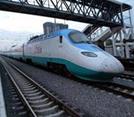 The
Beijing-Shanghai High Speed Railway will be put into operation at the end of
June, 2011. The journey takes about five hours. The train can reach speeds of
up to 380 kilometers an hour. The passenger volume (容量) is expected to reach 160 million a year, marking(标志) a great step in China’s
Railway development.
The
Beijing-Shanghai High Speed Railway will be put into operation at the end of
June, 2011. The journey takes about five hours. The train can reach speeds of
up to 380 kilometers an hour. The passenger volume (容量) is expected to reach 160 million a year, marking(标志) a great step in China’s
Railway development.