题目内容

阅读理解。

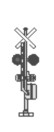
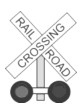
You can't play, walk, skate or ride a bike on the railroad(铁路). There are many places where the railroad tracks cross roads or streets. Many of these railroad crossings are marked(标注) with one of the signs in the table(表) below.

1.

This sign means you are coming to a railroad crossing. Always look both sides and listen carefully to be sure a train is not coming from either direction before crossing the tracks.

2.

Many railroad crossings have a gate with flashing lights that close when a train is coming.

● NEVER go around a closed railroad gate.

● NEVER try to get across the tracks before the train gets there.

3.

Some crossings which don't have gates may have this sign. When the lights are flashing, a train is coming. You should wait until the train has passed before trying to cross the tracks.

Be careful when crossing railroad tracks:

● Railroad tracks are uneven(凹凸不平的). You should not bicycle, skate or run when crossing tracks.

● Trains are very large and heavy, and take a long time to stop.

● Sometimes when a train has just passed from one direction, another train may be coming from the opposite direction. You might not notice the second train because of the noise from the first train.

1.The underlined word "tracks" means in Chinese.

A.轨道 B.足迹

C.标志 D.小路

2.When you see Sign One, you should .

A.not pass the railroad crossing

B.stop to wait for a car to pass

C.make sure no train is coming before you cross

D.pass the railroad crossing immediately

3.Where can you see Sign Three on the railroad?

A.On the railroad tracks.

B.At the train stations.

C.At crossings that have gates.

D.At crossings that have no gates.

4.What can we learn from the passage?

A.We can see many railroad signs in our cities.

B.There are many gates on the railway tracks.

C.It takes a short time for a train to stop.

D.It's dangerous to play, run or bicycle on the railroad.

5.What's the best title for the passage?

A.How to Cross the Railroad Tracks Safely

B.Pay Attention to Some Train Signs

C.Don't Play on the Railroad Tracks

D.How to Protect the Railroad Tracks
练习册系列答案
相关题目

阅读与表达(问答式)。

Pranav Kalyan may seem like any other fourth grader at Willow Elementary School. He likes watching the TV show "Pokemon" and playing soccer with his friends.

But the Agoura Hills student also spends up to nine hours studying computer programming.

That drive helped the 9yearold to become the youngest Microsoft Certified(被证明的) Technology Specialist(专家).

"I read the books and I write the code on the computers and if I don't understand what they say in the books I search it up on Google." Pranav said.

The previous(以前的) record holder was a 12-year-old from Dubai.

"He looks like any other little kid, acts like any other little kid, but I bet if you asked him any calculus(运算) problem he would give you the answer quickly." said Pranav's fourth grade teacher Sharlene Church.

"Do you plan many activities for your son?" I asked Pranav Kalyan's father.

"We don't want to push him, actually we are getting more advice from the school teachers and the headmaster and everything; we want to make sure he doesn't lose his childhood, we want him to enjoy." his father Kalyan Mohan said.

When asked why he went through all the work to get certified, Pranav proves once again that he's wise beyond his years, "It's easier to get a job when I'm older."

1.What does Pranav Kalyan like doing?

2.What is Pranav Kalyan famous for?

3.Who helps Pranav Kalyan to understand the code on the computers?

4.What childhood does Pranav Kalyan's father hope his son to have?

5.Why does Pranav Kalyan think he is easy to get a job when he's older?

阅读理解。

When I was seven years old, my family created an ant farm. First, we put clean sand in a thin glass box. Then we waited for the ants to arrive. After the ants were in the glass farm, they started to make tunnels. I was amazed that each one knew exactly what to do. Each had its own job.

On the fifth day a tragedy(悲剧) happened. I put my face so close to the glass farm that I knocked it over. All the tunnels fell down. Although the ants remained alive after their "earthquake", one by one they began to die. I was scared as I watched them give up their tunnel building to carry the bodies to a corner of the farm.

My mother said that the ants were dying of sadness. They simply could not stand that their tunnels were gone. Although much time has passed, I still think of that ant farm. Mom had hoped it would teach me about the natural world, but it taught me much more.

Over the years, I came to realize the importance of teamwork. Working together, the ants were able to make an amazing world for themselves. I also learned that they should be admired for their hard work. But there was an even larger lesson that I did not realize until recently: adversity(逆境) is a natural part of life, and must be accepted. Unlike the ants, we cannot give up when we are sad. We have to realize that if a tunnel is gone, we must build another.

Giving up, I say, is not a good choice.

1.The writer's family when he was seven.

A.built a farm of ants B.bought a few ants

C.caught a lot of ants D.founded an ant city

2.The underlined word "it" here refers to .

A.the ant B.the ant tunnel

C.the glass farm D.the corner of the glass

3.What can we know from the passage?

A.The writer broke the glass box because it made his face dirty.

B.The ants died one by one because the tunnels were destroyed.

C.Unlike people, teamwork is not so important for the ants.

D.Giving up is a good way when we meet troubles.

4.What did the writer come to realize a few years later?

A.Working together is useless. B.Teamwork is important.

C.He can't accept adversity. D.Working alone is amazing.

5.Which could be the best title for the passage?

A.An Ant Farm B.Ants Fear Adversity

C.My Family and Ants D.Good Lessons From Ants

阅读下面的短文后,将正确答案的序号填在题前括号内。

Jenny was a five-year-old girl. One day, while she was shopping with her mother, she saw a plastic pearl necklace (塑料珍珠项链) and loved it so much. So she asked her mother to buy it for her.

Every night, before Jenny went to bed, her dad would read stories to her. One night, when he finished the story, he asked, “Jenny, do you love me?”

“Dad, you know I love you,” Jenny answered.

“Well, give me your necklace,” Dad said.

“No, Dad. But you can have my favorite doll.”

Several times, when her father asked her to give him the plastic necklace, Jenny would give him something else instead. One evening, after Jenny’s father read her a story, Jenny said, “Here, Dad.” She put her plastic pearl necklace into her father’s hand.

Her father hold the necklace in one hand and opened the other hand. There was a real pearl necklace in it. He had had it for a long time, and waited for Jenny to give up the cheap one so that he could give her the real one.

So, don’t be mean. If we are generous (慷慨的), maybe we will get something better.

1.What did Jenny’s father do every night?

A. Asked for the plastic necklace.

B. Talked with Jenny.

C. Read stories to Jenny.

D. Played dolls with Jenny.

2.What did Jenny do when her father asked her for the necklace for the first time?

A. She asked him to buy a doll for her.

B. She gave him her favorite doll.

C. She said she didn’t love him at all.

D. She gave the necklace to him.

3.What does the underlined word “mean” mean in Chinese?

A. 吝啬的 B. 勇敢的 C. 逃避的 D. 害怕的

4.From the passage, we know that _________.

A. Jenny’s father bought the plastic necklace for her

B. Jenny didn’t love the plastic pearl necklace later

C. Jenny knew her father bought her a real pearl necklace

D. Jenny’s father gave her a real pearl necklace

5.What does the writer want to tell us?

A. We should put our things in a safe place.

B. We often lose our favorite things.

C. We should learn to be generous.

D. We should love our parents.

违法和不良信息举报电话:027-86699610 举报邮箱:58377363@163.com

精英家教网