题目内容
________ rains are faster than ________ buses.
- A./;/
- B.The;/
- C./; the
- D.The; a

 53随堂测系列答案
Maybe you know floods, droughts, earthquakes, sandstorms and so on. But have you ever heard of typhoons?
Typhoons are some of the worst storms, usually around the Pacific Ocean and the South China Sea. Most happen in July, August and September.
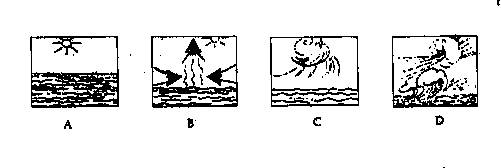
How does a typhoon happen? When lots of sea water gets hot in the summer sun, it evaporates into the air. This makes the air hotter. When the air gets warm enough, it starts to move higher up into the sky. Then, cooler air around it rushes in. It fills the space that is left. After the air gets warmer, it starts to move quickly, making wind. The wind goes in circles, and it keeps moving higher in the sky. The warmer the air gets, the quicker the wind moves. And when the wind moves faster than 30 meters a second, a typhoon begins.
A typhoon has two parts. One is called the "eye". In the eye, the wind does not move so fast. The other part is the wall of clouds around the eye. This is where the strongest wind and hardest rains are.
Typhoons are very dangerous. In 2004, Typhoon Yunna killed 164 people in Zhejiang, and 24 people were missing. In May 2006, Typhoon Pearl hit Guangdong and Fujian, and thousands of houses were damaged.
What to do when a typhoon hits:
·Stay inside, close all the windows and stay away from them.
·Try to bring all of your things inside. Strong winds could even blow away your bikes!
·Listen to the radio or TV for important information.
·If you're told to go to a safer place, do so right away.
【小题1】Which picture can tell meaning of the underlined sentences "... it starts to move higher up into the sky. Then, cooler air around it rushes in. '? 
【小题2】When a typhoon comes, we cannot
| A.close all the windows |
| B.listen to typhoon news |
| C.stay outside with our bikes |
| D.stay inside the strong house |
| A.The warmer the air gets, the slower the wind moves. |
| B.This year Typhoon Peal killed 164 people in Zhejiang. |
| C.The strongest winds and hardest rains are in the eye of typhoon. |
| D.A typhoon will happen when the wind goes faster than 30 meters a second. |
Don’t you want to go to school? You could tell your parents you’re ill. But last Monday, students from Shanghai and Zhejiang had an even better excuse: a typhoon(台风)!
Typhoon Khanun hit East China on September 11. In Shanghai, all the school were closed the next day, Monday.
It was the first time that Shanghai had to close schools because of bad weather.
But some students still came to school that day. “ I didn’t get the notice that the school was closing,” said Shen Sheng, a Junior 2 student from Shanghai Aiguo School. “ But it was nice that we could play in school rather than study.”
The school kept Shen and other 20 students safe inside and let them play sports like table tennis.
But the storm wasn’t all fun games. Typhoon Khanun killed 14 people. In Zhejiang, it damaged about 8,000 houses. More than one million people had to be taken to safer places.
Every year, typhoons hit different places around the world. Most happen in July, August and September. This year 15 typhoons hit China. Khanun was the strongest. Typhoons bring strong winds and rains. The winds can blow away houses and cars. The rains are bad for farmers’ fields.
Typhoon also kills people. Earlier this month, Typhoon Talim hit East and Central China. It killed at least 124 people.
【小题1】When was the first time that Shanghai had to close all the schools?
| A.In August | B.In July | C.On Sep.11. | D.On Sep.12. |
| A.bad traffic | B.heavy rain | C.Typhoon Khanun | D.Typhoon Talim |
| A. They were kept safe inside and played sports like table tennis. |
| B. They were asked to go back home as quickly as possible. |
| C. They were sent back home by their teachers at once. |
| D. They still had classed in the classroom as usual. |
| A.建造 | B.损毁 | C.伤害 | D.装饰 |
| A. If a typhoon hits, many students shouldn’t go to school or go out. |
| B. More than one million people were killed in Zhejiang that day. |
| C. Every year, 15 typhoons hit different places around the world. |
| D. Typhoons do a lot of harm to farmers’ fields and human beings. |