题目内容

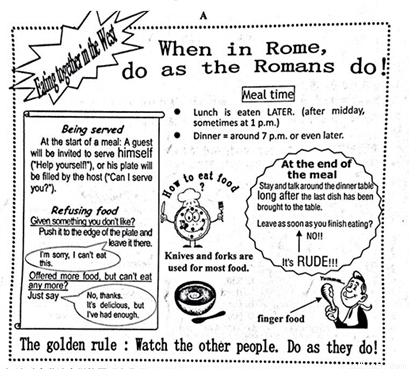
The golden rule: Watch the other people. Do as they do!

阅读以上节选自学校国际文化周活动中的海报,根据其内容回答下列各个小题。

1.What time do western people usually have dinner?

A. About midday.

B. At 5:00 in the afternoon.

C. Around 7 p.m. or even later.

D. Before 7:00 in the afternoon.

2.Most food in the West is eaten with ______________.

A. spoons B. chopsticks

C. fingers D. knives and forks

3.What will a host probably say to a guest at the start of a meal?

A. “Can I help you?” B. “Eat slowly!”

C. “Help yourself!” D. “Could you serve me?”

4.When might people want to say, “I’m sorry, I can’t eat this.”?

A. If they’ve been given something they don’t like.

B. If they are full.

C. If the hosts keep offering a lot of food to them.

D. If they are not hungry.

5.Which of the following is helpful when you’re in the West according to the poster?

A. You can leave as soon as you’ve finished eating.

B. If you don’t know what to do, just watch the others and do as they do.

C. You can’t eat chicken legs with your fingers.

D. The fork is held in your right hand and the knife in your left.

练习册系列答案
相关题目

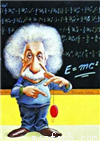
How much do you know about Albert Einstein?

Albert Einstein, born on March 14, 1879 in Germany, was a great scientist in the world. ①He was strange because he hated haircuts and new clothes. He believed in peace. All his life, he hated war. However, his most famous idea, E = mc², helped create the world’s most dangerous weapon (武器). Many people think he was the smartest person in the world. But Einstein said that he thought like a child with many questions and unusual ideas.

What did he like?

Einstein liked learning sailing (帆船运动). He sailed in small boats all his life. He once joked, “Sailing is the sport that takes the least energy!” When Einstein was a child, his mother made him take violin lessons. At first, he didn’t like the violin. But then he learned to love music and became a good violinist.

Later, he said, “②热爱是最好的老师。”

Why is the sky blue?

In 1910, Einstein asked a question which many children often ask, “Why is the sky blue?” After his careful research, he answered the question like this: “It’s because light is made up of many colors including blue. When light travels to Earth, gas particles (气体微粒) spread the blue light all over the sky.” His answer is true in physics.

1.请将文中①处句子译为汉语。

2.请将文中②处句子译为英语。

3.请在下面的加横线上填上一个三个词的短语。

Einstein ___________learning sailing and playing the violin.

4.请在文章中找出和所给句子意义相同的一句话。

Einstein’s parent made him take violin lessons when he was young.

5.How was the answer to the question why the sky is blue?

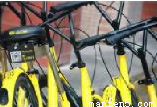
Suppose you find a bright yellow bike on a street corner in the city. You hop on(跨上)it and 31 . But wait—isn’t this stealing? No, it isn’t. 32 shouts,“Stop! Thief!” That is 33 this free ride is just fine with the city.

You 34 find hundreds of free yellow bikes in some US cities. The idea began in Portland, Oregon, in 1994. People saw a need for 35 transportation, and they wanted to help 36

pollution. So, to get citizens(市民) 37 their cars and onto pollution-free bikes, they 38 the Yellow Bike Project.

The 39 bikes are painted bright yellow and placed throughout the city. People can hop on the yellow bike and ride to run errands(短程差事), to work 40 to school. Then, they leave the bike for the 41 rider. There have been times when bikes have been stolen, but most people 42 the rules, because they think it is not wise to 43 the bike that’s already free.

Portland’s 44 was quickly loved by a lot of people. Within two years of its starts, similar programs were 45 in cities in six other states.

1. A. drive away B. ride away C. ride back D. run away

2.A. No one B. Someone C. Anyone D. Everyone

3.A. whether B. so C. because D. though

4.A. have to B. don’t have to C. can’t D. can

5. A. expensive B. crowded C. free D. common

6.A. protect B. control C. make D. bring

7.A. out of B. into C. up D. near

8.A. ended B. started C. changed D. refused

9.A. public B. private C. clean D. dirty

10.A. but B. as C. until D. or

11.A. next B. last C. best D. first

12.A. break B. make C. discuss D. follow

13.A. buy B. repair C. produce D. steal

14. A. citizen B. street C. idea D. school

15.A. looked up B. made up C. put up D. set up

We often face the following situations in our daily life:

? The woman next door plays her piano after 12 o’clock at night.

? The family across the street never cleans up their yard. The rubbish blows into your yard.

? The man next door always parks his car in front of your drive.

Have things like this ever happened to you? If so, you may ask yourself, “Who are these people? Why are they doing these things to me?”

These days, many people don’t know their neighbors. Sometimes we share a friendly smile or say hello, but lots of people don’t even know their neighbor’s names! When you don’t know someone, it’s easy to be angry when something has happened that you think is unfair. You think, “Maybe they like to make me angry, “or “Maybe they do it on purpose.” Believe it or not, your neighbors probably don’t mean to irritate(激怒)you. Often, they don’t even know that they’re making you feel angry. So before you take unusual steps to fix the problem, you should discuss it with them first.

When you move towards your neighbors, you should talk to them in a friendly manner. Praise their children to make them feel good. Then explain the situation. And if you can think of a simple way to solve the problem, suggest it.

If talking doesn’t work, ask another person to help. This person can listen to both sides of the story and help you and your neighbor solve the situation.

Finally, sometimes it’s a good idea to avoid the problem. Depending on the problem, it might be best to just stay out of your neighbor’s way.

1.What’s the writer’s purpose of writing paragraphs 1&2?

A. To ask some questions. B. To lead in the subjects.

C. To list some situations D. To tell some stories.

2. You should talk about the problem with your neighbors first because ________.

A. they often say hello or smile to you

B. you do not know what they are called

C. they probably don’t plan to make you unhappy

D. they will take unusual steps to solve the problem

3.When talking with your neighbors, you can make them have a good feeling by _______.

A. praising their children B. explaining the problem

C. shaking hands with them D. making friends with them

4.The best way to solve the problem sometimes is to ________.

A. ask another person for help B. turn a blind eye to it.

C. tell the story to your friend D. let your neighbor get out of the way

5.What does the passage mainly talk about?

A. Ways to deal with neighbors

B. Problems caused by neighbors

C. Situations we may face every day

D. Reasons why we become angry at neighbors

违法和不良信息举报电话:027-86699610 举报邮箱:58377363@163.com

精英家教网