题目内容

信息匹配。

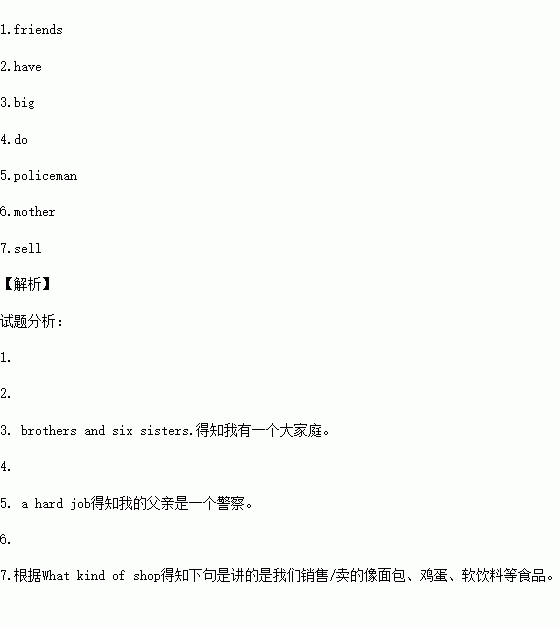
policeman,mother,have,big,sell,friend,do

Carl: Hi. My name’s Carl. Nice to meet you.

Mike: Nice to meet you, too. My name is Michael.

Carl: What?

Mike: Michael, but all my 1. and family call me Mike.

Carl: Okay, Mike. So, tell me about your family?

Mike: Well, I 2. seven brothers and six sisters.

Carl: Wow. That is a 3. family. So, are you the oldest, Mike?

Mike: No. I’m the second oldest in my family.

Carl: So, what do your parents 4.

Mike: My father is a 5._. It’s a hard job. My 6. is a shop owner.

She works with some of my brothers and sisters in our own shop.

Carl: What kind of shop?

Mike: We 7. food, like bread, eggs, soft drinks, rice, sugar, and so on.
练习册系列答案
相关题目

When punctuation(标点) began, it was mainly to help people read out loud. Until a few hundred years ago, not many people were taught to read, so there was a lot more reading out loud by the few people who could.

To help those reading out loud in the old days, sign(符号) known as “points” were added to pages of writing. Punctuation comes from the Latin word punctus, meaning “point”. These points told readers when to pause(暂停) or take a breath, and what to emphasize(加重).

In Europe from the early centuries AD, these points were widely used although not everybody used the same points for the same thing. When printing was invented, printers had to be made more clearly about what to put where, so that everyone was doing the same thing. Since that point, all sorts of punctuation rules have been discovered and invented.

Speech marks “...”

Speech marks or quotation marks are used to show that someone is speaking. The sort we have in English today began to be widely used during the 18th century. Before that readers simply understood from the way a sentence was written that someone was speaking although sometimes spoken words were underlined.

Comma , colon: period(full stop).

All three of these sorts of punctuation marks were given their Greek names by Aristophanes, a librarian who lived in Byzantium in the 2nd century BC. They were marks on the page, each with a message to the reader. Comma meant a short pause. Colon meant a medium(中等的) sized pause. Period meant a long pause.

Exclamation mark!

In the early days of punctuation, if you saw this sign, you were supposed to pause. Some people think the exclamation mark began as what the Greek word IO looked like if it was turned 90 degrees. This word means “Oh, gosh!” With the I on the top and the O under it, the sign as we know it today was developed.

Question mark?

In the middle age, a squiggle(圆弧) above a full stop was sometimes used to show the sentence was a question and that a person’s voice should go up at the end. By the 17th century it had turned into what we call a question mark. The shape may have come from the letter Q short for that Latin quaestio, meaning “question”.

Writers make choices about punctuation because they think differently about sentences and words. It’s part of the personality of their writing. Some writers hate punctuation, but others love punctuation. So whether you love or hate punctuation, the best advice may be to just enjoy it, play with it, think about it and use it. It belongs(属于) to the language and it belongs to you.

1.When did punctuation begin to be widely used, according to the passage?

A.In the 17th century. B.In the 2nd century BC.

C.In the 18th century. D.In the early centuries AD.

2.All punctuation rules were discovered and invented in order to ________.

A.help people read out loud B.meet the need of printing

C.guide the way of writing D.mention the spoken words

3.Which of the following is true?

A.A long pause comes after question mark.

B.Speech marks were named by a librarian.

C.Question mark comes from a Latin word.

D.The shape of a word makes exclamation mark.

4.What’s the problem about punctuation today?

A.People have completely different ideas about it.

B.Not many people are taught to use it correctly.

C.It has different meanings to different people.

D.Sometimes spoken words must be underlined.

My summer hols wr CWOT. B4, we usd 2 go 2 NY 2C my bro, his CF & thr 3:-@ kids FTF ILNY, its gr8.

Can you understand this sentence? If you can't, don't feel too bad: neither could the middle school teacher in England who received this as homework. This is Netspeak: the language of computerized communication found on Internet or cellphones. To newcomers, it can look like a completely foreign language. So, what is the "translation" of the sentence above? My summer holidays were a complete waste of time. Before, we used to go to New York to see my brother, his girlfriend, and their three screaming kids face to face. I love New York; it's great.

Schoolteachers and parents say this new form of writing is harming(破坏)the English language. Increasing spelling and grammatical mistakes cxan be seen in students' writing. They fear the language could become corrupted(面目全非的).

Everyone should just relax, say linguists(语言学家). They believe Netspeak is in fact more of a good thing. David Crystal, from the University of Wales, argues that Netspeak and Internet create a new language use and the almost lost art of diary writing has been picked up again. Geoffrey Nunberg, from Stanford University, agrees. "People get better at writing by writing," he says, "Kids who are now doing text messaging, e-mail, and instant messages will write at least as well as, and possibly better than, their parents."

Linguist James Millroy says, for centuries, it is believed without exception that young people are harming the language. And you can bet your bottom dollar that when today's teenagers become tomorrow's parents, they too will think this way. Milroy argues that languages do not and cannot become "corrupted"; they simply change to meet the new needs.

However, Netspeakers do agree that it is important to teach young people how to speak and write Standard English. Cynthia McVey says, "I can understand Netspeak worries teachers and it's important that they get across to their pupils that text messaging is for fun, but that learning to write proper English is a must for their future."

Perhaps we should give teenagers a little more trust anyway. Erin, age 12, says, "I wouldn't use text language in my homework. Texting is just for fun"

1.What is the main purpose of the first paragraph?

A. To give an example of a foreign language.

B. To show an example of creative methods.

C. To express worries about using Netspeak.

D. To lead in the topic of Netspeak.

2.Which of the following is true according to the passage?

A. Cynthia McVey points out teenagers can deal with Netspeak properly.

B. Geoffrey Nunberg believes Netspeakers can write Standard English.

C. David Crystal thinks Netspeak helps develop the habit of writing.

D. James Milroy says that language is changing and improving.

3.The expression "bet your bottom dollar" in Paragraph 5 means ______.

A. be fairly sure B. be greatly surprised

C. think it a pity D. find it interesting

4.What can be the best title for the passage?

A. Netspeak: A Widely-Used Language on Internet

B. Is Netspeak Harming the English Language?

C. Is Netspeak Helpful in Language Learning?

D. Netspeak: Advantages and Disadvantages

违法和不良信息举报电话:027-86699610 举报邮箱:58377363@163.com

精英家教网