题目内容
In some science fiction movies, evil robots refuse to die, no matter how hard people fight back.
Now science fiction has become science fact. For the first time, scientists have made a robot that can take a beating and keep on going. Scientists from Cornell University made the robot, which looks like a spider (蜘蛛) with four legs.
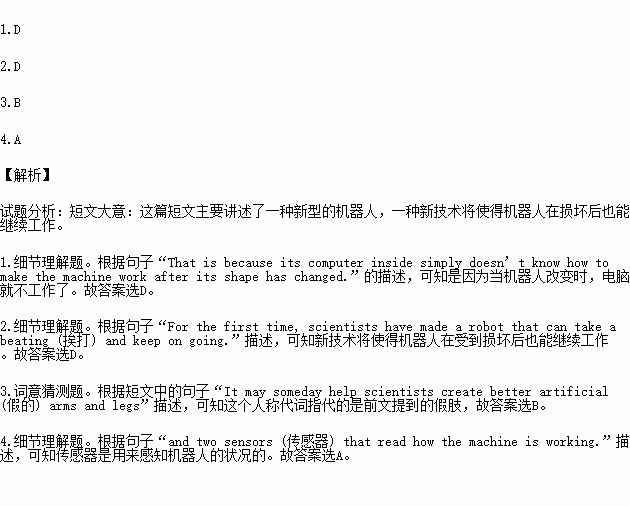
Until now, even the most advanced robot was almost certain to break down when it was broken. That is because its computer inside simply doesn’t know how to make the machine work after its shape has changed.
To deal with this problem, the scientists put eight motors (发动机) and two sensors (传感器) that read how the machine is working. They all give signals (信号) to the machine’s software. Using this information, the computer can then work out the machine’s shape at any moment.
The new technology is a big advance in robot-making, scientists say, and it’s far from scary. It may someday help scientists create better man-made (人造的) arms and legs and give new freedom to people who lose them. It might also help scientists understand how people and animals work out their own sense of place in space.
“It has been difficult to design robots that can work well when the environment changes or when it’s damaged,” says Olaf Sporns of Indiana University in the US. “With this work, we are nearer to solving this problem.”

1.Why do robots easily break down when they are damaged?
A. They have no computers inside.
B. The computer has changed a lot.
C. They cannot repair themselves.
D. The computer cannot work if the robot changes.
2.The new technology allows the robot to .
A. do house work for humans
B. tell people where it is
C. remember a lot of information
D. keep working after being damaged
3.The underlined word “them” in Paragraph 5 refers to .
A. sensors B. arms and legs C. scientists D. robots
4.How do the sensors in the robot work?
A. They help the computer learn the robot’s condition.
B. They can find out where the damage comes from.
C. They can replace (替代) the computer when it’s broken.
D. They can send signals to the person who uses the robot.

 天天向上一本好卷系列答案
 小学生10分钟应用题系列答案
任务型阅读
Teachers say the digital (数字的) age has had a good and a not-so-good influence on the American teenagers. More than 2,000 high school teachers took a survey on the Internet.
75 percent of the teachers said the Internet and digital search tools have had a “mostly good” use for their students' research habits and skills. But 87 percent agreed that these technologies "make the students not have enough attention.” And 64 percent said the technologies “do little to help them in courses.”
Judy Buchanan is a director of the National Writing Project. Ms. Buchanan says digital research tools are helping students learn more, and learn faster. Teachers really like these tools, because they are ways to make some of learning very exciting. Young people enjoy using these tools. And the goal is to help them do creative work, and not just that kind of copyist (模仿者,抄写员).
But one problem is that many students don't have a good understanding of how to use the digital knowledge well. In other words, they trust too much of the information. Judy Buchanan says these students have not developed the skills they need to tell whether the information on the Internet is good or bad.
Another problem is something that might not seem like a problem at all, being able to quickly find information from the Internet. Teachers say the ability of their students to work hard to find answers is becoming weaker. They say students depend too much on search engines and do not make enough use of printed books.
Besides, many teachers are also worried about the problem that the Internet makes it easy for students to copy work done by others, instead of using their own abilities.
The survey on whether digital age 1. American teenagers
Purpose | Students should learn how to use the digital tools in a right way. |
Different opinions | ● Three 2. of the teachers thought the Internet had a mostly good use for students’ research habits and skills. ● 87% of the teachers agreed technologies may 3. students from having enough attention. ● 64% said that the technologies are almost 4. to them in courses. |
Advantages of digital tools | Digital tools help students learn more and learn faster. ● Teachers think learning by using digital tools makes students feel very 5. . ● Young people also think they can finish their work 6. . |
7. | ● Many students have not developed the skills they need to tell whether the 8. information is good or bad. ● Many students 9. too much on search engines and do not make enough use of printed books. ● Internet makes it easy for students to copy 10. work, instead of using their own abilities. |