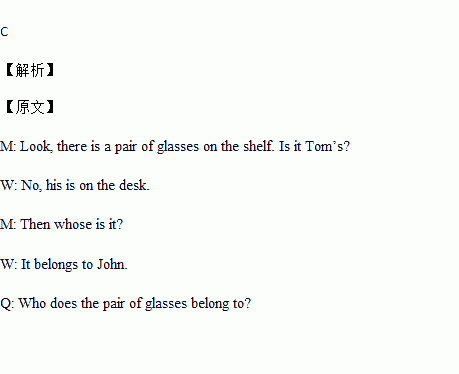
题目内容
A.Tom. B.Jim. C.John. D.Tim.
Take a map of Nanjing with you while traveling _________you have a guide or know the city well.
A.unless B.if C.since D.although
Hello! My name is Tom. I like to go out for a picnic with my parents on Sundays. I like fish and vegetables very much. My father is a driver. He likes meat and fish a little. My mother is an office worker. She likes apples and vegetables very much. But she doesn’t like bread and hamburgers at all. So we usually take some fish, meat, vegetables and apples with us. Then my father gets water. My mother likes to cook for us and she cooks fish, meat and vegetables. I fly a kite. We sing some songs. We are all very happy.
根据短文内容,选择最佳答案。
1.Tom likes to ______ with his parents.
A.go shopping B.go out for a picnic C.go to the zoo D.sing some songs
2.What does Tom’s father do?
A.An office worker. B.A doctor. C.A driver. D.A cook.
3.What does Tom’s mother like eating?
A.Fish and vegetables. B.Meat and fish.
C.Apples and vegetables. D.Bread and hamburgers.
4.Tom’s family take _______ with them.
A.vegetables, fish, meat and apples B.vegetables, fish, meat and bread
C.vegetables, fish, meat and hamburgers D.vegetables, fish, bread and hamburgers
5._______ gets water.
A.Tom B.Tom’s brother C.Tom’s father D.Tom’s mother
_______ tourists visit Hong Kong each year because Hong Kong is a “Shopping Paradise”.
A.Thousands B.Thousands of C.Thousand of D.Thousand
Listen to the passage and complete the sentences(听短文,完成下列内容,每空格限填一词):
1.George doesn’t have _______ _______ buy tickets.
2.One afternoon there would be the biggest football match of the year _______ _______.
3.George would have a _______ _______ so he couldn’t watch the match.
4.His mother was surprised to see _______ _______ in his hand.
写作
话题作文: 临近中考,作为初三学生的你们压力越来越大。学校组织一次以“ How to Deal with the Stress”为题的演讲比赛。请根据下面的思维导图写一篇演讲稿,介绍你缓解压力的方法。
How to Deal with the Stress
a health body , more energy to study, clam down(冷静), others’ help, do more sports, go to bed early, listen to some light music , have a talk with……
提示词: entrance exam入学考试; more or less 或多或少more or less
___________________________________________________________________________________________________________________________________________________________________________________________________________________________________________________________________________________________________________________________________________________________________________________________________________
China is a nation of etiquette(礼仪). Chinese people are____ the most hospitable(好客的) people in the world. If ____ visit a Chinese family. They would be ____ at the warmth that they would receive as guests.
When you visit a Chinese family, the host usually makes tea for you and_____ you snacks like biscuits or candy. Someone in the family will also chat with you, never letting you feel ____. At the same time, other family members will be busy ____ a meal for you. Chinese people treat their guests ____ a big meal. They always present more food than the guests can eat. On the table, the guests must be the_____ to eat. Perhaps one of the things that surprises a(an)_____ guest most is that the Chinese host likes to pick food for guests, which won't happen at western tables. The Chinese family____ to make you feel at home. As you finish eating, the host usually says, “It seems that you didn't eat much. Please have ____."You tell them you are full, ____ they still put more food in your bowl. _____warm and hospitable has been an important part of Chinese culture and tradition. As Confucius(孔子)said____ years ago: To meet friends from a place far away, how ____ we are!
1.A.between B.among C.during
2.A.foreign B.foreigner C.foreigners
3.A.surprised B.surprise C.surprising
4.A.serve B.serving C.serves
5.A.lonely B.alone C.happy
6.A.prepare B.preparing C.prepared
7.A.with B.as C.for
8.A.first B.second C.last
9.A.eastern B.southern C.western
10.A.get in their way B.go out of their way C.lose their way
11.A.more B.less C.many
12.A.although B.but C.because
13.A.Be B.Been C.Being
14.A.thousands of B.thousand C.thousand of
15.A.happily B.unhappy C.happy
— Let’s go to the countryside to have a picnic this weekend.
—________.
A.Have a good time B.Thank you C.Sounds great
Daniel’s parents were worried about him. “He shouldn’t go through life making excuses, and he always says that he forgets something only because he is so busy all the time.” His father said. “No one will trust him to do anything. He won’t be able to keep a job. No smart girl will marry him.”
“I don’t know what we can do.” His mother said.
“I have an idea,” his father said, “If this doesn’t work, nothing will.”
The next day was Daniel’s birthday. He was really looking forward to getting exciting presents. He woke up, expecting his parents to wish him a happy birthday. But all day what they said was “Good morning, Daniel. Hurry or you will be late for school”. There were no presents, not even a card. He was really disappointed.
“Never mind,” he thought, “There will be a surprise for me after school.” But there wasn’t.
Sadly, he said to his parents at dinner, “Today’s my birthday.”
“Oh,” his father said. “So it is. I forgot.”
“So did I.” his mother said.
“How could you forget?” Daniel asked. “There must be a reason.”
“Well, yes.” his father said, “We have a really good excuse for forgetting your birthday, Daniel. We didn’t remember your birthday because we were too busy.”
Poor Daniel! He never had a silly excuse for not doing something again, because every time he showed excuses, he thought he was so clever that everyone could believe in him. But this time, his parents taught him a good lesson.
1.Daniel always made excuses, because he doesn’t have a good memory.
2.Daniel’s parents were worried about him because they knew he would meet a lot of difficulties in future unless he corrected his mistakes.
3.Daniel’s parents didn’t buy him anything for his birthday because they were really very busy.
4.Daniel’s parents gave him a surprise after school on his birthday.
5.From the story, we know that people don’t like anyone who always makes excuses.

 名师伴你成长课时同步学练测系列答案名师伴你成长课时同步学练测系列答案