题目内容

Farley worked for the Canadian government. One day, he was __1__ to learn more about wolves. Do wolves kill lots of caribou(北美驯鹿)? Do they kill people?
  They gave him lots of food and clothes and guns. Then they put him on a plane and took him to __2__. The plane put him down and went away. There were no houses or people in this place. But there were lots of animals and lots of wolves.
  People tell terrible stories about wolves. They say wolves like to kill and eat people. Farley remembered these stories, and he was __3__. He had his gun with him__4_.
  Then one day, he saw a group of wolves. There was a mother wolf with four baby wolves. A father wolf and another young wolf lived with them.
  Farley watched these wolves every day. The mother was a very __5__ mother. She gave milk to her babies. She gave them lessons about life. They learned how to __6__ food. The father wolf got food for the mother. The young wolf __7__ the children. They were a nice, happy family—wolf family! Farley did not need his __8__ any more. In a short time, he got on well with the family. Farley watched them for five months. He learned that many stories about the wolves were __9__. Wolves do not eat people, and they do not eat many large animals. And he also learned bad things about men. It was men who killed many caribou and wolves.
  Later, Farley wrote a book about wolves. He wanted people to __10__ them and not to kill them.

  1. A. seen          B. told           C. heard              D. found
  2. A. a small town  B. a big city     C. a far place        D. a lonely village
  3. A. afraid        B. happy          C. angry              D. tired
  4. A. at times      B. all the time   C. once a week       D. every afternoon
  5. A. bad           B. good           C. hungry             D. thirsty
  6. A. cook          B. make           C. get                D. pick
  7. A. shouted at    B. looked into    C. laughed at         D. played with
  8. A. food          B. clothes        C. gun                D. plane
  9. A. not good      B. not true       C. not easy           D. not clear
  10. A. grow         B. have           C. teach              D. understand

 1.B。Farley是政府工作人员。从上下文得知, 他是被派去进行调查和研究狼的习性的,故选told。
2.C。根据下文飞机把Farley送到了一个没有房屋和人的地方, 说明了这个地方不可能是城市,小镇和村庄故a far place为正确答案。
 3.A。狼吃人的恐怖故事给孤身一人的Farley带来的应是afraid。
 4.B。因为Farley害怕, 所以枪应始终不能离身。all the time意为“一直、始终”。
 5.B。根据下文的描述,狼妈妈给孩子们喂奶,对孩子们进行训练,可见是一位好妈妈,故选good。
 6.C。狼只能猎取食物, 而不能烧食物, 生产食物。get合乎文意,为正确答案。
 7.D。shout at意为“朝……大声叫喊”;look into意为“调查、观察”;laugh at意为“嘲笑……”。这三个词组都不符文意。play with意为“和……一起玩耍”,合文意为正确答案。
 8.C。the nice happy wolf family让Farley不再害怕,因此也就不再需要枪了,故选择gun.。
 9.B。因为他的亲身体验与他所听到的相违背,说明以前关于狼的说法是不对的, 故选not true。
 10. D。understand意为“了解”合乎文意,为正确答案。

练习册系列答案
相关题目

Someone says, “Time is money.” But I think time is __1__ important than money. Why? Because when money is spent, we can get it back. However, when time is   2   it’ll never   3  . That’s   4   we mustn’t waste time.
  It goes without saying that the   5   is usually limited. Even a second is very important. We should make full use of our time to do   6__    useful.
  But it is a pity that there are a lot of people who do not know the importance of time. They spent their limited time smoking, drinking and   __7  . They do not know that wasting time means wasting part of their own __8  .
  In a word, we should save time. We shouldn’t   9   today’s work for tomorrow. Remember we have no time to   10  .

  1. A. much       B. less            C. much less          D. even more
  2. A. cost       B. bought          C. gone               D. finished
  3. A. return     B. carry           C. take               D. bring
  4. A. what       B. that            C. because            D. why
  5. A. money      B. time            C. day                D. food
  6. A. nothing    B. something       C. anything           D. everything
  7. A. reading    B. writing         C. playing            D. working
  8. A. time       B. food            C. money              D. life
  9. A. stop       B. leave           C. let                D. give
  10. A. lose      B. save            C. spend              D. take

Mrs. Ball had a son. His name was Mick. She __1__ him very much and as he was not a __2 __ child, she was always __3__ that he might be ill, __4__ she used to take him to see the best __5__ in the town four times a year to be looked __6__.
  During one of these __7__, the doctor gave Mick all kinds of tests and then said to him, “Have you had any __8__ with your nose or ears recently?” Mick __9__ for a second and then answered, “Yes, I __10__.”
  Mrs. Ball was very __11__. “But I’m sure you have __12__ told me that, Mick!” She said worriedly. “Oh, really?” Said the doctor __13__. “And what trouble have you with your nose and ears, my boy?” “Well,” answered Mick, “I always have trouble with them when I’m __14__ my sweater off, because the __15__ is very tight.”

  1. A. loved            B. hated         C. missed              D. cared
  2. A. rich               B. clever        C. strong               D. happy
  3. A. afraid            B. surprised    C. glad                  D. sure
  4. A. which            B. for             C. but                   D. so
  5. A. player           B. teacher       C. doctor               D. lawyer
  6. A. round            B. over           C. for                    D. after
  7. A. talks                     B. years          C. visits                 D. stays
  8. A. answer          B. thing          C. word                 D. trouble
  9. A. waited           B. thought      C. stood                D. looked
  10. A. did                     B. will           C. have                 D. do
  11. A. excited         B. interested   C. pleased              D. surprised
  12. A. already        B. just            C. never                D. always
  13. A. angrily        B. seriously    C. happily             D. carefully
  14. A. turning        B. taking        C. keeping             D. putting
  15. A. collar          B. nose           C. mouth               D. ear


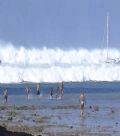
On Sunday morning, a strong earthquake hit Indonesia and then big tsunamis(海啸) followed. They soon went on to other countries in the south and southeast Asia as well as East Africa.
Tsunamis are especially dangerous for children. By Wednesday,  nearly 60 000 people died because of the tsunamis. 30% of them were children,  and most of them were 5 to 12 years old.
In open seas tsunamis are only one or two metres high. When they are near land, they are as high as 10 metres,  Houses and cars near the sea can be taken away by these big waves. Because tsunamis move fast and can travel to another side of the sea within one day, they may affect(影响)a lot of places.
The Pacific Ocean(太平洋)has a lot of strong tsunamis because of the size of the ocean and large earthquakes there. China doesn\'t see tsunamis often because its sea floor is quite flat(平的). Islands around China also help the country avoid from them.
What should you do when there\'s a tsunamis? Move to a safe place. If you are near the sea and you feel the earth shake, move to higher ground. Stay away from rivers and streams(溪流).
Reported by "China Daily" on Friday, December 31st, 2004.

1. The big Asian tsunamis first happened________.

A. on Friday morning               B. on the morning of December 26th
C. on December 31st, 2004          D. three days ago

2. Which places did the big tsunamis hit?
A. All the coastal(海岸的) countries.
B. Only in Indonesia and Sri Lanka.
C. South and southeast Asia as well as East Africa.
D. Vietnam(越南)and India.

3. Why does the Pacific Ocean have a lot of strong tsunamis?
A,  Because there are few islands in the ocean.
B,  Because of the strong wind on the sea.
C,  Because there are many Asian countries around the Pacific Ocean.
D. Because of the large earthquakes and the size of ocean.

4. Which of the following is wrong?
A. In open seas tsunamis are one or two metres high.
B. Tsunamis can\'t travel to another side of the sea within 24 hours.
C. Most of the children who died in tsunamis were under 5-12 years old.
D. China\'s sea floor is quite flat and tsunamis seldom happen.

5. You should________ when there\'s a tsunamis according to the passage.
A. listen to a weather report
B. try to find out what will happen
C. run to the policeman for help
D. get to a higher and safer place as soon as possible

违法和不良信息举报电话:027-86699610 举报邮箱:58377363@163.com

精英家教网