题目内容

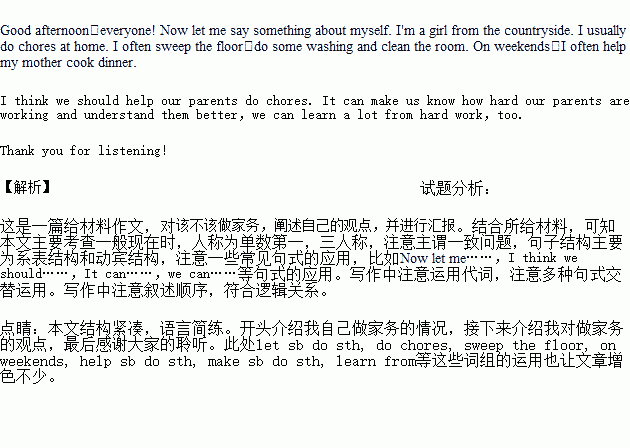
假设你班要举行一次有关“该不该做家务”的讨论会,请你写一篇短文,阐述自己的观点,并向全班做一个汇报。

要求:语句通顺,意思连贯,字迹清晰。词数约80。

提示:1.Do you often do chores?

2.What chores do you often do?

3.What do you think about doing chores?

______________________________________________________________________________________________________________________________________________________________________________________________________________________________________________________________________________________________________________________________________________________________________________________________________
练习册系列答案
相关题目

I love it at night. It’s peaceful. And when it cools down I sometimes do some ironing(烫衣服). I don’t really care for it. I work full-time and I am too busy for most housework. I remember the old woman who taught me to iron. I was about 15 and I had to get a job taking care of a woman to make a living. She had been an able-bodied, healthy woman until the accident that caused her to be paralyzed.

The woman sat in an electric wheelchair all day. She could only move her head and arms. She would tell me how to do things. She would teach me in great detail on the correct ways to do things. Her home was perfect and beautiful. She would follow me around in her wheelchair to make sure I did everything exactly right . I’m sure she had been a perfect homemaker. She would have me fold everything, including socks. I would complain silently and wish terrible things on her. She taught me the right way to make the bed. I know sometimes she’d get frustrated(沮丧的)and impatient with me. I knew she wanted to do it herself. But she never shouted or scolded(责骂). She only insisted I do it right. I didn’t like it much, but I did it.

Today I can iron pretty well. I know where to start on a shirt and the right way to do the trousers. Now when I think about it, I don’t think she is an old lady. I think she might have been about my age now. Anyway, when I iron, I think of her and silently thank her for all the things I learned.

1.The writer used to take care of the lady because______________.

A. she wanted to learn to do housework.

B. she was a friend of the lady’s.

C. she had to earn some money.

D. she couldn’t find a room to live in.

2.The underlined word “paralyzed” in the first paragraph may mean “___________”

A. destroyed B. deaf C. seriously ill D. unable to walk

3.Why did the woman follow the writer around in her electric wheelchair?

A. Because she felt lonely.

B. Because she wanted to help the writer with some housework.

C. Because she was worried if the writer could do things well.

D. Because she wanted the writer to be a perfect homemaker.

4.The little girl was _________ when the lady taught her how to do housework.

A. encouraged to learn B. unwilling to learn

C. delighted to learn D. recommended (推荐)to learn

5.What do we learn from the passage?

A. The writer is still afraid of the lady. B. The writer hates the strict lady.

C. The writer admires the disabled lady. D. The writer is very grateful for the lady.

An old woman is going shopping with a basket(篮子). She is going by boat. The boat is going across (穿过) the river. Her basket is empty now. Oh dear! Look! Her basket is in the water. “Help! My basket is in the river!” the woman says.

A boy sees the basket. He says, “Don't worry! I can swim. I can get it for you!” He takes off (脱下) his shirt and shoes.“Look after them for me, please!” he says, and gets into the river.

A duck(鸭子) sees the basket. It says ,“I can go by boat.” It thinks the basket is a boat. It gets into the basket.

The boy is swimming in the river. “Where's the basket?” he asks. “It's over there!” says the woman. “It's under that duck!” The boy gets to the basket. “Go away!” he says to the duck. The duck comes out of the basket and swims away.

The boy takes the basket back to the woman. “Oh, thank you very much,” says the woman. “Not at all!” says the boy. “Do you have my shirt and shoes, please?” “Yes, here you are. Oh! What's this in the basket?” “It's the duck's egg!”

1.What's the old woman going to do?

A. She's going shopping.

B. She's going swimming.

C. She's going home.

D. She's going to school.

2.What's the meaning of the underlined (画线的) word “empty”?

A. 大的 B. 长的 C. 空的 D. 满的

3.Can the boy swim?

A. No, he can't. B. Yes, he can.

C. Yes, he does. D. No, he doesn't.

4.A ________ gets into the basket.

A. dog B. cat C. panda D. duck

5.What's in the basket after the boy gives the basket back to the old woman?

A. The duck's egg. B. The boy's clothes.

C. The boy's shirt. D. The boy's shoes.

违法和不良信息举报电话:027-86699610 举报邮箱:58377363@163.com

精英家教网