题目内容
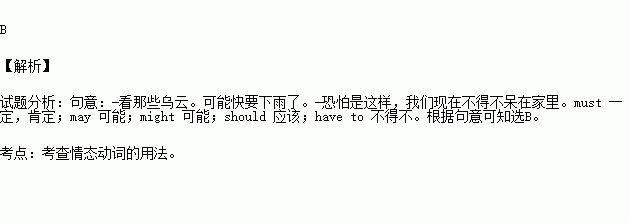
―Look at the dark clouds. It _____ rain soon.
―I’m afraid so, and we _______ stay at home now.
A. must, must B. may, have to
C. might, must D. should, have to

 名校课堂系列答案
—Your tea smells great! —It's from India. Would you like ___________?
A. it B. this C. some D. little
The Exploration of Antarctica(南极洲) | |
1773 | James Cook crossed the Antarctic Circle, but he didn’t see land. |
1898 | Adrien de Gerlache and his members were trapped in the Antarctic. They became the first to spend an Antarctic winter. |
1911 | Norwegian Roald Amundsen led a five-man expedition that reached the South Pole for the first time. |
1929 | Richard E.Byrd and three others from the US became the first to fly over the South Pole |
1935 | Caroline Mikkelsen from Norway became the first woman to arrive in Antarctica with her husband. |
1947 | The US sent the largest ever expedition of over 4,700 men, 13 ships and 23 airplanes to Antarctica. They took many photos to make a map. |
1957-1958 | 12 countries built over 60 space stations in Antarctica. It became the beginning of international work in Antarctica. |
1997 | Boerge Ousland from Norway became the first person to cross Antarctica unsupported. |
March 2007- March 2009 | International Polar Year-Researchers got the opportunity to work in both polar places or work in summer and winter. |
1. _______ is from the United States of America.
A. Boerge Ousland B. Richard E. Byrd
C. Roald Amundsen D. James Cook
2.The underlined word “opportunity” means “______”.
A. chance B. advice C. guide D. plan
3. ______ is the first woman to get to Antarctica.
A. Roald Amundsen B. Boerge Ousland
C. Caroline Mikkelsen D. Adrien de Gerlache
4.Which is WRONG according to the passage?
A. There were more than 60 space stations in Antarctica in the 1950s
B. Roald Amundsen was the first to fly over the South Pole.
C. Americans took many photos in the Antarctic to make a map.
D. Adrien de Gerlache was the first to spend an Antarctic winter.
5.The main idea of the passage is _____.
A. how to get to the Antarctic
B. the way of the exploration of Antarctica
C. the people who got to the Antarctic
D. the history of the exploration of Antarctica
1. But I could never understand her habit of cheering while we were walking in the race.
We walked together all over the town and entered half-marathons(半马拉松), 26 miles. 2.
I carried it to the starting line along. It had twenty-six cheering ideas, one for each mile. But I wasn’t really planning to slow myself down with all those ideas. I had to keep her list because I didn’t want to hurt Tina’s feelings.
3. I looked at Tina’s cheering list when I checked my watch. At the top of the list was only one word: “Yourself.” I thought it did give me a good start to the race. While I was at it, I took the chance to thank her for the strength the list brought to me. By the time I finished the second mile, my parents were cheering me on by the side of the road. It just so happened that “family” was the next on Tina’s cheering list. At that moment, I had plenty of things to be thankful for.
4. But by the time I was close to the final mile, I was nearly out of breath. I didn’t know if I could make it another mile. Then I looked at the final idea on Tina’s list in my hand: “You can make it.”
5. I had thought the cheering list would slow me down. Instead it carried me to cross the finishing line.
A. She gave me a cheering list to “talk” to me. B. I finished the marathon in less than six hours. C. Tina was the best speed-walker in our school. D. I walked the first mile of the race in 12 minutes. E. The next mile flew by, then the next and the next, each with a cheering idea. |