题目内容
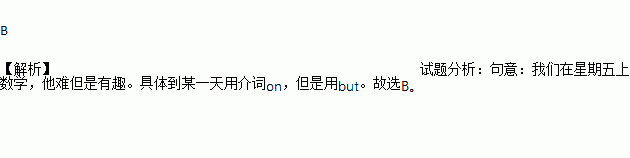
We have math Friday .It’s difficult interesting .
A. on ; and B. on ; but C. in; but D. in; and
– It’s eight o’clock now. Shall we leave for the shopping mall?
– It’s rush hour now. Let’s wait till nine o’clock. There will be _______ traffic then.
A. lots of B. more C. fewer D. less
Cindy, _______ is my sister Jenny. Jenny, this is my friend Cindy.
A. he B. this C. that D. she
翻译下列短语。
1.好莱坞一向最棒的女演员之一
_________________________________
2.因为失去…而感到难过
3.梦想成为一个成功的芭蕾舞演员
4.吸引某人的注意
5.一部以他的小说为基础的剧本
_______________________________
Bob and Linda’s favorite subject geography.
A. be B. is C. are D. am
In the eyes of many Westerners, Chinese are the best hosts (主人) but the worst guests in the world. This is probably because the guest-host relationship in China is much different from that in some Western countries.
In China, guests are almost like gods. Whenever I enter a Chinese person’s home, there is always fruit on the table for me, and someone is quick to bring me a cup of tea or water. In the West, things are different. Acting according to the host’s way of doing things is usual behavior for a guest.
And there are lots of things Westerners find difficult to adapt to. For example, my mother-in-law doesn’t smoke. So when I see some of her guests smoking in her house. As a non-smoker, I feel unhappy. Usually I want to stop them directly. But I must realize that, to be a good host in China, she mustn’t do that. However, in most North American homes, you should not smoke in the same case. You could ask, “Is it OK if I smoke?” But don’t be surprised if you get a “no”. In our culture, it’s not considered rude at all.
In China, you probably won’t need to change the guest-host relationship very much because you will probably only be the host, and Chinese are naturally very good hosts. But if western hosts invite you to their house, try not to be too surprised if their style of treating you is not what you have expected.
1.Many Westerners think Chinese are the worst guests because ________.
A. Chinese act like gods in their home B. they don’t expect gifts from Chinese
C. there are cultural differences D. Chinese are heavy smokers
2.When a Western guest visits a Chinese family, he often ________ .
A. buys some fruit B. feels like a god
C. wants some gifts D. takes a cup of tea
3.If the writer’s guests want to smoke in his house, he will probably say “________”
A. It’s OK. Go ahead. B. Would you like a cigarette (香烟)?
C. Smoking is a bad habit. D. Sorry, please don’t smoke here.
4.In the passage, the underlined phrase “adapt to” probably means “________”.
A. think back to B. get used to
C. look forward to D. keep close to
5.When it comes to the guest-host relationship, the writer thinks ________.
A. foreigners should learn from Chinese
B. hosts must do things in the guests’ way
C. Western hosts are always nice to guests
D. people should understand cultural differences
— The police advise us not to transfer money to a stranger without telling our family.
— ________ important advice they gave us!
A. How B. What C. What a D. What an
从方框中选择最佳选项补全对话
A: Hi, Jim. You look worried. 1.
B: An earthquake happened in my home town. I’m worrying about my grandparents.
A: 2. Was it serious?
B: No, my grandparents are OK but their house fell down.
A: What about other people there?
B: Many people lost their houses and they had no places to live. Let’s do something to help them.
A: 3.
B: Let’s raise some money for them.
A: 4. We are still students and we don’t have money.
B: How about selling newspapers after school?
A: Good idea. 5.
B: Not too much. We can search for something about it on the Internet.
A: OK, let’s begin.
A. What can we do to help them?
B. By the way, do you know about what to do during an earthquake?
C. Sorry to hear that.
D. What’s wrong with you?
E. But how can we do that?
There are two bananas , some yogurt and ice cream . Please them a milk shake .
A. turn ; down B. turn ; into C. turn ; up D. turn ; off