题目内容
In Western countries, bread is one of the most important foods. When they get up in the morning many people eat toast(烤面包). They spread butter and jam on their toast. People eat bread at other times of the day too. For example, at main meals, they often eat bread with soup.
It's also very common to eat sandwiches. A sandwich is two pieces of bread with a filling inside salad, cheese or fish. A hamburger is a kind of sandwich.
There are many different kinds of bread. Some are special to some countries. For example, the baguette(法国棍子面包) is a long, thin loaf that began in France.
There is also white bread and whole-wheat(全麦面) bread. What's the difference? White bread is refined(精制的). It has things taken out of it to make it softer and easier to eat. The trouble is, white bread also has lots of goodness taken out. Although some people dislike the taste of whole-wheat bread, it is much healthier.
Some kinds of bread have additives(添加剂). They are put into the bread for many reasons. Some additives are good for you, for example, vitamin C. Others are there to make the bread last longer. Still others to make it taste better-but they do not necessarily make the bread healthier to eat!
( )34. People in the west have as their main food.
A. butter B.bread C. cheese D. fish
( )35. The fourth paragraph tells us .
A. how to make white bread
B. how to make whole-wheat bread
C. the difference between white bread and whole-wheat bread
D. people dislike the taste of whole-wheat bread
( )36. Which of the statements about additives is WRONG?
A. Not all the additives are good for our health.
B. Vitamin C makes the bread last longer.
C. Some additives are put into bread to make bread healthier.
D. To make bread taste better, some additives can be put into bread.
BCB

 天天向上一本好卷系列答案
 小学生10分钟应用题系列答案
In the 13th century, the famous Indian traveller, Marco Polo, travelled a long way to China. He saw many wonderful things. One of the things he discovered was that Chinese used paper money. In western countries, people did not use paper money until the 15th century. However, people in China began to use paper money in the 7th century.
A Chinese man called Cai Lun invented paper almost 2,000 years ago. He made it from wood. He took the wood from trees and made it into paper. He then put these pieces of paper together and made them into a book.
Now paper still comes from trees. We use a lot of paper every day. If we keep on wasting so much paper, there will not be any trees left on the earth. If there are no trees, there will be no paper. Every day, people throw away about 2,800 tons of paper in our city. It takes 17 trees to make one ton of paper. This means that we are cutting nearly 48,000 trees every day. Since it takes more than 10 years for a tree to grow, we must start using less paper now. If we don’t, we will not have enough time to grow more trees to take the place of those we use for paper.
So how can we save paper? We can use both sides of every piece of paper, especially when we are making notes. We can also use cotton handkerchiefs(手帕) and paper ones. When we go shopping, we can use fewer paper bags. If the shop assistant does give us a paper bag, we can save it and refuse (拒绝) it later.
Everyone can help to save paper. If we all think carefully, we can help protect trees. But we should do it now, before it is too late.
【小题1】When he was in China, Marco Polo __________ .
| A.discovered Cai Lun invented paper | B.learned to make paper |
| C.saw many wonderful things | D.read a lot of books |
| A.17th | B.15th | C.13th | D.7th |
| A.1,700 | B.2,000 | C.2,800 | D.48,000 |
| A.To use both sides of every piece of paper. |
| B.To use the paper bags from shops more than once. |
| C.To use cotton handkerchiefs and paper ones. |
| D.All of the above. |
| A.Saving paper. | B.The history of paper. |
| C.Cotton handkerchiefs back again. | D.Cai Lun, the great inventor. |
(A)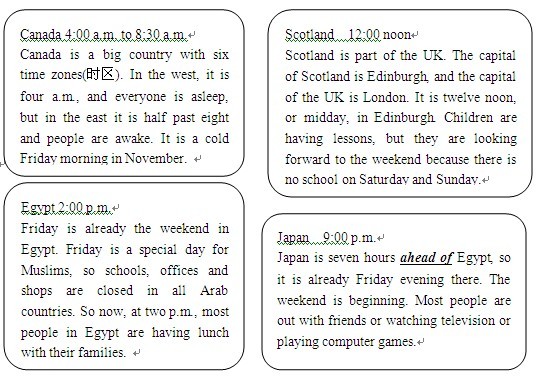
【小题1】If it is 8:00 a.m. in western Canada, the time is _______ in eastern Canada.
| A.12:00 | B.2:00 p.m. | C.12:30 p.m. | D.4:00 a.m. |
| A.having lessons | B.sleeping | C.watching TV | D.playing games |
| A.Canadians. | B.Scots. | C.Japanese. | D.Egyptians. |
| A.UK | B.Japan | C.Egypt | D.Canada |
| A.earlier than | B.later than | C.after | D.until |