题目内容
The map shows us ________ get to the park.
- A.how
- B.how can we
- C.how we can
- D.how can
宾语从句用陈述句语序。

In Chicago, a computerized system has been developed that controls(管理)traffic on the city’s 235 miles of seven expressways. Now one—a controller—can follow the movement of Chicago’s traffic by looking at a set of lights. The system uses electric sensors(感应器) that are built into each expressway, every half a mile. Several times a second, the computer receives information from each sensor and translates it into green, yellow or red lights on a map in the control room. A green light means traffic is moving forty-five miles an hour, yellow means thirty to forty-five miles an hour, and red means heavy traffic—cars standing still or moving less than thirty miles an hour.
“See that red light near Austin Avenue?”the controller asked a visitor.“That’s a repair truck fixing the road, and the traffic has to go around it.”At the Roosevelt Road entrance to the expressway, the light kept changing from green to red and back to green again.“A lot of trucks get on the expressway there,”the controller explained.“They can’t speed up as fast as cars.”The sensors show immediately where an accident or a stopped car is blocking the tr affic, and a truck is sent by radio to clear the road. The system has lowered the number of accidents by 18 percent. There are now 1.4 deaths on Chicago’s expressway for each one hundred million miles traveled, while in other parts of the county there are 2.6.
Traffic experts say that the Chicago system is the “coming thing”.Systems like Chicago’s are already in use on some expressways in Los Angeles and Houston.“Chicago has taken the lead,”said New York City’s traffic director and he added,“Chicago’s a good example.”
根据短文内容,选择最佳答案,并在答题卡上按要求作答。
【小题1】The passage is mainly about ________ on expressways in Chicago.
| A.the traffic control system | B.the movement of the traffic |
| C.the electric sensors | D.the traffic lights |
| A.the red light appears | B.the red light turns yellow |
| C.the yellow light appears | D.the green light turns red |
| A.some visitors are traveling on the expressway |
| B.there is no heavy traffic on Chicago’s expressways |
| C.the traffic on Chicago’s expressways is well managed |
| D.the number of accidents in the US has dropped by 18% |
| A.the red light | B.the truck that needs repairing |
| C.the traffic | D.the truck that is fixing the road |
| A.giving reasons and results | B.giving examples and explaining them |
| C.describing what he thinks | D.asking and answering questions |
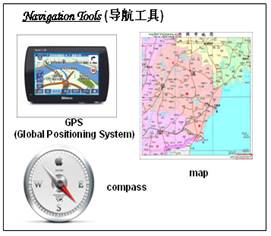
One of my favourite things to do is hiking in mountains. Because nobody likes the idea of getting lost, I always prepare before every trip. But what’s the best navigation tool, a Global Positioning System (GPS) or a good old map and compass? Five of my friends and I hiked through the mountains on a trail I marked. One team of three carried a GPS, and the other team used a map and compass.
It took the GPS team 3 hours and 11 minutes to get through the whole hike, however, it took the map and compass team only 2 hours and 49 minutes. The biggest problem the GPS team met was that they lost the satellite signal (卫星信号) in some places. With no map or compass, they had to walk around until they were in a place where the signal was good. The map and compass team was able to spot (认出) different landmarks, compare them to their maps and then use the compass to point them in the right direction.
When I head out on my future hikes, I’m bringing a map, a compass and a GPS to show me the way.
【小题1】The writer prepares before every trip because he doesn’t _________.
| A.like the old map or compass |
| B.know how to use the GPS |
| C.want to get lost in mountains |
| D.want to get into the mountains alone |
| A.had the same navigation tool |
| B.went along the same trail |
| C.had the same problem |
| D.finished the whole hike at the same time |
| A.the map and the compass were too old navigation tools to use any more |
| B.it wasn’t necessary to bring a map and a compass together with a GPS |
| C.the GPS had some bad points in hiking in mountains |
| D.he wouldn’t use a GPS any more |