ÌâÄ¿ÄÚÈÝ

It took me almost a whole day to _____ so many emails.

A. deal with B. cut in C. cheer for D. run out

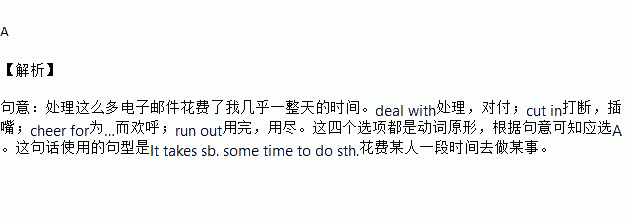
A ¡¾½âÎö¡¿ ¾äÒ⣺´¦ÀíÕâô¶àµç×ÓÓʼþ»¨·ÑÁËÎÒ¼¸ºõÒ»ÕûÌìµÄʱ¼ä¡£deal with´¦Àí£¬¶Ô¸¶£»cut in´ò¶Ï£¬²å×죻cheer forΪ¡­¶ø»¶ºô£»run outÓÃÍ꣬Óþ¡¡£ÕâËĸöÑ¡Ïî¶¼ÊǶ¯´ÊÔ­ÐΣ¬¸ù¾Ý¾äÒâ¿É֪ӦѡA¡£Õâ¾ä»°Ê¹ÓõľäÐÍÊÇIt takes sb. some time to do sth.»¨·ÑijÈËÒ»¶Îʱ¼äÈ¥×öijÊ¡£
Á·Ï°²áϵÁдð°¸
Ïà¹ØÌâÄ¿

Song of the Parting Son (ÓÎ×ÓÒ÷)

The thread in mother¡¯s hand -

A gown for parting son,

Sewn stitch by stitch, alas!

For fear his return be delayed.

Such kindness of warm sun

Can¡¯t be repaid by grass.

Song of the Parting Son may be the most popular Chinese poem about a mother¡¯s love. It describes a common matter in daily life ¡ª a mother making clothes for her son. Nearly every mother has sewn (·ì²¹) something for their child and many sons and daughters are familiar with this. For this reason, this short poem has touched many people¡¯s hearts.

In the last two lines, the poet uses a pair of metaphors (±ÈÓ÷). Meng compares the mother to the warm sun and the child to grass. This shows how great a mother¡¯s love can be and what little a child can do to repay his or her mother.

Poet Meng Jiao (751-814) lived in poverty (ƶÀ§) all his life. He didn¡¯t become a low-level official until he was in his 50s. Only a few years later, he resigned (´ÇÈ¥) from his official post because of the death of his mother. Meng was famous as a kuyin poet (¿àÒ÷Ê«ÈË)£®He took his poetry very seriously, spending a great deal of time considering each word.

ÔĶÁÒÔÉÏÐÅÏ¢£¬ÓÃÇ¡µ±µÄµ¥´ÊÍê³ÉÏÂÃæµÄ¶ÌÎÄ£¬Ã¿¿ÕÒ»´Ê¡£

Song of the Parting Son is one of the most popular Chinese 1. about a mother¡¯s love. It is very common that a mother sews clothes for her children in daily life. But just 2. of this, many people are moved by this short poem. It shows that a mother¡¯s love is great, but a child can do little for his or her mother in return. In fact, the poet, Meng Jiao lived a 3. life during his lifetime. He resigned from his official post because his mother 4.. He was a famous and diligent poet. He took every poem seriously and it 5. him much time to consider each word.

1.poems 2.because 3.poor 4.died 5.took ¡¾½âÎö¡¿ÊÔÌâ¶ÌÎĽéÉÜÁ˱í´ïĸ°®µÄ¶ÌÊ«¡¶ÓÎ×ÓÒ÷¡·ºÍÊ«×÷ÕßÃϽ¼µÄ¼òµ¥Éúƽ¡£ 1.¾äÒ⣺¡¶ÓÎ×ÓÒ÷¡·ÊÇÖйú×îÊÜ»¶Ó­µÄĸ°®Ê«¸èÖ®Ò»¡£¿¼²éϸ½ÚÀí½âÌâ¡£¸ù¾ÝSong of the Parting Son may be the most popular Chinese poem about a mot...

Once upon a time there was a white elephant and he lived with his old mother. The white elephant was good and kind. He ______ his mother all the time. To get enough food, he took his ______ to live near a lake.

One day, a ______ got lost and the white elephant helped him to find his way home. The man heard that the king was ______ a new elephant, so the man told the king about the white elephant¡¯s kindness.

The king ______ his soldiers (Ê¿±ø) to get the white elephant. The white elephant had to ______ them and leave his mother on her own. The king treated (¶Ô´ý) the white elephant very well, but the white elephant was ______ about leaving his mother.

The king let the kind-hearted white elephant ______ to his mother. The white elephant ______ left his mother again. When the white elephant died, the king set up a festival to ______ the white elephant¡¯s kindness.

1.A. hit B. asked C. helped D. painted

2.A. brother B. classmate C. friend D. mother

3.A. man B. king C. child D. woman

4.A. looking at B. looking for C. lifting up D. warming up

5.A. made B. brought C. asked D. gave

6.A. follow B. answer C. know D. care

7.A. happy B. excited C. careful D. sad

8.A. walk B. return C. take D. fly

9.A. sometimes B. never C. often D. usually

10.A. close B. see C. forget D. remember

1.C 2.D 3.A 4.B 5.C 6.A 7.D 8.B 9.B 10.D ¡¾½âÎö¡¿±¾ÎĽ²ÊöÁ˰×ÏóµÄ¹ÊÊ¡£°×ÏóºÍËûµÄĸÇ×סÔÚÒ»Æð£¬Ôø¾­¹úÍõÈÃÊ¿±ø°Ñ°×Ïó´ø×ߣ¬À뿪ËûµÄĸÇס£ËäÈ»¹úÍõ¶Ô°×ÏóºÜºÃ£¬µ«ÊÇËûÒòΪÀ뿪ĸÇ×£¬·Ç³£±¯ÉË¡£×îºó£¬¹úÍõÈð×Ï󻨵½ËûĸÇ×Éí±ß¡£ÕâÑù°×ÏóÔÙҲûÓÐÀ뿪ËûµÄĸÇס£ 1.C ¿¼²é¶¯´Ê¼°Óï¾³µÄÀí½â¡£A. h...

Î¥·¨ºÍ²»Á¼ÐÅÏ¢¾Ù±¨µç»°£º027-86699610 ¾Ù±¨ÓÊÏ䣺58377363@163.com

¾«Ó¢¼Ò½ÌÍø