题目内容

What should we do if a fire happens? Look at the following.

1. Shout——Shout as loudly as you can ,because people may be asleep.

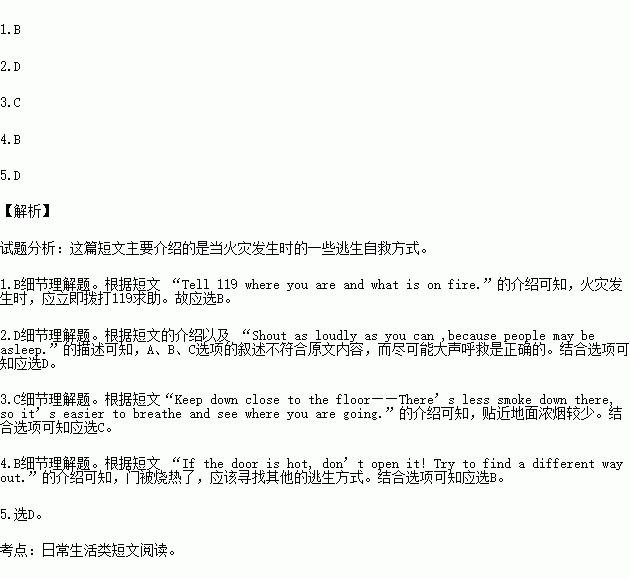
2. Call 119——Never try to put out a fire yourself. Tell 119 where you are and what is on fire.

3. Keep down close to the floor——There’s less smoke down there, so it’s easier to breathe and see where you are going.

4. Test the door—— the door is cool, open it carefully. If the door is hot, don’t open it! Try to find a different way out.

5. Get out—— not stop to pick up anything. A fire can become very big in afew seconds!

6. Don’t use the lift(电梯)——ways use the stairs. The lift may go wrong and keep you inside.

7. Don’t go back—— if you have left your pet or favorite toy inside, don’t go back for it.

Animals have a very good sense of smell. They often get out of building before people.

1.According to the passage, when something is on fire, you must _____ at once.

A. look for your pet B. telephone 119

C. call 120 D. put out the fire yourself

2.The passage tells us that we can _________ in a fire.

A. use the lift

B. try to put out a fire ourselves

C. open the hot door and go out

D. shout as loudly as possible

3.You should keep down close to the floor because __________.

A. people may be asleep

B. the firemen can find you easily

C. there is less smoke down there

D. you should look after your things carefully

4.If the door is hot, we should ________.

A. open it and get out

B. find another way out

C. stop to pick up something

D. go back for something

5.The lift is dangerous in a fire because __________.

A. it is too small B. it may go wrong

C. it may keep you inside D. both B an C
练习册系列答案
相关题目

According to an official report on youth violence(暴力), “The greatest danger to the lives of children is not disease or food shortage, but violence”. Why aren’t students taught to manage conflict(冲突)the way they are taught to solve math problems, drive cars, or stay physically fit?

First of all, students need to realize that conflict is unavoidable. A report on violence among middle school students shows that most violence between students begin with small things. For example, a fight could start over the fact that one student eats a peanut butter sandwich each lunchtime. Laughter over the sandwich can then lead to a fight. The problem isn’t in the sandwich, but in the way students deal with the conflict.

Once students realize that conflict is unavoidable, they can practice the golden rule of staying calm(平静的). Once the student feels calmer, he or she should choose words that will calm the other person down as well. Rude words only make things worse. On the other hand, soft words can put out the fire before it is out of control.

After both sides have calmed down, they can use another key way to help: listening. Listening allows the two sides to understand each other. One person should describe his or her side, and the other person should listen without getting in a word. Afterwards, the listener can ask some questions to make the speaker’s position clear. Then the two people should change roles.

Finally, students need to consider what they are hearing. This doesn’t mean trying to work out what’s wrong with the other person. It means understanding what both sides are trying to deal with. For example, a shouting match over a peanut butter sandwich might happen because one person thinks the other person is unwilling to try new things. Students need to ask themselves questions such as these: How did this start? What do I really want? What am I afraid of? As the problem becomes clearer, the conflict often simply becomes smaller.

There will always be conflict in schools, but that doesn’t mean there needs to be violence. Learning to resolve conflicts can help students deal with friends, teachers, parents and coworkers. In that way, conflict resolution(解决)is a basic life skill that should be taught in schools across the country.

1.What is the passage mainly about?

A. The lives of school children.

B. The causes of fights in schools.

C. How to explain youth violence.

D. How to deal with school conflicts.

2.What can we learn from Paragraph 2?

A. A small conflict can lead to violence.

B. Students seem to lose their temper easily.

C. Violence is more likely to happen at lunchtime.

D. The eating habit of a student often causes a fight.

3.Why do students need to ask themselves the questions in Paragraph 5?

A. To make clear what the real problem is.

B. To find out who should take responsibility.

C. To show more considerations for both sides.

D. To work out how to stop the shouting match.

4.What’s the writer’s purpose for writing this passage?

A. To tell the latest studies on school violence.

B. To teach students different skills for school life.

C. To describe some problems in school education.

D. To suggest teaching conflict management in schools

违法和不良信息举报电话:027-86699610 举报邮箱:58377363@163.com

精英家教网