题目内容
阅读填空 先通读下面的短文,然后根据短文内容,在文章后表格的空格内填入一个最
恰当的单词。所填单词必须写在答题卡对应题号的横线上。每个空格只能填一个单词。
If we agree that education is used to prepare us for life, then there is very little time to waste. So, while we can, we should teach children something really useful. Here is what our school should teach.
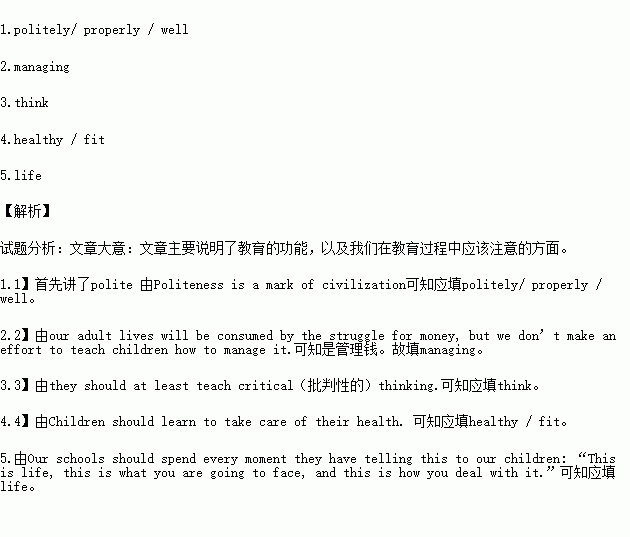
Politeness is a mark of civilization(文明). The sooner children learn this, the better. In any case, a lot can be achieved by a smile and good manners.
Like it or not, our adults work hard for money, but we don’t make an effort to teach children how to manage it. So our schools have a duty to teach them this ability from the beginning.
We’re likely to accept something we are told, but that’s not what educated people do. Educated people are reasonable(理性的) and they look at facts. If our schools teach nothing else, they should at least teach critical(批判性的)thinking.
Children should learn to take care of their health. They should know that if they eat junk food(垃圾食品), they will become fat and unhealthy. They should be very clear about what happens to their bodies when they drink or smoke.
All of us are part of society. We have rights and duties. We should understand what they are. We have to know a little bit of history and geography, because we need to have an environment in which to communicate with the people around us.
In a word, our schools should spend every moment they have telling this to our children: “This is life, this is what you are going to face, and this is how you deal with it.”
Title | Very Useful Education |
Introduction | Education should help children get ready for life. |
Advice | Important things should be taught in schools. |
What to teach | How to behave 1. The basic skill of 2. money How to 3. in a critical way How to keep 4. The rights and duties one has in society |
Conclusion | Children should be taught what _ 5. is and how to deal with it. |

In China, more and more villagers have left home to make a living in big cities. As a result, their children have become leftover (留守) children and they need more care. The survey below is from some villages in Central China. Three hundred children were chosen to answer the questions.
What they want | Love | Money | Freedom | Control | Something else |
40% | 18% | 28% | 10% | 4% | |
Who to talk with | Oneself | Family members | No one | ||
27% | 55% | 18% | |||
Communicate (交流) with their parents freely or not | Yes | A little difficult | No | ||
46% | 44% | 10% | |||
The way they like to live | Living with parents | Living without parents | No idea | ||
58% | 14% | 28% | |||
What they think of their parents’ working in cities | Bad | Good | No idea | ||
20% | 39% | 41% | |||
Happiest place | School | Home | Friend’s home | ||
48% | 34% | 18% | |||
1. Of all the four things, the leftover children need _________ most.
A. love B. money C. control D. freedom
2. _________ of the children think it good to live with their parents.
A. 14% B. 28% C. 44% D. 58%
3. How many children think their happiest place is their school?
A. 48. B. 102. C. 144. D. 156.
4.During the survey, the children were asked about many things EXCEPT _________.
A. food
B. places they like
C. their needs
D. their parents’ working in cities
5.We can learn that _________ from the survey.
A. most leftover children want more freedom without parents
B. over 40% of the children have difficulty talking to parents freely
C. all the leftover children dream of making money in big cities
D. most villagers prefer living a life in the countryside