题目内容

“He could have lived on his good looks, but instead he chose to live on talent and hard work.” This is how Internet users praised Chinese swimmer Ning Zetao.

On Aug 6, the 22-year-old won the 100-meter freestyle at the 2015 FINA Swimming World Championships in Russia. He was the first Asian to ever achieve this. Overnight the 191-cm-tall, handsome young man became the nation’s hero. Ning didn’t let the sudden fame(名声) get to his head. He said he only saw “a slight change” in his life after winning.

“My life is full of changes and challenges,” he said . “I welcome them and am never afraid of them.” The first big change in Ning’s life came at 2009.At the time, he specialized(专攻) in breaststroke(蛙泳) and was successful. But he felt a sharp pain in his knee. He suffered(遭受痛苦) every time he practiced his kicks. When he was 16,the knee pain got worse, and he had to stop swimming the breaststroke. Then he switched(转换)to sprint freestyle swimming. Ning didn’t let the change bring him down. Instead, he took advantage of it and became one of the best freestyle swimmers. Last year, he won four gold medals in freestyle races at the Incheon Asian Games in South Korea.

What is the next change Ning would like to see in his life? He said he wants to improve on his English. “English will help me communicate with foreign coaches and compete in the world games in the future.” Obviously Ning has high expectations for himself at the Rio Olympics next year. We wish him good luck.

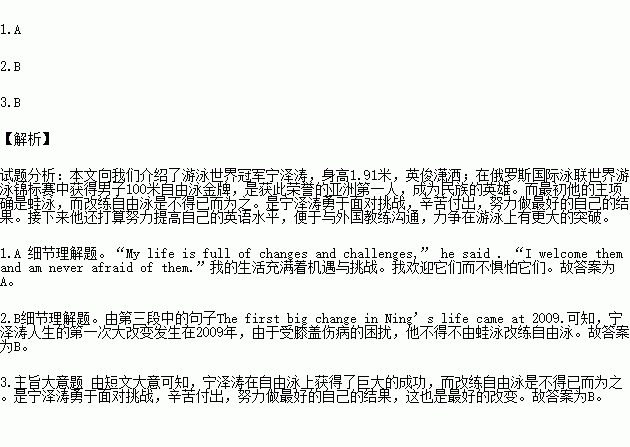
1.The underlined word “them” in Paragraph 3 means_________.

A. changes and challenges B. Ning’s fans

C. Internet users D. other swimmers

2.What is Ning’s first big change in his life?

A. Ning won the 100-meter freestyle at the 2015 FINA Swimming World Championships in Russia.

B. Ning switched to sprint freestyle swimming because the knee pain got worse.

C. Ning improved his English to communicate with foreign coaches

D. Ning specialized in breaststroke and was successful.

3.The best title of the article is ______________.

A. The freestyle swimming B. Change for the best

C. Ning’s life D. The first Asian swimmer
练习册系列答案
相关题目

Recycling is a way to take trash and turn it into new products. There are a number of different recycling processes that allow materials to be used more than once.

All kinds of materials can be recycled. Some of the most common processes in use today involve(牵涉) recycling plastic, glass, metals , paper, electronics and so on. Items made of these materials include soda cans, plastic boxes, newspapers, old computers, and cardboard boxes.

There are many steps in recycling. It isn’t actually a simple process and is different for each type of material. For example, paper starts its recycling process by being mixed with water and other chemicals to break it down. This process finally turns the paper into a pulp(纸浆). Then remove the plastics and other useless materials from the pulp. After that, it gets cleaned. Now the pulp is ready to be made into new paper.

However, computers and batteries(电池) are usually recycled in order to remove harmful chemicals as well as to find again some valuable materials such as gold.

In general, we should follow different steps in the recycling process. These steps are:

•Collecting recyclable materials, like cans and plastic bottles.

•Processing(加工) the old materials and making new items.

•Buying items made from recycled materials.

根据短文内容,选择正确答案。

1.What is recycling?

A. It makes your heart and body strong.

B. It is to reuse anything that can be used again.

C. It means keeping the land , air and water clean.

D. buying items made from recycled materials

2.Paragraph 2 mainly tells us _____.

A. recycling is very easy

B. recycling process is different

C. what materials can be recycled

D. throwing cans and plastic bottles away

3.Which shows the recycling process of paper correctly?

a. cleaning it

b. removing useless materials

c. being mixed with water and other chemicals

d. turning the paper into a pulp

A. c-d-b-a B. b-a-d-c

C. c-a -b-d D. a-b-d-a

完形填空,阅读下面短文,从每小题所给A、B、C、D四个选项中选出最佳选项。

提示:带星号*的单词可查阅试卷后面的小词典。

Life for the students in China is not easy. Their school days are very busy, they have 7 or 8 classes at school every day, but after school, they still need to do much homework. A lot of students complain that they are too ________ during the weekdays, they need free time to do things they like. However, teachers at school tell the students ________ except how to relax.

How do students ________ their weekends? Last month, we did a survey at NO.5 Middle School about ________ they usually did on weekends. Here are the results of the ________ . 40% of students do homework or study at home. More than 20% of students watch TV or listen to music to relax ________. Less than 20% of students like surfing the Internet and playing computer games for ________ . About 10% of students usually help their parents do ________ —— cleaning the room or washing the dishes. ________ , another 5% of students have to go to different lessons, including language learning, math classes and instrument practicing.

According to the survey results, half the students don’t relax well on weekends. A teacher ________ NO.5 Middle School said, “It’s important for students to have a good rest and keep healthy. Teachers and parents ________ help them learn to relax.” In the USA, most students have wonderful weekends. They may play sports or do some reading in the ________ with friends. They may ________ help parents do a yard sale. ________ the weather is nice, they will fly a kite in the park or enjoy the ________ on the beach.

As an old saying goes: “All work no play makes Jack a dull* boy.” We hope students in China will have more free time to enjoy themselves.

1.A. happy B. tired C. relaxed D. boring

2.A. something B. nothing C. anything D. everything

3.A. spend B. take C. cost D. pay

4.A. what B. how C. that D. which

5.A. story B. book C. survey D. note

6.A. himself B. herself C. ourselves D. themselves

7.A. money B. fun C. work D. study

8.A. housework B. homework C. schoolwork D. farm work

9.A. Happily B. Unhappily C. Fortunately D. Unfortunately

10.A. with B. for C. from D. about

11.A. should B. shouldn’t C. would D. wouldn’t

12.A. restaurant B. bank C. library D. station

13.A. too B. also C. either D. neither

14.A. Although B. But C. Because D. If

15.A. rain B. sunshine C. snow D. Wind

违法和不良信息举报电话:027-86699610 举报邮箱:58377363@163.com

精英家教网