题目内容
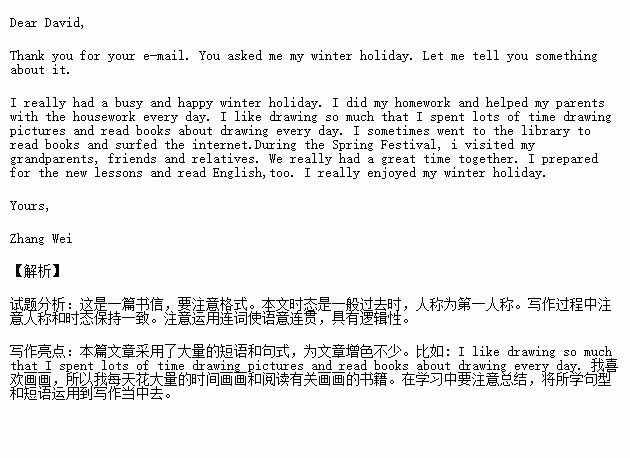
假定你是张伟,你的英国笔友David来信问及你的寒假生活,请给他回一封电子邮件。80词左右
John is six years old. He can read and write well. But he can’t tell the time. He says “breakfast time”, “lunchtime”, and “teatime” when it is eight o’clock, twelve o’clock and four o’clock in the afternoon. His mother doesn’t know how to help him.
One day John’s aunt, Mary, comes to see his mother. His mother tells her about that. “Let me help you. I think I can help him.”
When John gets home after school, Mary starts to teach him.
“Can you count, John?” she asks him.
“Yes. One, two, three, four…” John says. “That’s great. Now I put the longhand on twelve and the shorthand on one – that is one o’clock. I put the short hand on two, what is the time?”
“Two o’clock.”
“Good. And on three?”
“Three o’clock.”
It is then four o’clock in the afternoon, and John’s aunt asks him, “What time is it now, John?”
“Teatime, Aunt.” John looks at the clock and answers.
1. John’s mother can’t help him to _________ the time.
A. read B. write C. tell D. listen to
2.When it’s twelve o’clock, John says it’s _______.
A. breakfast time B. lunchtime
C. supper time D. teatime
3. Mary is John’s ________.
A. mother B. aunt C. teacher D. sister
4.The underlined word “count” means “_________” in Chinese.
A. 认识 B. 读 C. 数 D. 熟记
5.From the passage(短文) we know ____________.
A. John thinks breakfast time is eight in the morning.
B. John thinks four o’clock in the morning is teatime.
C. John can’t count
D. John has a nice watch but it doesn’t work.
I feel tired, but I don’t want to stop _______.
A. work B. to work C. works D. working
Why not _________?
A. encouraging her to study hard
B. to encourage her to study hard
C. encourage her to study hard
The teacher said the earth _______ round the sun.
A. goes B. went C. Go
Many people say that they are working too many hours. They don't have enough time to relax or to stay with their family.
Work hours are different from one country to another. In France, people spend about 1,646 hours a year at work. In Japan, however, people work about 2,159 hours a year. That means a Japanese worker works 513 more hours a year than a French worker.
Why do people work so many hours? Some people work extra hours because they want to make more money. However, many companies don't pay overtime. Their workers don't get more pay for more work. Some people think it's their duty to work more hours. Some are afraid of losing their jobs if they don't work more hours.
Many people say that their vacations are too short. In France, people get five weeks of paid vacation a year. In Germany, they get four to six weeks, and in the United States, two weeks. One study shows fewer than half of workers used all their vacation days. In Great Britain, there is a saying, "All work and no play makes Jack a dull (迟钝的) boy." If that is true, there must be a lot of dull people in the world.
1.A Japanese worker works _ _ more hours a year than a French one.
A. 513 B. 1,646
C. 2,159 D. 3,805
2.The word "extra" in Paragraph 3 means ".
A. 正常的 B. 额外的 C. 有用的 D. 少量的
3.People in ________ get only two weeks of paid vacation a year.
A. France B. Germany
C. the United States D. Great Britain
4.Which of the following is true according to the passage?
A. No companies offer vacations to their workers.
B. Many people say they have enough time to relax.
C. Not all companies pay their workers for more work.
D. More than half of workers use all their vacation days.
5.What can we infer from the passage?
A. Many workers have to work long hours.
B. Many people have vacations long enough.
C. Work hours are the same around the world.
D. There are a lot of dull people in the world.
I'm surprised to hear from her. ________, we last met ten years ago.
A. On one hand B. That is to say
C. Believe it or not D. In other words
根据要求完成大作文,词数:60---80词左右;(15分)
现在的科技日新月异,各种发明以及高科技产品成为了我们生活中不可缺少的东西,如电脑、笔记本电脑(laptop)、手机(mobile phone)、MP4、数码相机(digital camera)、数码摄影机(DV)等。请以My favorite invention为题描述你最喜欢的一种发明,并说明理由(理由至少有两个方面)。
My Favorite Invention
句型转换(共10分,每题2分)
1.Does Anna like eating hamburgers?(作否定回答)
No, _____ _____
2. Lucy's brother is fifteen years old.(对画线部分提问)
_____ _____ is Lucy's brother?
3.Gina likes English because it’s fun. (对画线部分提问)
_____ _____ Gina like English?
4.My birthday is on September 21st. (对画线部分提问)
_____ _____ your birthday?
5.I like math best.(改为同义句)
My _____ _____ is math.