题目内容
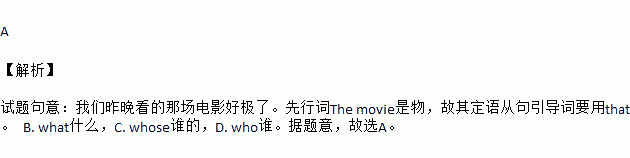
The movie ______ we saw last night was fantastic.
A. that B. what C. whose D. Who
To stay healthy, your brain needs enough as well as your body.
A. exercise B. change C. idea D. act
Dear Rita, long time no see! Do you know_____ I want to see you again?
A. how long B. how much C. how many D. how often
下面文章中有五处(第31—35题)需要添加一个问题。请从以下选项(A、B、C、D、E和F)中选出符合各段的提问。选项中有一项是多余选项。
A. When does flu season start?
B. Do I really need a vaccine(疫苗) every year?
C. Do I really need to be vaccinated against the flu?
D. I am afraid of needles(针). Can I take medicine instead?
E. What are the risks(风险)?
F. How many viruses(病毒) change every year?
The weather becomes colder and colder. You see people sneezing and getting a runny nose. It's time to think about getting vaccinated to protect yourself against the flu. Below are some questions and answers about the illness.
Q: 1.
A: Yes. The Centers for Disease Control and Prevention(CDCP) in the US says that it's better to get a flu vaccine if you are 6 months old or older.
Q: 2.
A: Yes. Public Health officials look at which flu viruses will be the most common every year. Then they set a formula(配方) to work against those special viruses. So the formula can change from year to year.
Q: 3.
A: It usually begins in October and can last through May, with the season peaking(达到高峰) in February. But people don't know seasonal peaks may be different in different places.
Q: 4.
A: Unluckily not! But now, there is a new, less scary way. It uses a new needle which causes less arm?ache later. People aged from 18 to 64 can have this kind of vaccine.
Q: 5.
A: Serious problems from flu vaccines seldom happen. Common problems include: soreness or redness where the shot was given, fever, headache, and a cough. People with allergies(过敏), especially to eggs, should talk to their doctors before getting a shot.
The seasons in Australia are opposite(相反) to ours. _______it is winter here, it is summer there. Australia is _________ the south of the world. June, July and August are the winter months. The summer is in December, _______ and February. The north of the country is _________ than the south.
Australia’s main(主要的) problem is water. A _______ large part of the country has no rain at all. But the east coast(海岸) has rain _________ the year round. There are no dry months here.
In March, 1982, there was a terrible drought(干旱) in Australia. The summer rain didn’t _______ . There were 138 million sheep in Australia that year. This was 14% of all the sheep in the world.
Because there was not _______ rain and the grass didn’t grow well, the farmers _______ to sell many of their sheep and many sheep __________ , too. It was a great disaster(灾难)for Australia farmers.
1.A. Because B. Since C. When D. For
2.A. in B. on C. to D. near
3.A. November B. January C. March D. October
4.A. colder B. cooler C. hotter D. warmer
5.A. very B. so C. too D. much
6.A. whole B. half C. all D. part
7.A. have B. fall C. give D. keep
8.A. plenty B. a little C. a lot D. enough
9.A. have B. had C. must D. needed
10.A. died B. dead C. death D. dying
I’ve read all the books ________ you gave me.
A. what B. of that C. that D. where
Do you have _____ healthy food every day?
A. more B. lots of C. many
根据对话内容,运用方框中所给的句子补全对话。选项中有一项是多余的。
A: Hi, Sandy, what are you going to do this weekend?
B: I am going to see a movie.1.
A: Sure. What kind of movies do you like?
B: I like adventure(冒险) movies. They can make me excited.
A: Have you ever seen the movie Jurassic World?
B: No, I haven't. 2.
A: Yeah, I saw it yesterday.
B: 3.
A: I think it is interesting and exciting. I want to see it again.
B: 4.
A: About two and a half hours.
B: Is the price of the ticket high?
A: It's OK. 5. We can buy the tickets on WeChat at a very low price.
B: Thank you! I am going to see it.
A: You're welcome. I promise it's really worth(值)the money.
A.How long does it last?
B.It cost me 40 yuan.
C.Can you give me some advice?
D.What do you think of it?
E.But I heard it was great.
F.I can't agree more.
My English used to be very poor. __________ wanted to give up, Dad would encourage me to work harder.
A. However B. Whatever C. Whenever D. Wherever