题目内容
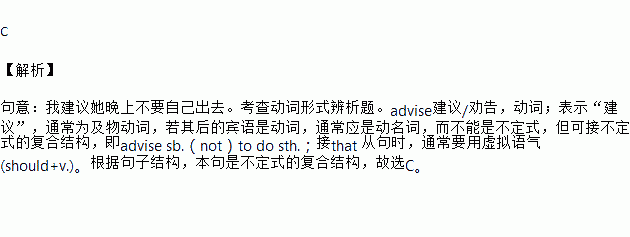
I advise her not _______ out on her own at night.
A. go B. goes C. to go D. going
The most important lesson I learned in high school had nothing to do with maths or American history. It came at graduation, several minutes before I left Miramonte High School.
I was rather shy back then, content to hang around with my few friends and to concentrate on my _______ . I was doing so well that by the end of senior year I had perfect scores and enough credits(学分) to go to college.
But my good record soon became a _______ to my well-being. In early June of senior year, the headmaster railed me into his office. He asked me to give a leave-taking speech at graduation. I looked at him. my heart _______ fast. This was the reward(回报) for my hard work? I said something, but not very clearly, and hurried away from the office.
I was hesitant(犹豫不决) about the decision, finally agreeing to compromise. I wasn't the only speaker—I would_______ the honor with five other students. Still, it was doubtful whether the task was _______ me. How would I give a speech to hundreds of people?
Graduation day soon arrived and, as _______ , I was nervous. I'd been practicing my speech for days, and I had it _______. But I had never been so terrified in my life. The first half hour of the ceremony passed, and then my mother came…
Now I still have the video tape of that speech. My voice trembled (颤抖) a little, but _______ it was clear and strong. I'm proud of that tape. I achieved something I'd never _______ — I spoke in front of hundreds of people. ________ I didn't realize it at the time, the successful completion of that speech gave me the ________ to participate in class at college, to give oral reports, and to eventually break free of my ________ .
1.A. characters B. interests C. games D. subjects
2.A. luck B. benefit C. fear D. solution
3.A. burning B. breaking C. aching D. beating
4.A. share B. bring C. spare D. give
5.A. about B. for C. upon D. beyond
6.A. known B. hoped C. expected D. planned
7.A. thrown B. printed C. memorized D. completed
8.A. partially B. immediately C. frankly D. mostly
9.A. dreamed B. made C. decided D. requested
10.A. Because B. When C. Although D. Unless
11.A. respect B. confidence C. freedom D. excuse
12.A. shyness B. pride C. stupidity D. courage
(1)Da Shan, a Canadian, is perhaps China’s most famous foreigner. He speaks Chinese well. He was born in 1965. He(2)started to learn Chinese when he studied at Toronto University. In order to remember more Chinese words, (3) wrote, he, them, often, on, cards, down, small . But he would only memorize words he met with while reading, listening or talking in the following two weeks. “There’s no use learning words that don’t appear often,” he said. “And the best way to learn a foreign language is to keep using it and understand the culture behind it, Or you’ll forget everything quickly. ”
Da Shan says it is important to get into the language environment. (4)与中国朋友交谈has helped him learn not only the words, but also the country and its people.
1.请将(1)处的句子翻译成汉语。
______________________________________________________________
2.请用适当的词替换(2)处的单词。_______________________
3.将(3)的单词组合成一个完整的句子。
_______________________________________________________________
4.将(4)处的短语译成英语。
5.请回答下面的问题:
What does Da Shan think is the best way to learn a foreign language?
__________________________________________________________.
—I am going to see the teacher tomorrow. —
A. I, too. B. Me, too. C. I also. D. Me, neither.
Nobody went there with him. He went by ______.
A. him B. himself C. his D. themselves
Thanks for your invitation, but I’m so sorry I can’t go. I need to my younger sister at home.
A. look at B. look up C. look after D. look for
II.汉译英
1.十二个月______________
2.第二个月_______________
3.在三月______________
4.在四月八日______________
5.快乐的一天______________
6.多大年纪______________
7.一次英语测验______________
8.一届艺术节______________
9.亲爱的同学们______________
10.忙碌的一学期______________
11.过得愉快______________
12.在今天下午三点______________
13.妇女节______________
14.儿童节______________
15.教师节______________

 举一反三单元同步过关卷系列答案举一反三单元同步过关卷系列答案