ÌâÄ¿ÄÚÈÝ

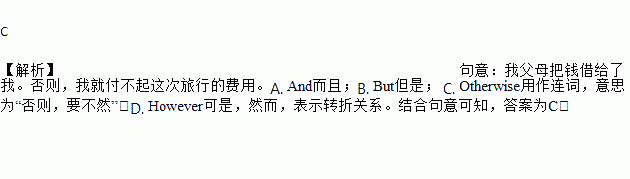
My parents lent me the money. _______, I couldn¡¯t pay for the trip.

A. And B. But C. Otherwise D. However

C ¡¾½âÎö¡¿¾äÒ⣺ÎÒ¸¸Ä¸°ÑÇ®½è¸øÁËÎÒ¡£·ñÔò£¬ÎҾ͸¶²»ÆðÕâ´ÎÂÃÐеķÑÓá£A. And¶øÇÒ£»B. Butµ«ÊÇ£» C. OtherwiseÓÃ×÷Á¬´Ê£¬Òâ˼Ϊ¡°·ñÔò£¬Òª²»È»¡±£»D. However¿ÉÊÇ£¬È»¶ø£¬±íʾתÕÛ¹ØÏµ¡£½áºÏ¾äÒâ¿ÉÖª£¬´ð°¸ÎªC¡£
Á·Ï°²áϵÁдð°¸
Ïà¹ØÌâÄ¿

There are about 5,000 different kinds of ladybugs(ư³æ ) in the world. They come in many different colours like blue, yellow, white, orange and black.

In many cultures, people think ladybugs can bring good luck. Most people like them because they are beautiful and not bad for people¡¯s health. But farmers love them because they eat plant-eating insects. One ladybug can eat up to 5,000 small insects in its lifetime!

Ladybugs are colourful for a reason. Their colours tell other animals, ¡°Eat something else! I taste terrible.¡±

Ladybugs are happy in many different habitats, such as forests, cities and along rivers. Ladybugs like to keep warm. When the weather turns cold, they look for a warm place to hibernate (¶¬Ãß), such as inside houses.

Here are some other facts about ladybugs:

¡ñ Though most ladybugs eat small insects, a few kinds eat plants.

¡ñ Ladybugs will clean themselves after a meal.

¡ñ There are more than 400 kinds of ladybugs in North America.

1.How many kinds of ladybugs live in the world?

A. About 80. B. About 400. C. About 1,000. D. About 5,000.

2.Why do farmers love ladybugs?

A. Because they aren¡¯t bad for people¡¯s health. B. Because they eat plant-eating insects.

C. Because they never eat plants. D. Because they are beautiful.

3.What does the underlined word ¡°habitats¡± mean in Chinese?

A. ¼¾½Ú B. Æøºò C. ÕÓÔóµØ D. ÆÜÏ¢µØ

4.Ladybugs like to stay somewhere _________.

A. dry B. warm C. quiet D. tidy

5.Where can we probably ( ºÜ¿ÉÄÜ) read the passage?

A. In a magazine. B. On a menu. C. In a guide book. D. In a sports newspaper

1.D 2.B 3.D 4.B 5.A ¡¾½âÎö¡¿ÕâÊÇһƪ½éÉÜÆ°³æµÄ¿ÆÆÕÀàÎÄÕ¡£½éÉÜÁËÆ°³æµÄÖÖÀ࣬ÈËÃÇϲ»¶ËüÃǵÄÔ­ÒòÒÔ¼°ËüÃǵÄÉú»îϰÐÔ¡£ 1.ϸ½ÚÀí½âÌâ¡£¸ù¾Ý¶ÌÎÄ¿ªÍ·µÄ¾ä×Ó¡°There are about 5,000 different kinds of ladybugs(ư³æ ) in the world.¡±¿ÉÖª£¬ÊÀ½çÉÏ´óÔ¼ÓÐ5000ÖÖ²»Í¬µÄư³æ¡£¹Ê´ð°¸ÎªD¡£ ...

Jack worked for the Canadian government. One day, he was told to learn more_______wolves. Do wolves kill lots of caribou(±±ÃÀѱ¹)? Do they kill people? They gave him lots of_____ , clothes and guns(ǹ). Then they put him on a plane and______him to a far place. The plane put him down and went away. There were no houses or people in this place.________there were lots of animals and lots of wolves. People_______terrible stories about wolves. They say wolves like to kill and eat people. Jack remembered these stories, and he was______. He had his gun with him all the time.

Then one day, he saw a group of wolves. There was a mother wolf with four baby wolves. A father wolf and another young wolf_______with them. Jack watched these wolves every day. The mother was a very good mother. She gave_________to her babies. She gave them lessons about life. They learned________to get food. The father wolf got food for the mother. The young wolf________with the babies. They were a nice, happy family¡ªwolf family! Jack did not need his_________any more. In a short time, he got on well with the________. Jack watched them for five months. He learned that many stories about the wolves were not________. Wolves do not eat______, and they do not eat many large animals. And he also learned_________things about men. It was men who killed many caribou and wolves. Later, Jack wrote a book about wolves. He wanted people to understand them and not to kill them.

1.A. at B. about C. with D. by

2.A. food B. money C. chocolate D. candy

3.A. brought B. caught C. took D. helped

4.A. And B. So C. Because D. But

5.A. say B. tell C. talk D. speak

6.A. happy B. angry C. afraid D. tired

7.A. lived B. watched C. ate D. killed

8.A. drink B. water C. juice D. milk

9.A. where B. why C. how D. who

10.A. laughed B. played C. shouted D. worked

11.A. food B. clothes C. gun D. plane

12.A. father B. family C. mother D. babies

13.A. good B. important C. clear D. true

14.A. people B. food C. animals D. meat

15.A. good B. bad C. easy D. pleasant

1.B 2.A 3.C 4.D 5.B 6.C 7.A 8.D 9.C 10.B 11.C 12.B 13.D 14.A 15.B ¡¾½âÎö¡¿ÊÔÌâ·ÖÎö£º±¾ÎĽ²Êöһλ½Ð½Ü¿ËµÄ¼ÓÄôóÕþ¸®¹¤×÷ÈËԱΪÁËÁ˽â¸ü¶àÓйØÀǵÄÇé¿ö£¬½ü¾àÀëºÍÀÇ×å½Ó´¥²¢¹Û²ìÁËÒ»¶Îʱ¼ä¡£¶øºó·¢ÏÖÀDz¢²»ÊÇÈËÃÇÏëÏóµÄÄÇÑùÐײУ¬´ËÎĸæËßÈËÃDz»ÒªÔÙɱº¦ÀÇ¡£...

Do you need friends? I'm sure your answer is "Yes, of course. Everybody does! "You need friends when you play and when you work. If you have friends, you will feel happy. If you have no friends, you will feel lonely.

Do you know how to make friends? There is only one good way¡ªYou make friends by being friendly.

A friendly person is interested in other people. He is always helpful. If you want to make friends with a new classmate, you can talk with him, tell him about the other classmates in your class and try your best to be helpful to him.

1.We need friends __________.

A. because we must play with them

B. Because we must work with them

C. when we play and when we work

D. when we talk with them

2.If we want to make friends, we should __________.

A. be politely to them B. be friendly to them.

C. be afraid of them D. when we talk with them.

3.A friendly person is _________ other people.

A. interested in B. worried about

C. surprised at D. like them

4.If we want to make friends with a new classmate, _________.

A. we can talk with them

B. we must try to help him

C. we can tell him about the other classmates in our class

D. A,B and C

5.Which of the following is true?

A. No one needs friends.

B. Everyone needs friends

C. Only classmates need friends.

D. Someone needs friends.

1.C 2.B 3.A 4.D 5.B ¡¾½âÎö¡¿ÄãÐèÒªÅóÓÑÂð£¿Êǵġ£Ã¿¸öÈ˶¼ÐèÒªÅóÓÑ£¬µ±ÄãÍæ¡¢µ±Ä㹤×÷µÄʱºò£¬ÄãÐèÒªÅóÓÑ¡£Èç¹ûÄãûÓÐÅóÓÑ¡£Äã»á¸Ðµ½¼ÅįµÄ¡£Èç¹ûÄãÏëºÍÐÂͬѧ½»ÅóÓÑ£¬Äã¿ÉÒÔ¸úËû½»Á÷£¬¸æËßËû¹ØÓÚÄãÃǰàÉÏµÄÆäËûͬѧ£¬¾¡Äã×î´óµÄŬÁ¦°ïÖúËû¡£ 1.ϸ½ÚÀí½âÌâ¡£¸ù¾ÝYou need friends when you play and when you work...

Î¥·¨ºÍ²»Á¼ÐÅÏ¢¾Ù±¨µç»°£º027-86699610 ¾Ù±¨ÓÊÏ䣺58377363@163.com

¾«Ó¢¼Ò½ÌÍø