题目内容
Hubei is ________ the north of Hunan.
- A.in
- B.on
- C.to
- D.at

 阅读快车系列答案
Milu deer, a kind of animal with large horns(角), used to be common in China long ago. Like other deer they lived together and ate grass and the soft parts of trees. Milu deer were often killed for food or sport. The Ming and Qing dynasties(朝代) did not protect them and many were killed. That is how the Milu deer disappeared from China.
Luckily before all of them were killed, some were taken to Britain to improve the environment of the beautiful park which belonged to the Duke of Bedford. He liked them so much that he took them from China to Britain. Milu deer liked the cool, wet weather in England and their number increased year by year. As a result, when in 1985 the government of China wanted to bring back the Milu deer, the Duke of Bedford was able to help. The first deer came back to China to the Nanhaizi Milu Park 20 kilometers south of Beijing and the centre in Dafeng, Jiangsu province.
The deer certainly seem happy to be back in China because their number has grown quickly. There are now so many of them that a new park has been opened for them in Hubei Province. At the moment the Milu deer live in centres where they are being well protected and cared for. It is hoped that one day there will be enough animals to let them live in the wild again.
294words
【小题1】The Milu deer disappeared long ago in China because .
| A.they were not well protected | B.they could find nothing to eat |
| C.they died of a serious disease | D.they had the habit of living together |
| A.people used them to carry things |
| B.the Duke of Beford sold them all |
| C.they didn’t like the weather there |
| D.their number became larger and larger |
| A.The number of the Mulu deer. | B.The life of the Milu deer. |
| C.The return of the Milu deer. | D.The importance of the Milu deer. |
Many students ask for advice about improving their English. There are three basic questions.
The first question is about real English. Li Hao from Hubei wrote, “I enjoy watching English films and listening to real English songs. But it takes a long time. What do you think?”
This is a great way to learn English! Talk about the film or song with your friends, and guess the meaning of the new words. Just enjoy yourself!
The second question is about speaking. Sam, from Suzhou wrote, “Our school has a foreign teacher. But I’m shy and can’t speak to her. What should I do?”
When I visit China, lots of people in the street say, “Hello! How are you? Where are you from? Do you like China?” These are good questions to start a conversation. Many people are shy when they speak English, so before you begin, take a deep breath and smile! Smiling always helps.
The third question is about vocabulary. Olive, from Anhui wrote, “I want to remember all the new words. I wrote them down, but I forget them quickly. What should I do?”
Try to remember eight or nine words a day. Write them on pieces of paper and place them in your bedroom. Say the words when you see them, and change them every day. And when you’re shopping, how about counting the English words, or saying the English names for everything you see?
【小题1】How many basic questions do the students often ask?
| A.Two. | B.Three. | C.Four. | D.Five. |
| A.Watch English films. |
| B.Write down the words first. |
| C.Listen to real English songs. |
| D.Take a deep breath and smile before you begin? |
| A.He’s too shy to talk with others. |
| B.He’s not able to count English words. |
| C.He can’t remember new words. |
| D.He doesn’t know what real English is. |
| A.How to learn English |
| B.Talking about English films |
| C.Advice about English writing |
| D.The way of beginning an English conversation |
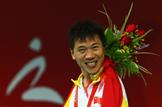
He Junquan is a Chinese swimmer and has won many Paralympic(残奥会) gold medals. Born in Jingmen, Hubei province, He Junquan was a healthy boy. But one day at the age of three, he climbed up to the high-voltage electricity(高压线) box and lost both of his arms forever. He became a disabled boy!
From then on he learnt to do everything with his feet: writing, eating, getting dressed and taking things. Seeing other pupils swimming in the river, he jumped in, too. Without arms, he suffered a lot in the river at the beginning. But he finally learnt to balance himself in water and could swim much faster than the other pupils. Once he even saved a little boy who fell into the water and couldn’t swim. His father was so happy to see that this son had a talent in swimming.
In 1995, He Junquan became a real swimmer. He practices swimming for more than four hours every day. Since 1996, he has won more than twelve gold medals of the world class. At the 2008 Summer Paralympics, he won a silver medal. Reporting on the competition at the 2008 Games, Will Swanton of the Sydney Morning Herald wrote:
“The Water Cube has been a sight for sore(气愤的) eyes. China’s He Junquan, with no arms, was leading the 50m backstroke(仰泳) final. … He came to the finish— and had to crash into the wall with his head. As he slowed down to lessen(减少) the impact(撞击力), Brazilian Daniel Dias hit the wall first with a hand. You’ve never heard a silence like it.”
【小题1】What happened to He Junquan when he was three?
| A.He climbed up the tree but failed onto the ground. |
| B.He saved a little boy who fell into the river and couldn’t swim. |
| C.He climbed up to the high-voltage electricity box and lost his two arms. |
| D.He began to practice swimming in the swimming pool with the other children. |
| A.With his feet. | B.With his mouth. |
| C.With his legs. | D.With his hands. |
| A.Only one. | B.Less than four. | C.About ten. | D.More than twelve. |
| A.He Junquan should not take part in the 2008 Games. |
| B.Daniel Dias didn’t hit the wall first at the 2008 Games. |
| C.The match was a little unfair for He Junquan because he had no arms. |
| D.He Junquan swam a little faster than Daniel Dias but he won a gold medal. |
| A.A Terrible Accident. | B.A Disabled Boy. |
| C.An Unforgettable Experience. | D.A Hero without Arms. |