We all have our own ways of sharing our life experiences with others.
Photographers use cameras, artists use brushes, musicians use songs and writers use stories.
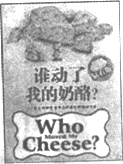
Spencer Johnson's story Who Moved My Cheese? shows changes exist in(存在于)our life.Life changes and so we do.We must change ourselves to face the changing environment, or we will fail.
Just look at the cycle(循环)of the seasons.Trees bud(发芽)in spring and in summer their leaves turn green.In autumn, their leaves start to fall onto the ground.When winter arrives, there are no leaves on trees.Next spring the cycle begins again.Since we know there are cycles in nature, we can prepare for them.We know it is colder in winter and hotter in summer, so we can dress properly.
Since we accept the cycles of nature, we should also accept the changes in our life.
We can prepare ourselves for changes by becoming more flexible(灵活的)).We can regard the changes in our life as chances.As we keep changing ourselves, we can keep up with the changes in our life.
(1)
What do writers use to share their life experiences?
[ ]
A.
Stories.
B.
Newspapers.
C.
Basketballs.
D.
Pianos.
(2)
Who Moved My Cheese? tells us that ________.
[ ]
A.
changes exist in our life
B.
we should move other's things
C.
we should use books to share our life experiences
D.
there are difficulties in our life
(3)
The cycle of the seasons means ________.
[ ]
A.
we should wear warm clothes in winter
B.
we should accept the changes in our life
C.
we should prepare for the weather
D.
leaves turn yellow in autumn
(4)
If you fail a test, what should you think according to the passage?
[ ]
A.
I have no chance to pass the test.
B.
Exams are hard for me.
C.
I have bad luck.
D.
It's good for me because I know there are more to learn
(5)
What's the main idea of this passage?
[ ]
A.
Weather changes in different seasons.
B.
Who Moved My Cheese?is a good book.
C.
We should change ourselves when life changes.
D.
We should not lose heart when we meet with difficulties.
You will have a lot of reading to do in this grade this year.You can do more of it in less time if you learn to read rapidly.
Perhaps you have been told about some habits (习惯) which keep a person from reading fast and have been strongly asked to break those habits which you might have.
Do you still have any of these bad habits?Check yourself by answering“yes”or“no”to these questions.
(1) Do you move your lips (嘴唇) when reading silently?
(2) Do you point to words with your finger as you read?
(3)Do you move your head from side to side as you read?
(4)Do you read one word at a time?
If you answer“yes”to any of these questions,start at once to break the habit.If you move your tips,hold your fingers over them,or hold a piece of paper be-tween your lips while you are reading.Then if your lips move,your will know it and can stop them.
If you point to words,hold the two sides of your book,one side with your left hand,the other side with your right hand.Then you won't have a free finger to use in pointing while reading.If you move your head,place your chin (下巴) in one hand and hold your head still (静止不动的).
If you read no more than one or two or three words at a time,you need to work very hard in learning to take in (吸收) more words at each glance (一瞥) as your eyes travel across the lines of words.
Even if you do rather fast now,you can learn to read even faster.As you probably have been told,the secret of fast reading is to take in whole groups of words as each glance.Read in through groups and force (迫使) your eyes along the lines of words as fast as you can to make them go.Anyone who practices doing these things will he able to read faster.
(1)
You may hold your fingers over your lips while reading so as ______.
A.to tell others to be silent
B.to feel whether your lips move or not
C.to hold a piece of paper between them
D.to keep yourself from talking to others
[ ]
(2)
When you read,______.
A.don't keep your head still
B.don't hold your books with your hands
C.don't stand up near a desk
D.don't use your finger to point to words
[ ]
(3)
If you learn to read fast,______.
A.you can read more in less time
B.you can write faster
C.you can understand better
D.you can read less in more time
[ ]
(4)
You must _______ those habits that we are talking about in this reading.
A.remember B.have C.get rid of D.keep
[ ]
(5)
This reading is mainly about ______.
A.the way of reading fast
B.the importance of fast reading
C.the bad habits in reading
D.how to speak quickly
[ ]
阅读理解
Good afternoon.Welcome to England.We hope that your visit will be a pleasant one.Today I'd like to tell you something about a few of our laws.
The first one is about drinking.Now you may not buy wine in this country if you are under 18 years of age,nor may your friends buy it for you.
The second one,noise.Enjoy yourselves by yourself,but don't make unnecessary noise,especially at night.We ask you to respect other people who may wish you be quiet.
The third one,crossing the road.Be careful.The traffic moves on the left side of the road in this country.Use pedestrian crossing (人行横道) and don't take any chances when crossing the road.
My next point is about rubbish.It isn't lawful to drop rubbish in the street.When you have something to throw away,please put it in your pocket and take it home,or put it in a dustbin.
Finally,smoking.It is against the law to buy cigarettes if you are less than 16 years of age.
I'd like to finish by saying that if you need any kinds of help,you should contact the police.They will be glad to help you.You can call,write or go to ask any policemen.
(1)
Who do you think is most likely to make the speech?
A.A guide. B.A person who makes laws.
C.A teacher. D.An English officer.
[ ]
(2)
How many laws are discussed in the speech?
A.Four. B.Three. C.Six. D.Five.
[ ]
(3)
The main purpose (目的) of this speech is to ______.
A.tell people that those above 18 can drink and smoke in England
B.declare (宣布) the different laws in England
C.give advice to the travelers in England
D.warn people against going to England
[ ]
(4)
The underlined word“contact”in the last paragraph means“______”.
A.keep up B.go to see C.make a call to D.bring trouble
[ ]
(5)
From the passage we can learn______.
A.in England,if you are under 18 years of age,you can't buy wine,but your friends can buy it for you
B.you may not buy cigarettes unless you are above 16 years of age
C.because the traffic moves on the left side of the road,you must use the pedestrian crossing when crossing the road